
Home › Jurassic World Survival › Tylosaurus Ultimate Damage
Ultimate Damage Review
Tylosaurus Ultimate Damage
A brand new species, a 52-centimetre body, and the thing collectors have been asking for over and over: colour that does not give up halfway down the figure. This is the first Tylosaurus Mattel has ever produced — and you can turn it through every angle without finding the spot where the factory stopped caring.
⭐ First Mattel Tylosaurus📏 ~52 cm / 20.5 in💡 Light-up damage & sound🧊 Neck lift + jaw snapMattel · 2026Scan code included
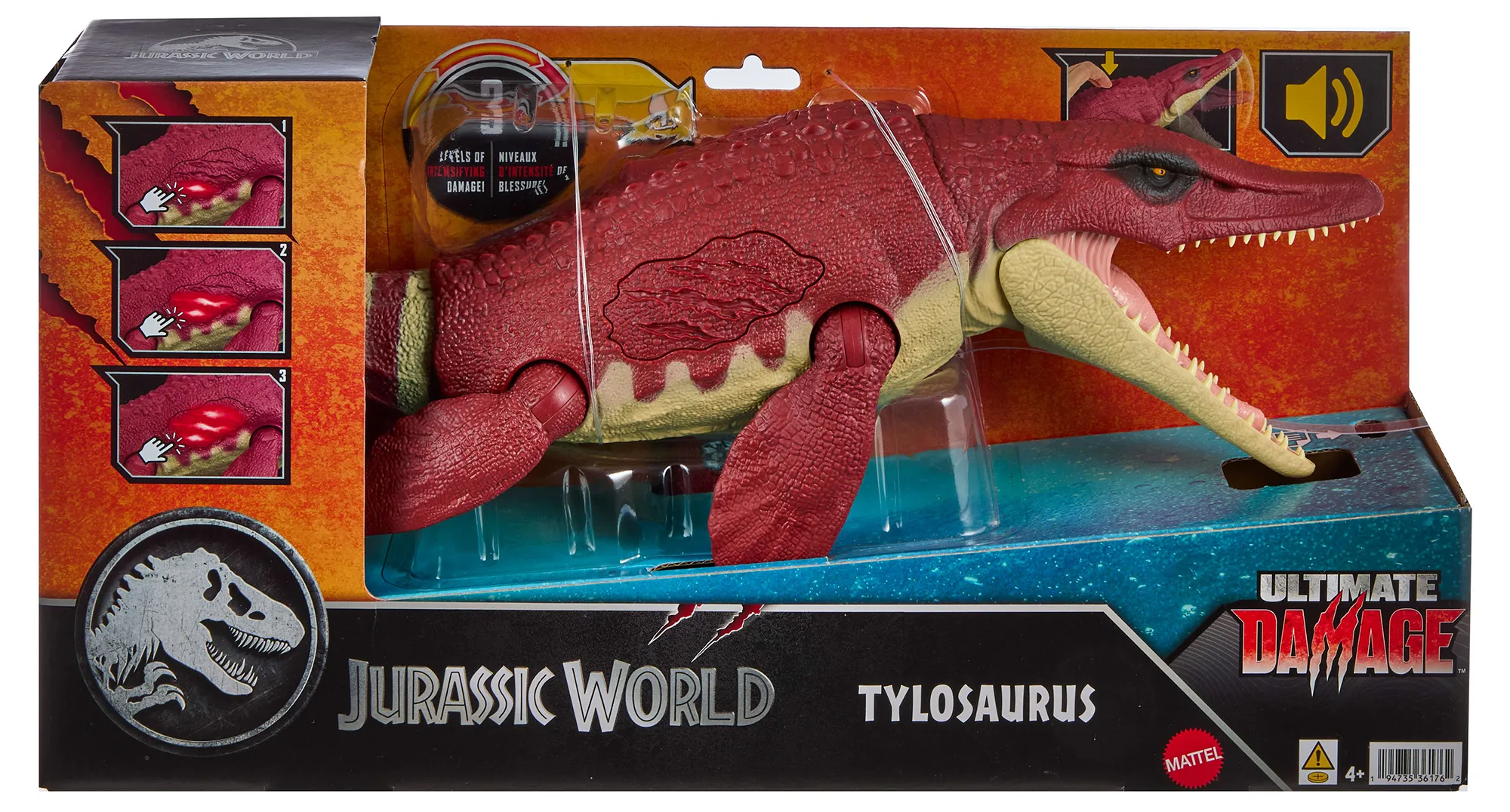
🎨 The Coverage Map
Most of the complaints levelled at Mattel’s figures over the years come down to the same thing, and it is not sculpting — the tooling has been good for a long time. The problem is what happens after the plastic leaves the mould, when a handful of paint operations get applied to the head and the upper back and everything below the waterline is left as bare moulded colour. Turn a figure over and the illusion collapses. Not here. A full walkaround turns up this:
Exactly one zone falls short of a clean sweep, and it is the roof of the mouth, where the pink is present but applied with less precision than everywhere else. That is the entire list of complaints about the paint on a 52-centimetre figure.
What Is Ultimate Damage?
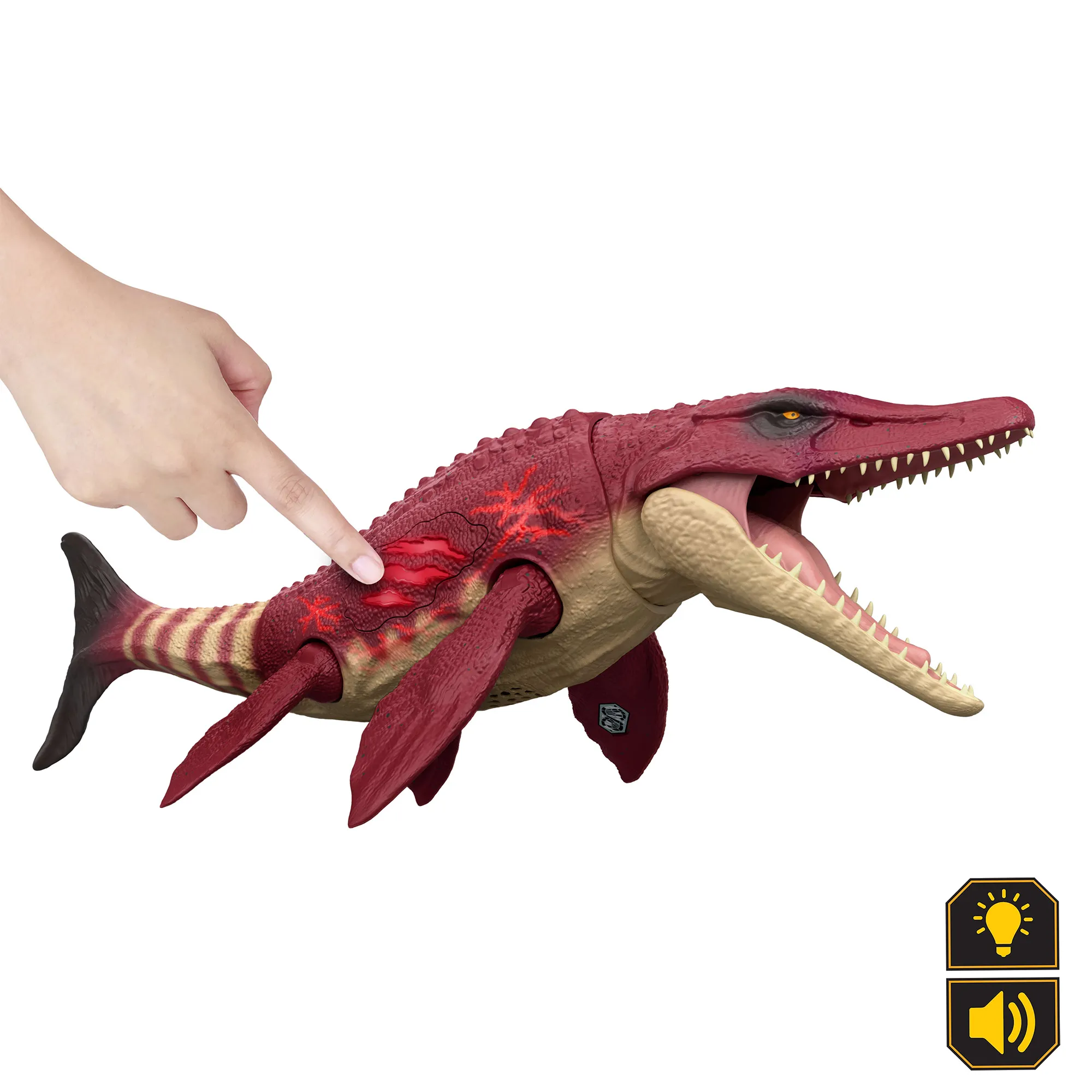
Ultimate Damage is the large, electronic tier of the Jurassic World Survival range, sitting well above sub-lines like Wild Roar, Strike Attack and Frenzy Pack. The shared idea is battle damage you can trigger: sculpted wounds cut into the body, a light that pulses out through them, sound effects, and a mechanical action feature on top.
Other Ultimate Damage releases on the site include Indominus Rex, Allosaurus and the Mutadon Destruction Pack.
Paint & Colour Scheme
Body, back & flanks
Jaw, throat & belly
Scattered through the red
Eye ring & tail fin
Mouth & tongue
Teeth
Eye
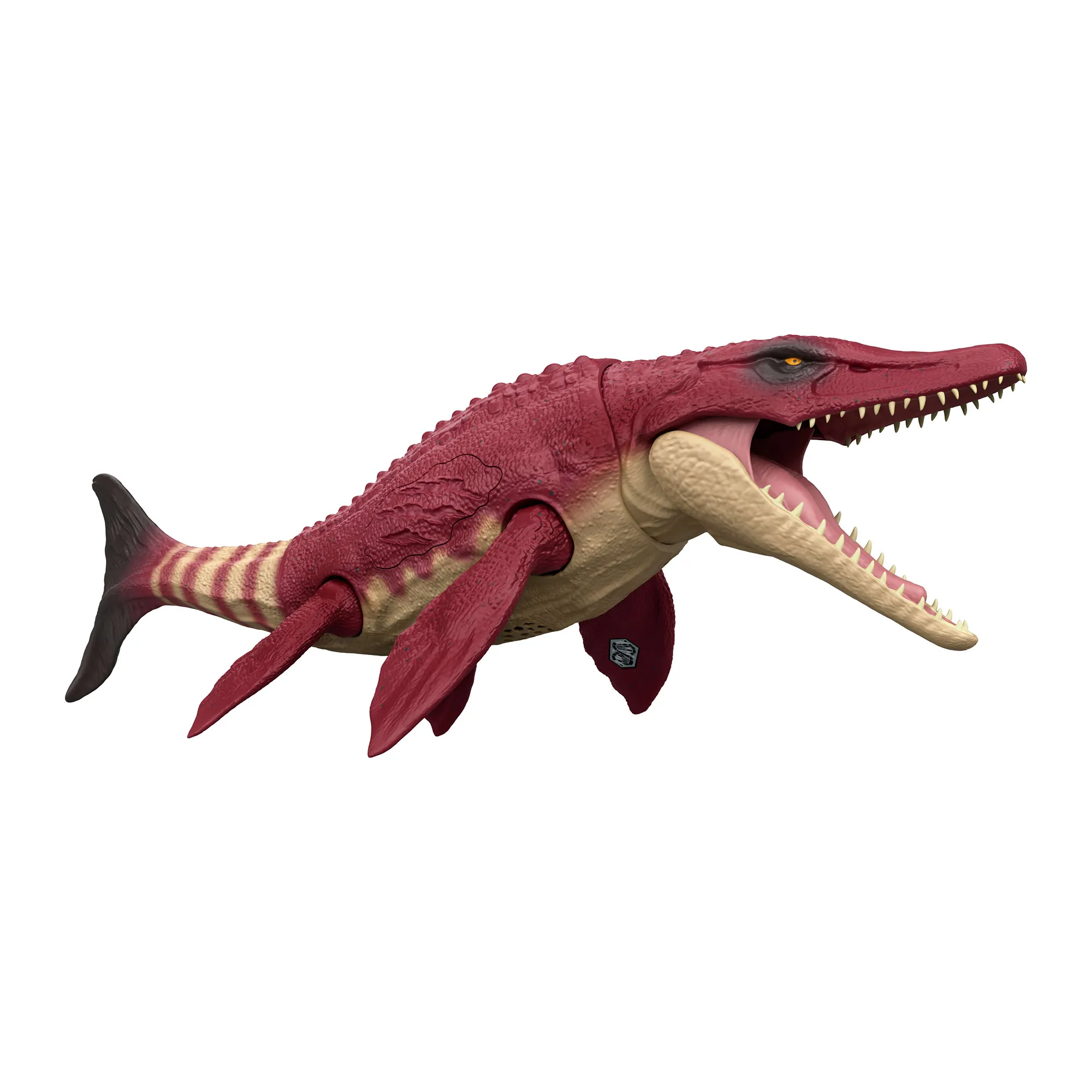
Red is a risky choice for a marine reptile. It has no basis in anything that swims and it usually tips a figure straight into cartoon territory. This one gets away with it, and the reason is the grey.
Scattered across the red, in dense enough quantity to change the overall tone, is a fine dark grey speckle. From a distance it reads almost like a wash laid over the base colour, knocking back the brightness and adding a depth that flat red would never produce on its own. The same dark grey appears as a ring around the eye socket and again at the far end of the animal on the tail fin, which quietly ties the two extremities together.
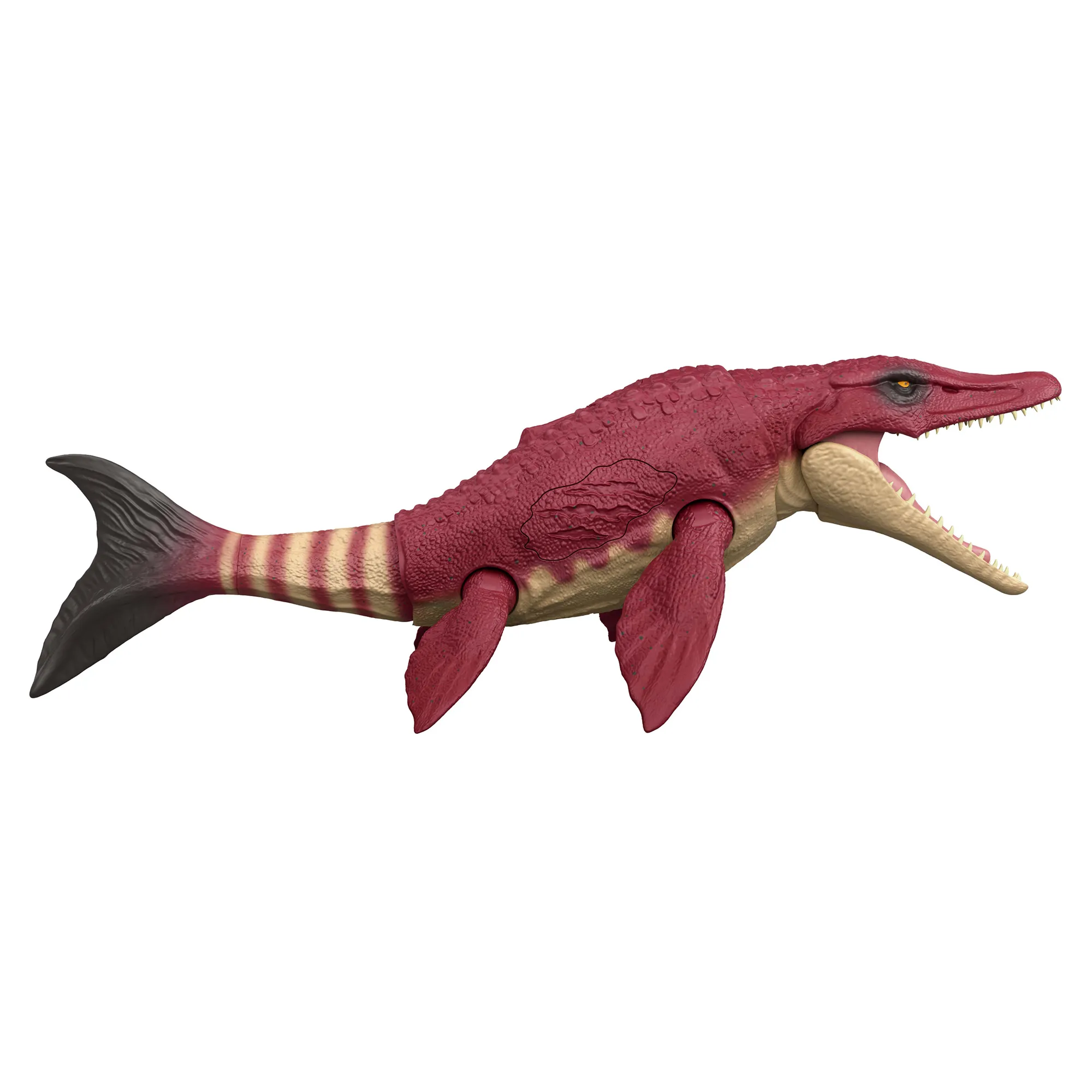
Underneath, a pale yellowish tan runs from the lower jaw along the throat, down the entire belly and out toward the tail — where instead of simply fading it breaks into interlocking stripes that trade back and forth with the red before the tail fin takes over. That striped transition is the most technically ambitious piece of painting on the figure, and it is cleanly executed.
The Sculpt
Three different skins on one animal
The surface work is among the sharpest Mattel has managed recently, and what makes it interesting is that it is not one texture repeated across the body — the figure changes its skin depending on where you look.
Along the top of the head and running down the spine, the scales build into large, plated, distinctly crocodilian shapes, raised enough to catch light and cast their own small shadows. Move down the sides and those plates taper away into progressively finer scaling, dense and regular, the kind of texture you only notice when the light rakes across it. Roll the figure over and the pattern changes again: the throat is almost smooth, nearly scale-free, before proper scaling resumes across the chest.
That variation is what sells the animal as something that existed rather than something that was designed. A row of scutes runs along each flank, and there is a surprise waiting on the spine — a tiny dorsal ridge, barely breaking the surface, easy to miss entirely and absent from the promotional photography.
Flippers and tail
The flippers are the technical highlight. Fine scaling covers them, but underneath you can make out the structure of the limb bones pushing against the skin — run a fingertip across one and you can feel the ridges. That is a detail nobody would have complained about missing, which is exactly why including it matters.
The tail earns its own mention. Rather than running dead straight it sweeps into a curve that gives the figure movement even sitting still, and the fin at the end carries deep creasing and wrinkling across its surface. Viewed from directly above or from behind, the curve is pronounced enough to change the silhouette entirely.
Open the mouth — it keeps going
Articulation & Action Features
✓ Jaw — tied to the action feature✓ Neck — raises and lowers★ Front flippers — multi-axis★ Rear flippers — multi-axis✓ Tail — left and right✓ Rear tail swivel✓ Light-up damage + sound✓ Neck lift + jaw snap✗ Tail does not travel up or down
The flipper joints are the standout. All four limbs rotate on multiple axes, swinging out away from the body as well as up, down, forward and back, so you can genuinely pose this thing mid-turn — banking into a dive, or flaring the flippers to brake. That is far more than a figure with an electronics package usually offers, because the battery compartment normally eats into the engineering budget.
Two caveats. The rear flipper joints can be stiff out of the box and may need a firm hand to break in, so do not panic on the first attempt. And the tail moves only side to side with no vertical travel — side to side is the correct axis for a mosasaur, whose propulsion was fundamentally a sideways sweep, so this is a missed opportunity for dramatic posing rather than an accuracy problem.
The Ultimate Damage package. Two buttons, two jobs. The first is set directly into the wound sculpted along the left flank, surrounded by gashes cut into the body: press it and light pulses through those openings along with sound effects. The second sits further back on the spine and drives the mechanical feature — the neck rises and the jaws snap shut in one motion, closing cleanly rather than with the loose rattle these mechanisms sometimes have. In a normally lit room the lights are barely noticeable; dim them and the glow pushes out through the wound and pools around the button properly. The sound effects appear to be drawn from the Mosasaurus library rather than recorded fresh, which for a species’ first appearance is understandable.
Size & Specs
Lined up against Mattel’s other aquatic releases the picture is clear: this is now the second largest marine reptile in the range, and the gap between it and everything except the Mosasaurus is substantial.
Put a Wild Roar figure next to it and the size difference is comic. The Tylosaurus can comfortably fit a Ceratosaurus head inside its jaws, which is a diorama opportunity that more or less sets itself up. Against the Mosasaurus it is plainly the smaller animal, but that is the correct relationship — the two work well side by side rather than making each other redundant.
Verdict: 4.6 / 5
This is the figure to point at the next time somebody claims mass-market dinosaur toys have to cut corners. A species making its first ever appearance in the line, at a size that commands shelf space, with layered surface detail that changes as it travels down the body, an interior mouth that is finished rather than implied, and paint that simply does not stop until it runs out of animal.
The electronics are conventional for the sub-line rather than exceptional, and the recycled sound effects are a small tell. The lower tooth plate and the slightly loose palate paint are worth noting only because so little else here is. None of it meaningfully dents what Mattel has achieved.
If you collect marine reptiles, this one is essential. If you have drifted away from the range because the recent designs were not for you, this is the one worth coming back for.
✦ What Works
- Complete paint coverage from snout to tail fin, belly included
- Grey speckling across the red reads as a wash and adds real depth
- Three distinct skin textures across head, flanks and underside
- Limb bone structure visible and tangible through the flippers
- Fully finished mouth interior including the palatal tooth row
- Soft-moulded teeth taper to convincing points
- Multi-axis flipper articulation on all four limbs
- Clean, satisfying jaw snap with no rattle
- Genuinely impressive 52 cm length
- A restrained, recognisable take on the real animal
✦ What Doesn't
- Lower teeth are one solid plate with no gum line showing through
- Palate paint is less precise than the rest of the figure
- Tail swings side to side only, with no vertical movement
- Rear flipper joints can be stiff out of the box
- Sound effects appear carried over from the Mosasaurus
- Light effect needs a dark room to be appreciated
About the Tylosaurus
A deliberate step back from the mutants. Take the real animal, keep its proportions and its recognisable features, then apply a little stylistic flair on top — nobody would mistake this for a palaeontological reconstruction, but nobody would struggle to identify the species either.— Why this release lands the way it does
After a long run of heavily restyled, exaggerated creature designs, this one returns to the older approach. If you have grown tired of guessing what animal a figure is supposed to be, it lands as a relief; if you specifically enjoy the wilder reinterpretations, you may find it comparatively plain. Establishing a debut species properly and getting strange with it later is the right call. Which makes the real animal worth knowing.
First, the correction everyone needs. Tylosaurus is not a dinosaur, and neither is any other mosasaur. These were marine lizards — squamates — sitting on the branch of the reptile family tree that leads to today’s monitor lizards and snakes. They were no more dinosaurs than a crocodile is.
Where and when. Tylosaurus patrolled the Western Interior Seaway, the vast shallow ocean that split North America in two during the Late Cretaceous, roughly 86 to 78 million years ago. Its remains come out of the chalk beds of Kansas in remarkable quantity — in what is now dry grassland, hundreds of miles from any coast.
The battering-ram snout. The genus name refers to the distinctive bony projection at the front of the upper jaw, which extends well beyond the first teeth into a solid reinforced prow. It is widely interpreted as a ramming weapon used to stun or injure prey and rivals by impact, and some specimens show damage consistent with exactly that kind of use.
That second row of teeth is real. The extra teeth Mattel sculpted into the roof of the mouth are not artistic licence. Mosasaurs carried pterygoid teeth, a genuine second set mounted on the palate behind the main jaw teeth, which gripped struggling prey and walked it backward down the throat. Snakes use a comparable arrangement today. It is a lovely detail to find on a mass-market toy.
Size and menu. The best-known species, Tylosaurus proriger, reached somewhere in the region of 13 metres, and a gigantic new species described from Texas has pushed the upper limit for the genus further still. Fossilised stomach contents give an unusually direct picture of the diet: fish, sharks, plesiosaurs, smaller mosasaurs, and the flightless diving bird Hesperornis. It ate essentially whatever shared its water.
About that tail. Mosasaurs were long restored with simple eel-like tails, but soft-tissue preservation has since shown a downturned fluke at the end, closer to a shark’s arrangement. Mattel giving this figure a proper tail fin rather than a tapering point is the modern interpretation, and it is good to see it reflected here.
Unlock the Tylosaurus in the Jurassic World Play App
Scratched the code off the belly?
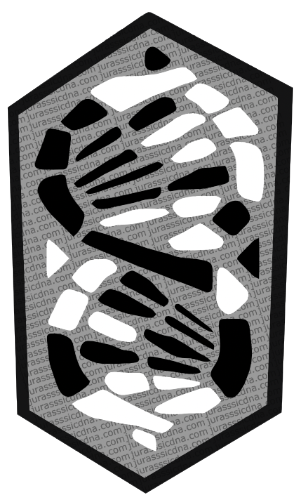
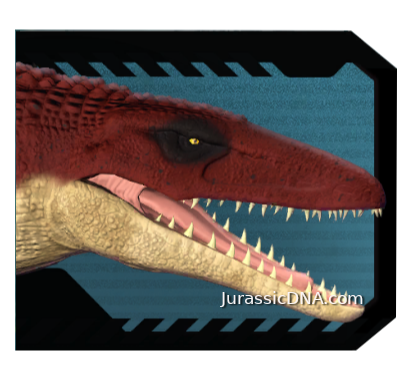
The DNA scan code sits on the underside of the body, printed into the pale belly section. Scan it with the Jurassic World Play App to unlock the Tylosaurus in your collection.
If the code on your figure is scratched, worn or has disappeared under a price sticker, scan the copy below straight from your screen. That is exactly what JurassicDNA is for — the complete free scan code database is right here, no sign-up, no paywall.
Tylosaurus Ultimate Damage Gallery
Frequently Asked Questions
Roughly 20 to 20.5 inches long, which works out at almost exactly 52 cm from the tip of the snout to the end of the tail fin. Propped up on its front flippers it stands about 6.75 inches, around 17 cm. That makes it the second largest marine reptile Mattel has released, behind only the Mosasaurus.
Yes. Despite years of Jurassic World releases covering a very wide roster of species, Tylosaurus had never appeared in the Mattel line until now. This is a genuine debut rather than a repaint or a retool of an existing marine reptile mould, which is part of why it is worth attention.
There are two buttons. The one built into the wound on the left flank triggers a blinking light that shines out through the sculpted gashes, accompanied by sound effects. A second button on the back drives the mechanical action: the neck lifts and the jaws snap shut. The lights are worth seeing in a darkened room, as they are easy to miss under normal lighting.
No. Tylosaurus was a mosasaur, a group of large marine lizards. They belong with squamates, the group that today includes monitor lizards and snakes, and are not dinosaurs at all. The same applies to plesiosaurs and pterosaurs, both of which are also frequently and incorrectly called dinosaurs.
Because the real animal had them. Mosasaurs possessed pterygoid teeth, a genuine second set anchored to the palate behind the main jaw teeth, used to grip prey and work it backward toward the throat. Snakes use a similar mechanism. Mattel sculpting and painting them here is an unusually accurate touch for a toy at this price.
On the underside of the body, printed along the pale belly section. Scan it with the Jurassic World Play App to unlock the creature. If your printed code is damaged, worn or obscured, you can scan the copy hosted free in our database instead.
The Mosasaurus remains the largest marine reptile in the range by a visible margin. The Tylosaurus is not far behind and outsizes every other aquatic figure Mattel has produced. Displayed together they read as two apex predators of different scale rather than as duplicates, so owning both is not redundant.
No, it ships separately and clips into place during assembly. It takes a few seconds and needs no tools. The figure looks considerably better once assembled than the loose parts in the tray suggest, which is worth remembering if you are judging it through the packaging window.