
Home › Jurassic World Primal Ambush › Shunosaurus Gigantic Thrashers
Gigantic Thrashers Review
Shunosaurus Gigantic Thrashers
Shunosaurus is one of the strangest sauropods Mattel has ever made. The real animal was a short-necked plant-eater with a bony club at the end of its tail, and this Gigantic Thrashers figure keeps the club but adds spikes almost everywhere else: on the head, over the shoulders and all the way down the spine. It looks more like a battle-hardened mutant than a museum model. Somehow it still works. The deep blue body and red head make a bold pairing, the paint carries on right to the tail club, and pulling the spike on its back swings the tail and lifts the head in a fun, slightly unpredictable rhythm. My son liked it a lot, and it won me over too.
⭐ New species for the Mattel line💥 Tail and head strike feature📏 ~36 cm / 14.25 inGigantic Thrashers · Wave 1DNA scan code included
🦴 How Accurate Is the Primal Ambush Shunosaurus?
Shunosaurus is one of the best known sauropods of all, with several near-complete skeletons from a single quarry in Sichuan, so there is no mystery about how it was built. Mattel kept the one feature that makes it famous and then dressed the rest of the body for battle.
The tail club and the legs are the parts that ring true. Everything else is Primal Ambush styling, and without the spikes this would have been a far more faithful Shunosaurus. If you take it as a fantasy creature rather than a fossil, it is one of the most eye-catching sauropods in the line.
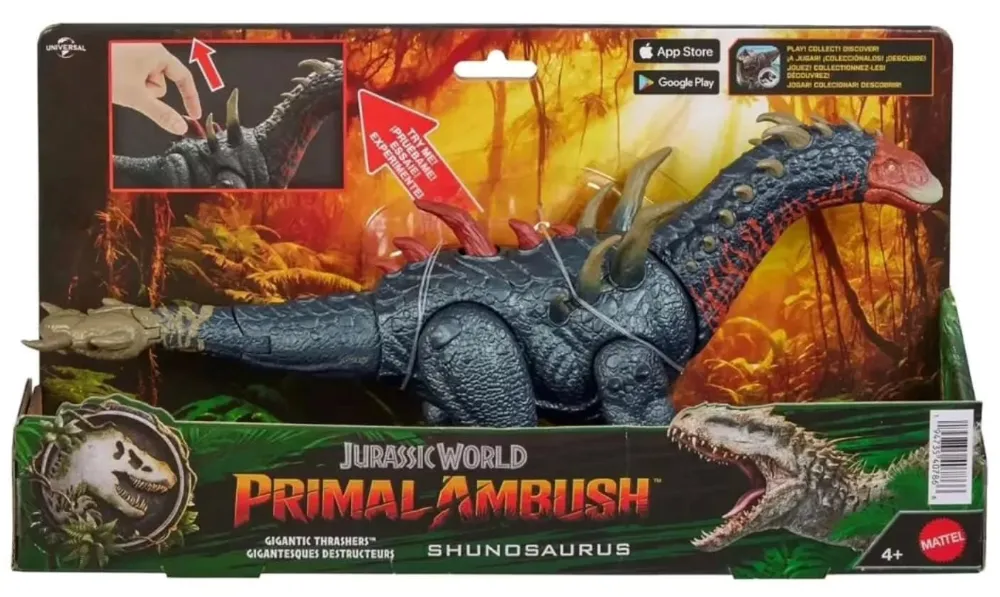
Out of the Gigantic Thrashers Box
Gigantic Thrashers is the large-figure assortment of Primal Ambush: bigger dinosaurs with a built-in strike feature. Wave 1 has just two figures, this Shunosaurus and the Daspletosaurus, and both come in the same box design.
The back of the box gives a quick taste of the action feature and shows the Daspletosaurus as its partner in the wave. There is nothing to assemble, so it is ready to play the moment it comes out of the tray.
Colours & Paint
Body, legs and most of the tail
Head, throat stripes and back spikes
Eyes, head spikes and snout tip
Tips of the shoulder spikes
Tail club and tail spikes
Teeth inside the mouth
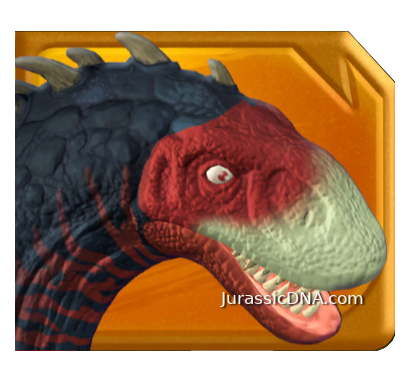
The colours are a big part of why this figure works. The head is a strong red with a paler tip on the end of the snout, and the red stops in a sharp line behind the head where the dark navy blue of the body takes over. That blue covers almost everything from the neck back, and the plastic has a very faint metallic sheen that you notice when it catches the light.
The best touch is under the neck. Red stripes run down the throat and stand out brilliantly against the dark blue around them. It is a lovely detail, and the only pity is that it stops at the base of the neck instead of running along the belly.
Most of the spikes get their own colour, which keeps them from blending into the body. The head spikes are tan, the big shoulder spikes start dark and fade to a tan green at the tips, and the tail club and its spikes are a greenish brown. Many Mattel figures end with a bare tail, so seeing paint all the way to the club is a welcome change. The spikes along the middle of the back are red, which feels a little random next to the rest of the scheme, and the two small spikes on top of each front leg are left unpainted.
The claws are unpainted too and almost vanish into the dark blue legs. A simple gloss coat would have made them look finished.
Sculpt Breakdown
Head, neck and throat
The face carries decent skin texture, and the jaw opens to show sculpted teeth and a tongue, although the mouth is small and hard to see into. Spikes start right on top of the head and run down the neck. They are well sculpted, with crisp edges, but they do a lot to hide the real animal underneath.
Behind the head the scales grow large and bumpy, almost like rounded stones, and a row of armour-like scutes follows the spine all the way back. It gives the figure a rugged, tank-like feel that suits the way it plays.
Body, legs and tail club
The body mixes three kinds of texture: ordinary sauropod skin on the flanks, big bony plates across the back and a different, finer pattern on the belly, where you can just make out the ribs. The legs are the most convincing part of the sculpt. On the front legs the scales start large at the shoulder and shrink toward the foot, the muscles are well defined and the elbow is clearly shaped. The hind legs show a strong calf. Each foot has one oversized inner claw, and the front claws have small cracks sculpted into them.
The tail is shorter than it should be, but it does not look as stubby as some smaller Mattel sauropods. It keeps the armoured top all the way to the club, which is jointed and finished with small, neatly detailed spikes. The two sides of the figure are nearly identical apart from slightly different leg positions.
Only one of the five spike groups belongs on a Shunosaurus. The other four are pure Primal Ambush.
The eye with no pupil
Action Feature & Articulation
✓ Opening jaw (via the feature)✓ Neck up and down✓ Tail up, down and side to side✓ Jointed tail club✓ Front legs forward, back and outward✓ Hind legs forward and back★ Pull-spike tail and head strike✗ Hind legs stiff, no outward swing
The feature is worked from a spike on the back. Pull it and the figure springs into a fight, but it does not do the same thing every time:
The feature switches between tail and head as you keep pulling, so you never quite know which end will attack next. It works the same way as on the Daspletosaurus from the same wave, and it is a clever fit for a sauropod that really did defend itself with its tail.
Outside the feature the joints are better than expected for a big action figure. The front legs swing forward and back and also move out from the body, which helps with stable, wide stances. The hind legs only go forward and back and feel a bit stiff. The tail has several joints along its length plus one at the club.
How Big Is the Gigantic Thrashers Shunosaurus?
This is a properly big figure, as you would expect from Gigantic Thrashers. Its partner in the wave, the Daspletosaurus, is almost exactly the same overall size, so the two make a well-matched pair for a predator against prey battle. Among other Mattel sauropods it sits in the same size range as the Bajadasaurus.
The real Shunosaurus was about 9.5 metres long, which puts the figure at very roughly 1:26 scale, smaller than the standard figures around it. That is normal for Mattel sauropods, and the short tail keeps the length down even more.
Final Verdict
On paper this should not work. Shunosaurus is a sauropod famous for one weapon, and Mattel has added a dozen more. It is far from a faithful reconstruction, and anyone hoping for a museum-style figure will be disappointed.
In hand it is a different story. It is a very cool figure. The dark blue and red scheme is one of the most striking in Primal Ambush, the red throat stripes are a lovely detail, and having paint right out to the tail club is more than most Mattel figures get. The sculpt is rich with texture, the legs are excellent, and the pull-spike feature, which alternates between a tail strike and a head lift, keeps playtime unpredictable. It is big enough to be the centrepiece of a battle, and my son liked it a lot.
The faults are real but small: the eye has no black pupil, the back spikes are an odd red, the claws and front leg spikes are unpainted, the tail is short and the hind legs are stiff. If you enjoy the exaggerated Primal Ambush look, this one is easy to recommend.
✦ The Good
- Bold dark blue and red colour scheme
- Striking red stripes down the throat
- Painted, jointed tail club, true to the real animal
- Fun feature that switches between tail and head
- Big size and detailed, muscular legs
✦ The Not So Good
- Covered in spikes the real animal never had
- No black pupil in the eye
- Unpainted claws and front leg spikes
- Tail shorter than it should be
- Stiff hind legs with no outward movement
Meet the Real Shunosaurus
A long-necked plant-eater that carried a bony club on the end of its tail, a weapon we usually link with armoured dinosaurs, not sauropods.Why this species is worth knowing
Where and when. Shunosaurus lii comes from the lower Shaximiao Formation of Sichuan Province, China. Most fossils were dug from a single site, the Dashanpu quarry near Zigong. These rocks have long been dated to the Middle Jurassic, around 170 million years ago, but a 2018 study of zircon crystals suggests they are no older than about 159 million years, which would place Shunosaurus in the early Late Jurassic.
The name. Dong Zhiming, Zhou Shiwu and Zhang Yihong named it in 1983. Shu is an old name for Sichuan, so Shunosaurus means Shu lizard. The species name honours Li Bing, the engineer and governor of Sichuan in the third century BC who built its famous irrigation works.
One of the best known sauropods. The first skeleton was found in 1977 by students practising excavation at a road cutting. About twenty more specimens followed, including near-complete skeletons, skulls and juveniles, so almost the entire skeleton is known. Shunosaurus makes up the great majority of fossils found at Dashanpu.
Built low. At about 9.5 metres long and around 3 tonnes it was small for a sauropod, and its neck was unusually short. It probably browsed on low plants, cropping them with long teeth that ended in spoon-shaped tips.
The tail club. In 1989 researchers announced that the tail ended in a bony club topped by two short spikes. It was most likely swung at predators, which makes Shunosaurus one of the very few sauropods known to have carried a weapon like this. It shared its world with the stegosaur Huayangosaurus, the meat-eater Gasosaurus and the long-necked Omeisaurus.
Unlock the Shunosaurus
How to unlock Shunosaurus from Primal Ambush?
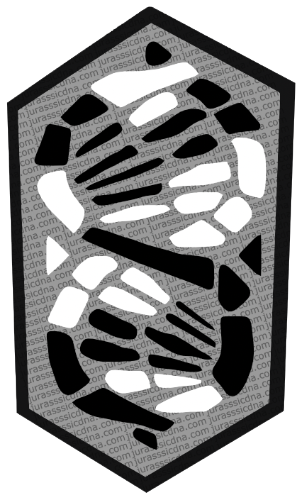
The DNA scan code is printed on the underside of the Shunosaurus, on its belly. Scan it with the Jurassic World Play App to add the Primal Ambush Shunosaurus to your digital collection.
New figures sometimes reach shops before the app is updated, and then the code will not scan yet. If that happens, update the app and try again a little later. If the code on your figure has worn off or is hard to read, scan the copy on this page straight from your screen.
Shunosaurus Gallery
Shunosaurus FAQ
Only partly. The tail club and the sturdy legs match the real animal, but the spikes on the head, shoulders and back are invented, and the tail is too short. It is best enjoyed as a stylised Primal Ambush creature rather than a scientific model.
It is about 14.25 inches (just over 36 cm) long from snout to tail club and just over 6.25 inches (about 16 cm) tall at the top of the neck, almost the same size as the Gigantic Thrashers Daspletosaurus.
Pull the spike on its back and the figure attacks. Some pulls swing the tail club from side to side or flick it upward, others raise and lower the head and open the jaw, so the strike alternates between the two ends.
Yes. Fossils described in 1989 show that its tail ended in a bony club topped by two short spikes, probably used to fend off predators. Very few sauropods are known to have had one.
Shunosaurus means Shu lizard. Shu is an ancient name for Sichuan, the Chinese province where its fossils were found.
Open the Jurassic World Play App, tap Scan and point your camera at the DNA code on the belly of the figure, or at the copy on this page.