
Home › Jurassic World Primal Ambush › Zhejiangopterus Wild Roar
Wild Roar Review
Zhejiangopterus Wild Roar
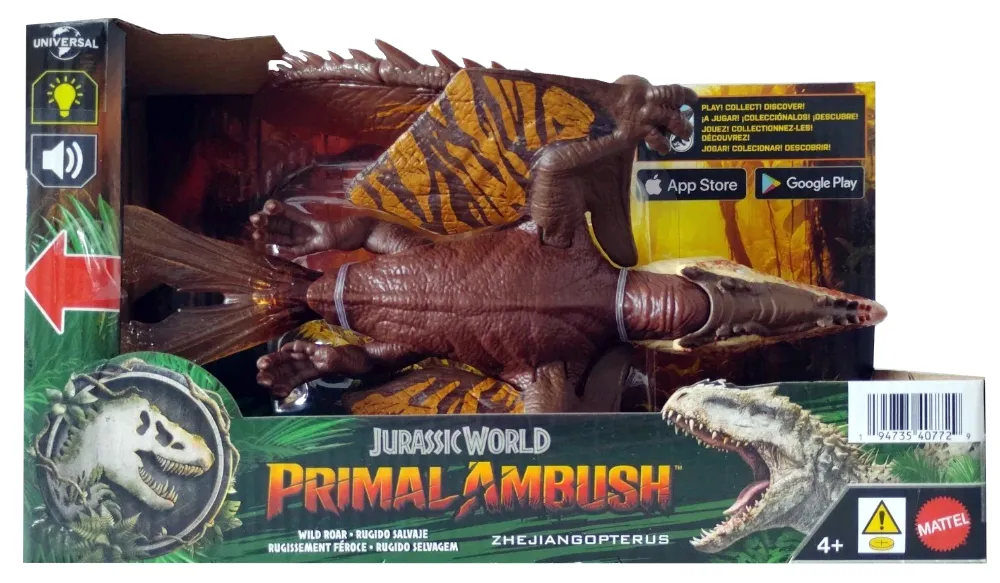
Most people have never heard of Zhejiangopterus, and that is exactly why this figure is worth a look. It is the only flying reptile in the first Wild Roar wave and an azhdarchid, a long-beaked cousin of Quetzalcoatlus rather than yet another Pteranodon. Pull its tail and the wings flap, the beak opens and the body lights up orange. The tiger-striped wings look great, but Primal Ambush has added spikes and soft teeth the real animal never had, the neck does not move, and it will not stand up on its own. It is a fun, different pterosaur with a few frustrating limits.
⭐ First Mattel Zhejiangopterus🪽 Wing-flap feature💡 Orange glowWild Roar · Wave 1DNA scan code included
🦴 Fossil vs Figure: How Real Is It?
Zhejiangopterus is one of the best known azhdarchids, with several fairly complete skeletons, so we have a good idea of what it looked like. Mattel got the overall shape right and then added some Primal Ambush menace.
The crestless head is a nice accurate touch, but the spikes on the beak and wings push it firmly into Primal Ambush territory. It is a stylised creature first and a museum model second.
The Only Flyer in Wild Roar
Wild Roar is the electronic assortment of Primal Ambush, with an action feature and a light inside every figure. Zhejiangopterus is the only pterosaur in Wave 1, alongside Cristatusaurus, Gryposuchus, Sinraptor and Tsintaosaurus.
The box carries the Primal Ambush logo with the Indominus rex, and the species info on the packaging places Zhejiangopterus in China in the Late Cretaceous, 81 million years ago. A big arrow on the side points to the tail, which is where the action feature lives. The figure comes packed with its wings folded against its body.
Colours & Paint
Body, neck, limbs and lower jaw
Wing membranes
Tiger stripes on the wings
Upper beak
Speckles and tip of the upper beak
Tail, glows orange
The colour is saved for where it counts. The body, neck, legs and lower jaw are a plain chocolate brown, which makes the wings pop when you spread them. The wing membranes are a warm orange crossed by bold dark brown tiger stripes, easily the best part of the paint job and very different from the usual single-colour pterosaur wing.
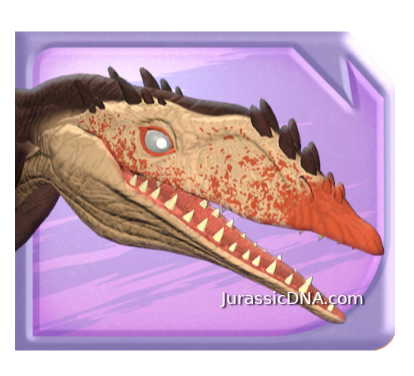
The upper beak is cream, speckled with a peachy red that deepens towards the tip. The lower beak does not get that treatment and stays brown, which looks a little unfinished when the mouth is open. The eyes are a pale, milky white, which gives the figure a slightly blank, blind look rather than a fierce one.
The tail is moulded in translucent plastic so the internal light can shine through. When the feature is triggered it glows orange, which suits the warm wing colours nicely.
Sculpt Breakdown
Head and beak
The head is long and low with no crest, just like the real animal, and the beak makes up most of its length. Along the edges of the beak Mattel has sculpted a row of spikes that look like sharp teeth. They are actually made of soft plastic, as is the tongue inside the mouth, so they look menacing without being sharp to touch. The head is also noticeably bigger than the Survival Pteranodon’s, which gives it real presence.
Wings, body and tail
The wings spread wide for a flying pose and fold back against the body for display. Spikes run along the wing edges as well, another Primal Ambush addition. The body is compact with a wrinkled skin texture, the hands end in small claws, and the short hind legs can be moved. The neck is shorter and thicker than the real animal’s very long one and is fixed in place.
Behind the legs sits a long, broad tail in translucent plastic. Real azhdarchids had only a tiny tail, so this is mostly there to house the light and work the action feature.
A toothless animal with teeth
Articulation & the Wing-Flap Feature
✓ Wings spread and fold✓ Legs✓ Upper beak via the feature★ Pull the tail to flap and glow✗ No neck or head joints✗ Cannot stand on its own
The feature is not obvious at first, so here is the trick: you pull the tail, you do not press it. One pull sets off three things at once:
It is a lively feature and a lot more fun than a static flyer. The trade-off is posing. The neck and head have no articulation at all, so the head always points the same way, and the figure cannot stand up by itself. Set it down on its feet and wing hands and it simply tips over, which is a shame for an animal that, in real life, spent much of its time walking on all fours. The wings and legs do move, so it works best held in the hand or displayed in flight.
Next to the Pteranodon
The obvious comparison is Mattel’s Survival Pteranodon. The Pteranodon has the wider wingspan, but the Zhejiangopterus has a bigger head and a longer tail, so it looks just as substantial on the shelf and arguably has more personality. That roughly matches real life too: Pteranodon was the bigger flyer, while azhdarchids like Zhejiangopterus were built around a large head and long beak.
We have not put a tape measure on this one yet, and we will add exact length and wingspan figures here once we do.
Final Verdict
Getting any azhdarchid at all is a treat, and Zhejiangopterus is a properly obscure pick that most fans will be meeting for the first time. The tiger-striped orange wings look fantastic spread out, the big crestless head has real presence, and pulling the tail to make it flap, open its beak and glow is simple, satisfying fun.
The compromises are hard to ignore, though. Teeth and spikes on a toothless pterosaur will bother anyone who wanted an accurate model, the fixed neck limits posing, and a flying reptile that falls over when you set it down is frustrating on a shelf. The plain lower beak and blank eyes also make it feel a little less finished than the best figures in the wave.
It is a good, different figure rather than a great one. If you want something other than another Pteranodon, it is well worth picking up.
✦ The Good
- First Mattel Zhejiangopterus, a rare azhdarchid
- Pull the tail to flap, open the beak and glow
- Tiger-striped orange wings
- Accurate crestless head with a big beak
- Soft, play-safe teeth and tongue
✦ The Not So Good
- Teeth and spikes on a toothless pterosaur
- No neck or head articulation
- Cannot stand without support
- Pale eyes look blank
- Lower beak left plain brown
Meet the Real Zhejiangopterus
Most azhdarchids are known from a handful of broken bones. Zhejiangopterus is known from several fairly complete skeletons, which makes it one of the best windows we have into what these long-necked giants looked like.Why this species is worth knowing
Where and when. Zhejiangopterus linhaiensis lived in what is now eastern China during the Late Cretaceous, about 81 million years ago. Its fossils come from the Tangshang Formation near the village of Aolicun in Linhai, Zhejiang Province.
The name. Cai Zhengquan and Wei Feng described it in 1994. Zhejiangopterus means “Zhejiang wing”, and the species name honours the city of Linhai. It was first placed with the nyctosaurs, but in 1997 it was recognised as an azhdarchid, a relative of the giant Quetzalcoatlus.
What it looked like. The skull was long, low and gently arched, with no crest and a long, thin, pointed beak that had no teeth at all. The neck was built from very long vertebrae, and the legs were slender, with a thigh bone about one and a half times the length of the upper arm.
How big was it? Early estimates gave it a five metre wingspan, but this was later revised to about 3.5 metres, larger than any living bird. Palaeontologist Mark Witton estimated its weight at only around 8 kg, because pterosaur bones were thin-walled and full of air.
Not a dinosaur. Like all pterosaurs, Zhejiangopterus was a flying reptile that lived alongside dinosaurs but was not one. Azhdarchids are now thought to have spent much of their time on the ground, walking on all fours and snapping up small animals with their long beaks.
Unlock the Zhejiangopterus
How to unlock the Primal Ambush Zhejiangopterus?
The DNA scan code is printed on the Zhejiangopterus figure. Scan it with the Jurassic World Play app to add the Primal Ambush Zhejiangopterus to your digital collection.
New figures sometimes reach shops before the app is updated, and in that case the code will not scan yet. If that happens, update the app and try again a little later. If the code on your figure has worn off or is hard to read, scan the copy on this page straight from your screen.
Zhejiangopterus Gallery
Zhejiangopterus FAQ
Yes. The Primal Ambush Wild Roar Zhejiangopterus is the first Zhejiangopterus Mattel has made for its Jurassic World toy line.
Pull the tail. The wings flap, the upper beak opens and the figure lights up orange through its translucent tail.
Not on its own. The figure tips over when set down on its feet and wing hands, so it is best displayed in a flying pose or with a stand.
No. Zhejiangopterus had a smooth, toothless beak like all azhdarchids. The teeth and spikes on the figure are a Primal Ambush styling choice, and they are made of soft plastic.
No. Zhejiangopterus was a pterosaur, a flying reptile that lived alongside the dinosaurs in Late Cretaceous China about 81 million years ago.
It had a wingspan of about 3.5 metres and probably weighed only around 8 kg, thanks to its light, air-filled bones.