
Home › Jurassic World Primal Ambush › Sinraptor Wild Roar
Wild Roar Review
Sinraptor Wild Roar
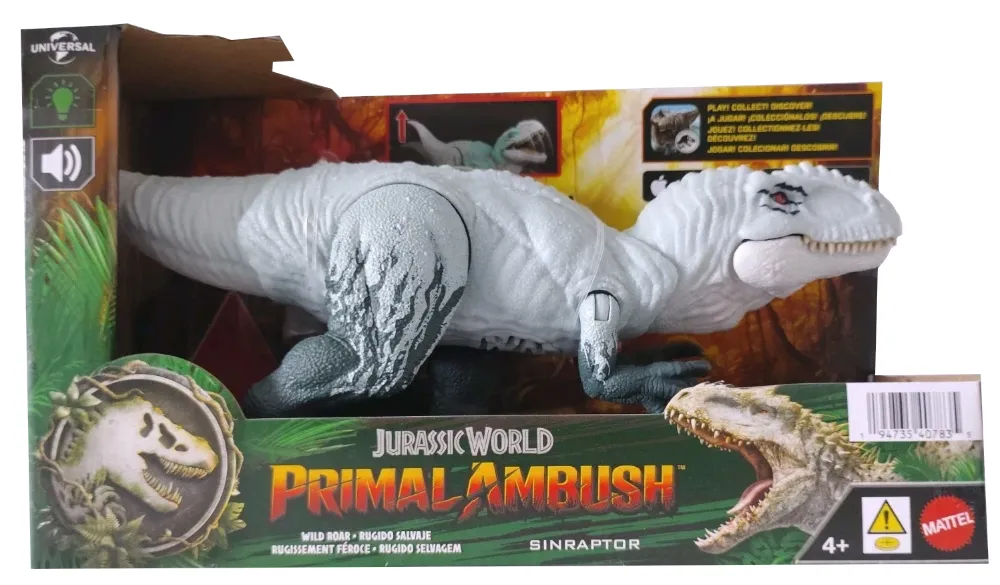
Most of the first Primal Ambush wave leans hard into spikes, sails and mutant styling. The Sinraptor does not. Mattel’s first ever Sinraptor is a clean, believable theropod in a striking off-white skin, with dark markings around the eyes that give it a cold, predatory stare. Lift the tail and it rears up with a roar and a green glow, and keep holding it and the roar keeps going. A few small shortcuts aside, this is the standout figure of the wave and the dinosaur we would point anyone to first.
⭐ First Mattel Sinraptor💡 Green glow & roar📏 ~30 cm / 12 inWild Roar · Wave 1DNA scan code included
🦴 How Close Is It to the Real Sinraptor?
Sinraptor is known from a good skull and much of a skeleton, but artists still draw its head in very different ways, so there is no single “correct” look to hold the figure against. Measured against the fossil itself, Mattel has got the important things right and taken only small liberties.
The figure also keeps faint ridges running along the nose, a detail that suits the metriacanthosaurid family Sinraptor belongs to. Compared with the heavily stylised dinosaurs elsewhere in Survival and Primal Ambush, this is about as faithful as a Mattel mainline theropod gets.
What Is a Wild Roar?
Wild Roar is the electronic assortment of Primal Ambush: medium-large figures with an action feature, sound effects and, in this line, a light that glows through the plastic. Wave 1 pairs the Sinraptor with Cristatusaurus, Gryposuchus, Tsintaosaurus and Zhejiangopterus.
The box follows the rest of the line, with the Primal Ambush logo on the front, the Indominus rex peeking out on one side and the wave line-up on the back. The tail is packed separately inside the box and simply plugs into the body once you have it out. The back panel shows a jungle scene with an arrow pointing to the action feature, and there is a small leaflet tucked in as well.
Paint & Colours
Cast colour of the whole body
Stripes around the eyes and head
Hands and feet, fading up the limbs
Lower jaw, throat and under the tail
Inside of the mouth
Teeth
White is a bold choice for a big predator, and it works beautifully here. The whole figure is cast in a soft off-white, which makes it stand out on any shelf and lets the sculpted texture catch the light. In person the colour is warmer and creamier than it looks in most photos.
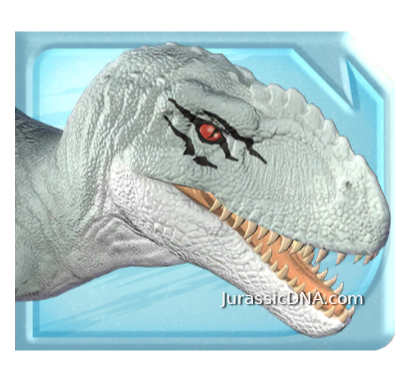
The real star is the dark markings around the eyes. They run back across the head like war paint and give the Sinraptor a hard, menacing glare that photos rarely capture. It is a simple idea that does a lot of work.
There is more paint than first appears. A very pale pink-tan covers the lower jaw, the throat and the underside of the tail, the inside of the mouth is a soft pink, and the teeth are a cream-brown rather than stark white. The hands and feet are a darker grey-brown that fades up the arms and legs, which helps hide the fact that the claws are unpainted. Some will want more pattern on the body, but the restrained scheme suits this animal and gives it a clean, natural look.
On our sample there is a small dark smudge on the upper leg, the only paint flaw we found. It is worth checking the figure in the box if you can.
Sculpt & Detail
The head
The head has a long, solid predator profile, with low ridges along the nose and a small bony ridge above each eye. Fine scratch-like texture runs along the sides of the face, as if the animal has a few old battle scars, which is fitting for a species whose skull really does carry bite marks. The teeth are exposed with no lips, which some fans will miss, but it suits the classic Jurassic look of the figure.
If anything lets the head down, it is the eye. It is a little large and cartoonish compared with the rest of the sculpt. It does not spoil the face, and the dark markings around it do a lot to sharpen the expression, but a smaller eye would have made it perfect.
Body, arms and legs
The body is lean and natural, with no extra spikes, sails or armour bolted on. Muscles and skin texture are well defined across the torso, and the underside houses the speaker grille without spoiling the shape. The three-fingered hands look right for a metriacanthosaurid and sit at a believable angle.
The legs are solid and powerful but plainer than the rest of the sculpt, and they are moulded as one piece below the hip, so there are no knee or ankle joints. The claws are unpainted throughout, although the darker hands and feet help them blend in. Overall it sits comfortably alongside the best theropods Mattel made for Rebirth, and that is high praise.
Where is the crest?
Articulation & the Glow and Roar Feature
✓ Arms, forward, back and out✓ Legs, forward and back✓ Head, jaw and tail via the feature★ Lift the tail to roar and glow✗ No knee or ankle joints✗ Jaw opens only a little
The arms swing forward, back and outward, and the legs have a good range: far enough back for a running pose and well forward for a stride. They only wiggle slightly outward, so wide stances are out. The head, jaw and tail are all tied to the action feature rather than posed by hand, and the jaw only opens a short way, so it cannot really grab other figures.
The action feature is where this figure earns its keep. Here is what happens when you use it:
That hold-to-continue trick is a real improvement over the Survival figures, which glowed for a set time and then stopped. The sounds also seemed new to us rather than the familiar recycled roars, and that closing growl is excellent. Whether a glowing dinosaur makes sense is another question, but on a plain, natural figure like this the green light through the white plastic looks great, especially in a dim room.
Size & Scale
From snout to tail the Sinraptor measures about 12 inches (30 cm). It stands about 4.75 inches (12 cm) tall at the hips and about 4.25 inches (11 cm) at the top of the head in its normal pose. That is a solid mid-size theropod, and it scales nicely with Mattel’s human figures.
Next to other Mattel figures, it is close in size to the Megaraptor, which is an inch or two longer, and about an inch longer than the Rebirth Utahraptor. A standard Mattel Velociraptor is barely the size of its head and neck. The long-bodied Survival marine reptiles outstretch it, but the Sinraptor stands much taller.
The known Sinraptor skeleton is about 7.6 metres long, and it came from an animal that was not fully grown. That puts the figure at roughly 1:25, a sensible size for a big Jurassic predator in the mainline.
Our Verdict
Sinraptor is a species fans have asked for for years, and Mattel has delivered it without the spikes, sails and mutations that weigh down so much of this wave. It looks like a real animal, and the white body with those dark eye markings makes it one of the most striking predators on the shelf.
The glow and roar feature is the best version of the idea yet. Holding the tail keeps the roar and light going, the sounds feel fresh, and the final growl is a lovely touch. Add a strong sculpt, a good range of motion and a sensible size, and it is easy to see why this is the figure everyone in the wave wants.
It is not flawless. The eye is a bit cartoonish, the claws are bare, the legs have no knees or ankles, and the jaw opens only a little. None of that matters much on a figure this well judged. It gets our full five stars and our first recommendation from Primal Ambush.
✦ What We Love
- First ever Mattel Sinraptor
- Natural design with no mutant extras
- Striking off-white colour scheme
- Menacing dark markings around the eyes
- Hold the tail to keep it roaring and glowing
- Fresh sound effects with a great final growl
✦ What Could Be Better
- Eye is a little large and cartoonish
- Unpainted claws
- No knee or ankle joints
- Jaw opens only a short way
- Head slightly big, tail slightly short
About the Sinraptor
The first Sinraptor skull ever found is covered in healed bite marks from another big theropod, probably another Sinraptor. Its owner fought, was bitten in the face, and survived.Why this species is worth knowing
Where and when. Sinraptor dongi lived in what is now Xinjiang in north-western China during the Late Jurassic, around 160 million years ago. Its skeleton came from the Shishugou Formation and was found in 1987 by the Sino-Canadian Dinosaur Project, a joint expedition between Chinese and Canadian palaeontologists.
The name. Philip Currie and Zhao Xijin named it in the early 1990s. Sinraptor means “Chinese robber”, and the species honours the Chinese palaeontologist Dong Zhiming. Despite the name, it was not a raptor like Velociraptor. It was a large carnosaur, a distant relative of Allosaurus.
How big was it? The original skeleton is about 7.6 metres long and came from an animal that was not fully grown. Gregory S. Paul estimated around 8 metres and 1.3 tonnes, and some estimates go a little higher. Its skull alone was roughly 90 cm long, with blade-like teeth for slicing flesh.
Battle scars. That first skull shows curved tooth gouges, small punctures and one wound that went right through the bone, all partly healed. A broken rib had also healed. It is some of the best evidence that big theropods bit each other on the head in fights.
Its world. Sinraptor gives its name to a group of Asian and European predators, now usually called metriacanthosaurids. In the Shishugou Formation it shared the land with the giant long-necked Mamenchisaurus, the small crested tyrannosaur relative Guanlong, the odd beaked theropod Limusaurus and the stegosaur Jiangjunosaurus, a likely target for a hunter of its size.
Unlock the Sinraptor
How to unlock the Primal Ambush Sinraptor?
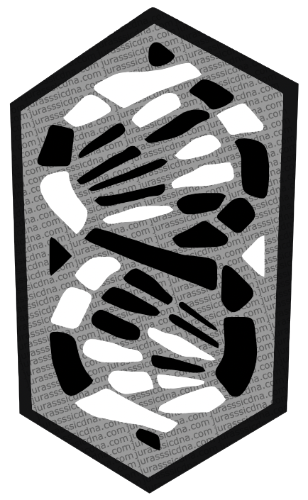
The DNA scan code is printed on the Sinraptor figure. Scan it with the Jurassic World Play app to add the Primal Ambush Sinraptor to your digital collection.
If the code on your figure has worn off, been scratched or is hidden by a sticker, scan the copy on this page straight from your screen.
Sinraptor Gallery
Sinraptor FAQ
Yes. The Primal Ambush Wild Roar Sinraptor is the first Sinraptor Mattel has made for its Jurassic World toy line.
Lifting the tail makes the head rear up and the jaws open, while the figure roars and glows green from inside. Hold the tail up and the roar and light keep going. When you let go, it finishes with a final growl.
It is about 12 inches (30 cm) long and stands about 4.75 inches (12 cm) tall at the hips, close in size to Mattel’s Megaraptor.
No. The figure is a natural-looking theropod with no extra spikes, sails or armour, which sets it apart from most of the first Primal Ambush wave.
No. Despite the name, which means “Chinese robber”, Sinraptor was not a dromaeosaur like Velociraptor. It was a large carnosaur from the metriacanthosaurid family, distantly related to Allosaurus.
The original skeleton is about 7.6 metres long and came from an animal that was not fully grown. Estimates for adults run to around 8 metres and 1.3 tonnes or more.