

Home › Jurassic World Epic Evolution › Gryposuchus Wild Roar
Wild Roar Figure Guide
Gryposuchus Wild Roar
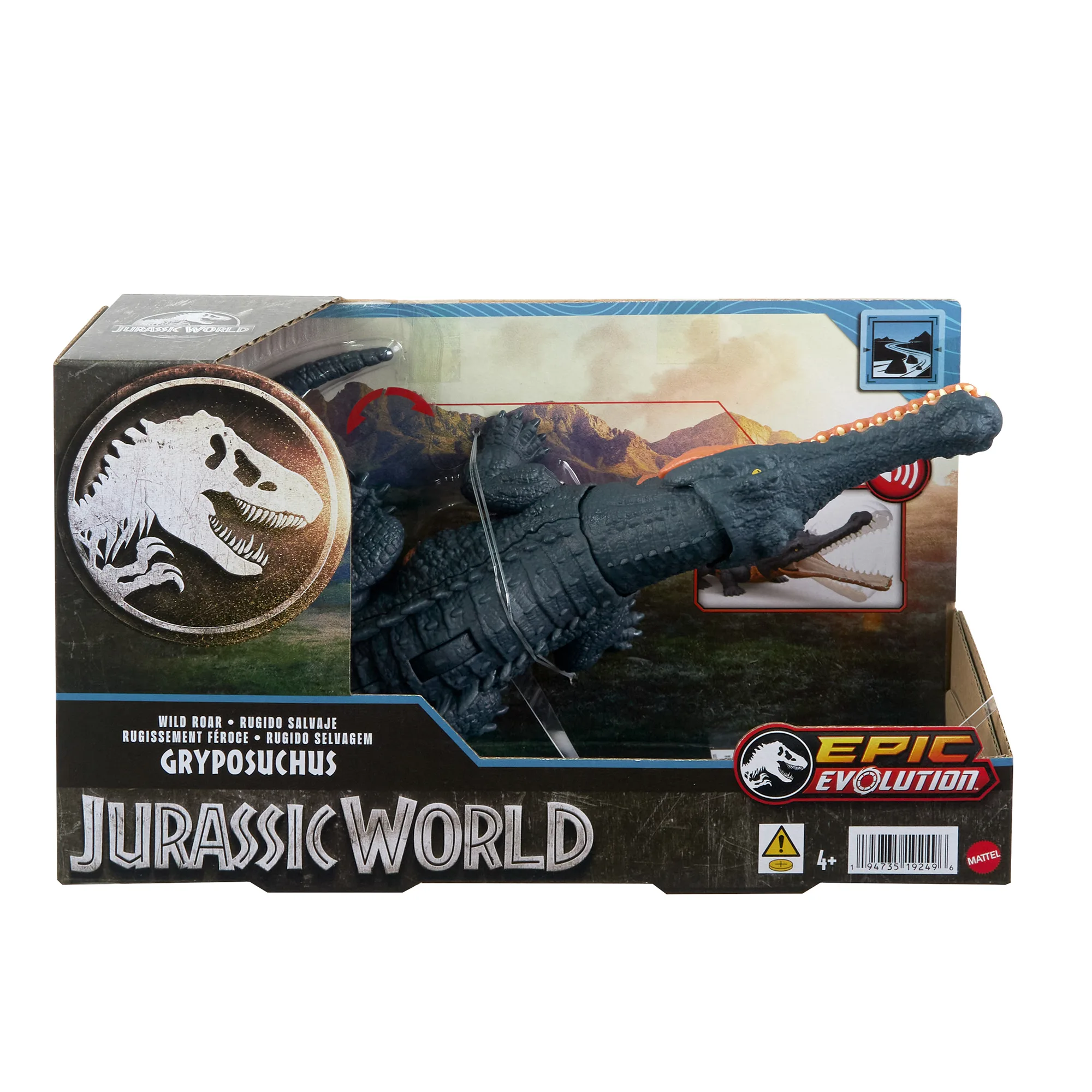
Gryposuchus was a giant, long-snouted relative of the gharial that lived in South America long after the dinosaurs were gone. Mattel added it to the first Wild Roar wave of Jurassic World Epic Evolution as a dark navy reptile with orange markings, a roar sound and a snapping jaw. Here is what the figure looks like, where it sits in time, and how to unlock it in the Jurassic World Play App.
Giant gharialRoar soundSnapping jaw🧬 DNA scan code
Timeline Check: After the Dinosaurs
Gryposuchus is in a dinosaur toy line, but it never saw a dinosaur.
That makes it one of the largest crocodilians ever, but it lived tens of millions of years after T. rex.
What Is Wild Roar?
Wild Roar is the mid-sized assortment of Mattel’s Epic Evolution line. Each figure has a roaring sound, an attack motion and movable joints, and runs on small button cell batteries. Like every Epic Evolution figure, it comes with a DNA code that unlocks the animal in the Jurassic World Play App.
Gryposuchus came in the first Wild Roar wave of Epic Evolution, alongside Ekrixinatosaurus, Megalosaurus and Hesperosaurus.
Paint and Colours
Back, tail and head
Spots and stripes on the sides
Belly and jaw
Teeth
A dark, river-hunter look. The back, tail and long snout are a deep navy, with orange spots and stripes along the sides. The belly and jaw edges are lighter, and the narrow snout is lined with small white teeth.
Sculpt and Detail
Snout and jaw
The snout is very long and narrow, built for catching fish, and the jaw opens to snap shut.
Body and tail
Gryposuchus lies low on four short legs with rows of bony scutes along the back and a tall, ridged tail for swimming.
Figure vs fossil
Action Features and Articulation
✓ Roar sound✓ Attack motion✓ Movable joints✗ Sound needs batteries
Like every Wild Roar figure, Gryposuchus roars when you trigger it and snaps its long jaws. It runs on small button cell batteries.
Size and Specs
Long, low figure for ages 4 and up. Look for the Epic Evolution logo and the navy body with orange spots.
Is It Worth Buying?
Gryposuchus is an unusual pick, a giant crocodilian with a fun snapping jaw. It looks great in a river scene. Dinosaur purists may skip it.
It came out in the first Epic Evolution Wild Roar wave.
What we like
- Very long snapping snout
- Navy and orange paint
- Roar sound
- Rare animal
Good to know
- Not a dinosaur
- Lived after the dinosaurs
- Needs batteries for sound
About Gryposuchus
Gryposuchus was named in 1912 by Georg Gurich. Fossils have been found in Colombia, Venezuela, Peru, Brazil and Argentina.
It lived in the Miocene, roughly 18 to 5 million years ago. The largest species, Gryposuchus croizati, may have reached about 10 m long.
Gryposuchus was a gavialoid, a relative of the living gharial of India. Its long, thin snout was ideal for catching fish.
How to Unlock Gryposuchus in the Jurassic World Play App
Open the Jurassic World Play App (it used to be called the Jurassic World Facts App), tap Scan and point your camera at the DNA code below.

Frequently Asked Questions
No. It is a crocodilian related to the gharial.
No. It lived about 18 to 5 million years ago, long after the dinosaurs died out.
It roars and snaps its long jaws.
Yes, small button cell batteries power the roar.
The largest species may have reached about 10 m long.
Open the Jurassic World Play App, tap Scan and point your camera at the copy of the code on this page.