
Home › Jurassic World Dino Trackers › Diabloceratops Wild Roar
Wild Roar Figure Guide
Diabloceratops Wild Roar
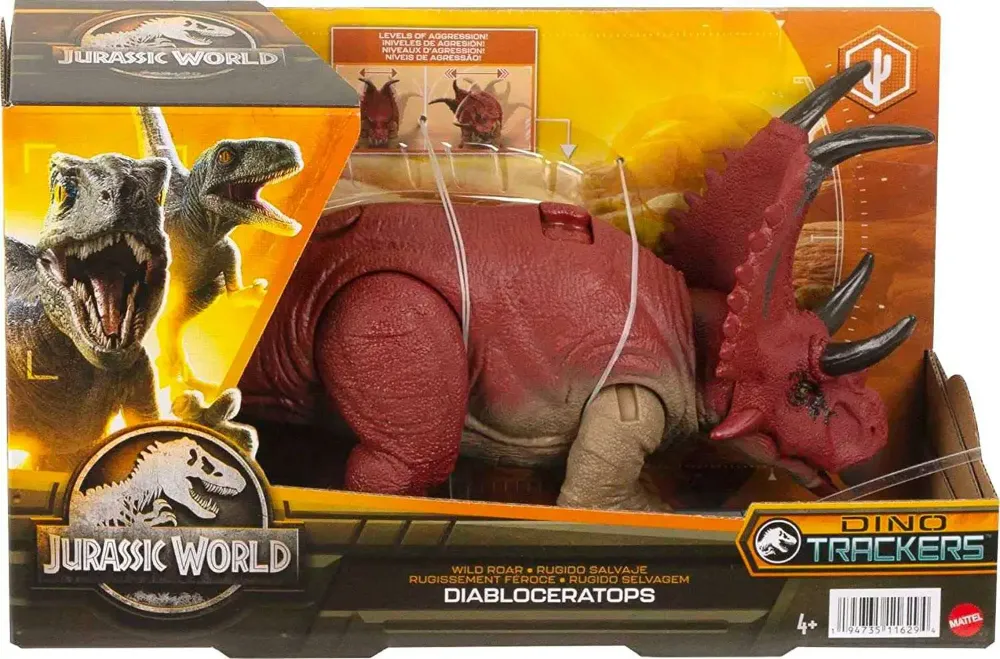
Diabloceratops was the horned dinosaur of the first Wild Roar wave of Jurassic World Dino Trackers in 2022, alongside Eocarcharia, Dryptosaurus and Kronosaurus. Its name means devil-horned face, thanks to two long spikes rising from the top of its frill. Mattel’s figure is a bold red plant-eater with black horns, a roar and a charging head butt. Here is what the figure looks like, how its horns compare with the fossil, and how to unlock it in the Jurassic World Play App.
🌿 Horned plant-eater🔊 Roar sound💥 Head butt charge🧬 DNA scan code
Horn Check: Figure vs Fossil
Horned dinosaurs are told apart by their horns, so here is how Mattel’s version lines up with the real skull, which is kept at the Natural History Museum of Utah.
The frill spikes, the part that gave the animal its name, are spot on. The big curved brow horns are the figure’s main departure from the fossil: they make it look more like Triceratops than the real animal did.
What Is Wild Roar?
Wild Roar is the mid-sized assortment of Mattel’s Dino Trackers line. Each figure has a roaring sound, a species-specific attack motion and movable joints, and runs on button cell batteries that come already installed. Wave 1 brought Diabloceratops, Eocarcharia, Dryptosaurus and Kronosaurus, and wave 2 added Orkoraptor, Irritator, Nigersaurus and Regaliceratops.
Wild Roar has carried on in every Jurassic World line since, with later figures adding lights and wheel-activated attacks.
Paint and Colours
Head, frill, back and tail
Belly, chin and lower legs
Horns, frill stripe and tail tip
Eyes
A loud, devilish colour scheme that suits the name. The head, frill and back are a strong brick red, with a sand tan belly, chin and lower legs underneath. The horns are glossy black, a black stripe runs up the middle of the frill, and the tail tip is dark too. Bright gold eyes finish the fierce look.
Sculpt and Detail
Head, frill and horns
The head is the star of the figure. The frill is edged with small spikes and topped by two long black spikes that sweep upwards, and a second pair of curved black horns sits over the eyes. The deep snout ends in a sharp, parrot-like beak, which Diabloceratops used to crop tough plants.
Body and legs
The body is stocky and low, with four sturdy legs and a short, thick tail, so it stands firmly on a shelf or table. The skin is covered in fine scales with rougher, larger scales along the back.
Why devil horns?
Action Features and Articulation
✓ Legs forward and back★ Press the hips: head butt charge★ Roar sound✗ No opening jaw
Press down on the back above the hips and the head swings up and forward in a horn-first charge, while the figure roars. It is the classic horned dinosaur move and works well against the predators in the same wave. The sound runs on three LR44 button cells, which come installed in a new figure.
Size and Specs
Released in 2022 for ages 4 and up. It is the only plant-eater in Wild Roar wave 1, so it makes a natural target for Eocarcharia or Dryptosaurus. For a horned dinosaur display, pair it with Regaliceratops from wave 2.
Is It Worth Buying?
Diabloceratops is a good pick for kids who want a horned dinosaur that is not another Triceratops. The red and black paint is eye-catching, the frill spikes look great, and the head butt charge is easy to trigger. Collectors get one of the few toys ever made of this Utah dinosaur, though the brow horns are bigger than the fossil shows.
It came out in 2022 and is mostly found second hand now. Test the roar before buying a used one, or plan on fitting three new LR44 batteries.
What we like
- Rare species in toy form
- Accurate long frill spikes
- Roar plus head butt charge
- Bold red and black paint
- Stands firmly on four legs
Good to know
- Brow horns far too long
- Jaw does not open
- Sound needs working batteries
About Diabloceratops
Diabloceratops eatoni was named in 2010 by James Kirkland and Donald DeBlieux from a partial skull that DeBlieux collected in 2002 in the Wahweap Formation of Kane County, southern Utah, inside Grand Staircase-Escalante National Monument. Rock dating published in 2022 puts it at about 81 million years old, in the Late Cretaceous.
It was a centrosaurine, part of the same horned dinosaur family as Centrosaurus and Styracosaurus, and when it was described it was the oldest ceratopsid known. It grew to about 4.5 m long and 1.3 tonnes, with a deep, short skull, a small nose horn, small brow horns and a pair of very long frill spikes.
It lived on the southern part of Laramidia, the western half of North America, alongside duck-billed dinosaurs such as Acristavus and the tyrannosaur Lythronax, which was probably its main predator.
How to Unlock Diabloceratops in the Jurassic World Play App
Open the Jurassic World Play App (it used to be called the Jurassic World Facts App), tap Scan and point your camera at the DNA code below. The same code is on a small tag on the figure.

Gallery

Frequently Asked Questions
Press down on the back above the hips and the head swings up and forward in a horn-first charge while the figure roars.
Three LR44 button cells, which come installed in a new figure.
The two long frill spikes are accurate, but the figure’s curved brow horns are much longer than the small brow horns of the real skull.
Devil-horned face, from the Spanish diablo for devil, after the two long spikes on top of its frill.
About 4.5 m long and around 1.3 tonnes. It lived in Utah about 81 million years ago.
Open the Jurassic World Play App, tap Scan and point your camera at the tag on the figure, or at the copy of the code on this page.