
Home › Jurassic World Dino Trackers › Dryptosaurus Wild Roar
Wild Roar Figure Guide
Dryptosaurus Wild Roar
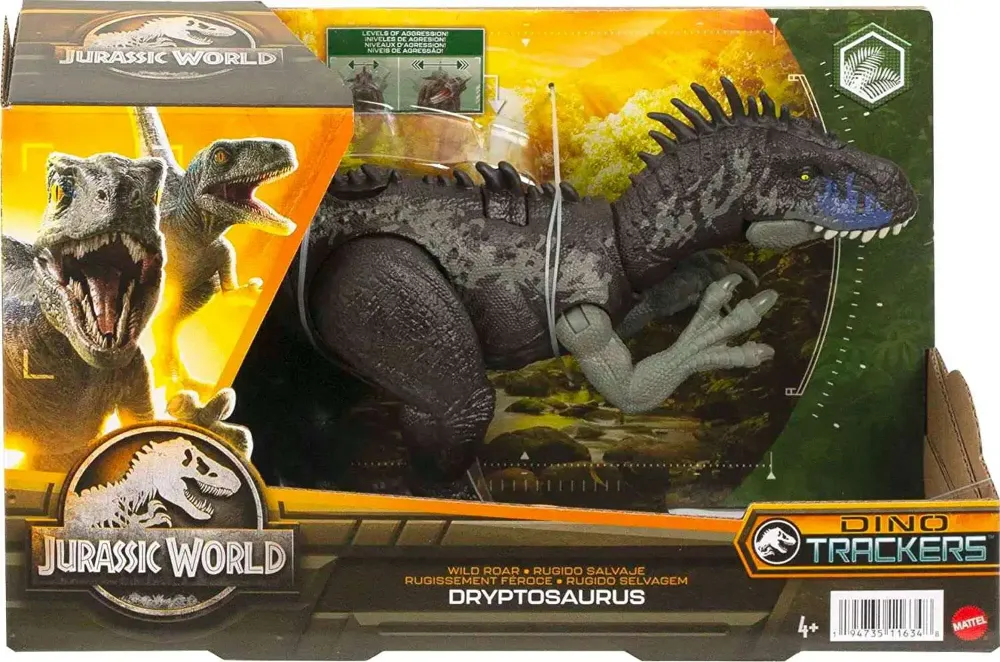
Dryptosaurus joined the first Wild Roar wave of Jurassic World Dino Trackers in 2022, alongside Eocarcharia, Kronosaurus and Diabloceratops. It is one of the very first meat-eating dinosaurs ever found in North America, a long-armed tyrannosaur relative from New Jersey, and it rarely gets a toy. Mattel’s version is a dark, spiky hunter with a blue face, big hand claws, a roar and a lunging bite. Here is what the figure looks like, what it does, and how to unlock it in the Jurassic World Play App.
🦖 Rare species in toy form🔊 Roar sound💥 Lunging bite🧬 DNA scan code
A Tyrannosaur From the Other America
In the Late Cretaceous a shallow inland sea split North America in two. Dryptosaurus lived on the eastern half, cut off from the giant tyrannosaurs of the west.
That isolation is why Dryptosaurus looks so different from T. rex despite living near the very end of the age of dinosaurs. Its long, clawed arms were still a working weapon.
What Is Wild Roar?
Wild Roar is the mid-sized assortment of Mattel’s Dino Trackers line. Each figure has a roaring sound, a species-specific attack motion and movable joints, and runs on button cell batteries that come already installed. Wave 1 brought Dryptosaurus, Eocarcharia, Kronosaurus and Diabloceratops, and wave 2 added Orkoraptor, Irritator, Nigersaurus and Regaliceratops.
Wild Roar has carried on in every Jurassic World line since, with later figures adding lights and wheel-activated attacks.
Paint and Colours
Head, back, legs and tail
Arms, flanks and tail top
Patch on the side of the face
Inside of the mouth
A moody, dark scheme. Most of the figure is a deep charcoal, with olive grey on the arms, flanks and along the top of the tail, so it looks like a predator built to hide in a forest at dusk. The one bright accent is a blue patch on the side of the face behind the eye, which makes the head stand out, and the red mouth shows when it lunges.
Sculpt and Detail
Head and crest
The head is deep and toothy, with an opening jaw. Mattel added a ridge of spiky quills running from the top of the head down the neck, which gives the figure a wild, bristly silhouette. No such crest is known from the fossils: only a few pieces of the skull have ever been found, so this is Mattel’s artistic choice.
Arms and claws
The arms are the best part of the sculpt. They are long and strong for a tyrannosaur relative, with big, curved hand claws, which is exactly what makes Dryptosaurus special. The legs are powerful, the feet broad, and the figure stands well on its own.
Eagle claws
Action Features and Articulation
✓ Opening jaw✓ Posable arms✓ Legs forward and back★ Press the hips: lunging bite★ Roar sound
Press down on the back above the hips and the whole front of the body tips forward, so the head lunges down into a bite while the figure roars. It is a simple, satisfying move for battles with other Dino Trackers figures. The sound runs on three LR44 button cells, which come installed in a new figure.
Size and Specs
Released in 2022 for ages 4 and up. It is a good match in size for Eocarcharia from the same wave, and the two make a natural pair of rival predators.
Is It Worth Buying?
Dryptosaurus is a great pick for collectors who want something beyond the usual Jurassic World stars. Very few toy companies have ever made one, and Mattel’s version gets the long arms and big claws right. Kids get a dark, spiky predator with a roar and a lunging bite that is easy to trigger.
It came out in 2022 and is mostly found second hand now. Test the roar before buying a used one, or plan on fitting three new LR44 batteries.
What we like
- Rare species in toy form
- Long arms and big hand claws
- Roar plus lunging bite
- Striking dark paint with a blue face
- Stands well on its own
Good to know
- Spiky crest is invented
- Dark paint hides some detail
- Sound needs working batteries
About Dryptosaurus
Dryptosaurus aquilunguis was found by quarry workers in a marl pit in Gloucester County, New Jersey, and described by Edward Drinker Cope in 1866 as Laelaps, after a hunting dog from Greek myth. That name already belonged to a mite, so his rival Othniel Charles Marsh renamed it Dryptosaurus, meaning tearing lizard, in 1877. It was one of the first meat-eating dinosaurs known from more than teeth anywhere in North America.
It lived about 67 million years ago, near the end of the Cretaceous, and is estimated at about 7.5 m long and around 1.5 tonnes. For a long time its place in the family tree was unclear. The discovery of its close relative Appalachiosaurus in 2005 confirmed it as an early-branching tyrannosaur relative.
Charles R. Knight’s 1897 painting of two Dryptosaurus fighting, often called Leaping Laelaps, was one of the first to show dinosaurs as fast, active animals.
How to Unlock Dryptosaurus in the Jurassic World Play App
Open the Jurassic World Play App (it used to be called the Jurassic World Facts App), tap Scan and point your camera at the DNA code below. The same code is on a small tag on the figure.

Gallery

Frequently Asked Questions
Press down on the back above the hips and the head lunges forward into a bite while the figure roars.
Three LR44 button cells, which come installed in a new figure.
It was an early-branching tyrannosaur relative from eastern North America, with much longer arms than Tyrannosaurus rex.
Edward Drinker Cope named it Laelaps in 1866. That name was already used for a mite, so Othniel Charles Marsh renamed it Dryptosaurus in 1877.
About 7.5 m long and around 1.5 tonnes, based on a partial skeleton from New Jersey.
Open the Jurassic World Play App, tap Scan and point your camera at the tag on the figure, or at the copy of the code on this page.