

Home › Jurassic World Dino Trackers › Kronosaurus Wild Roar
Wild Roar Figure Guide
Kronosaurus Wild Roar
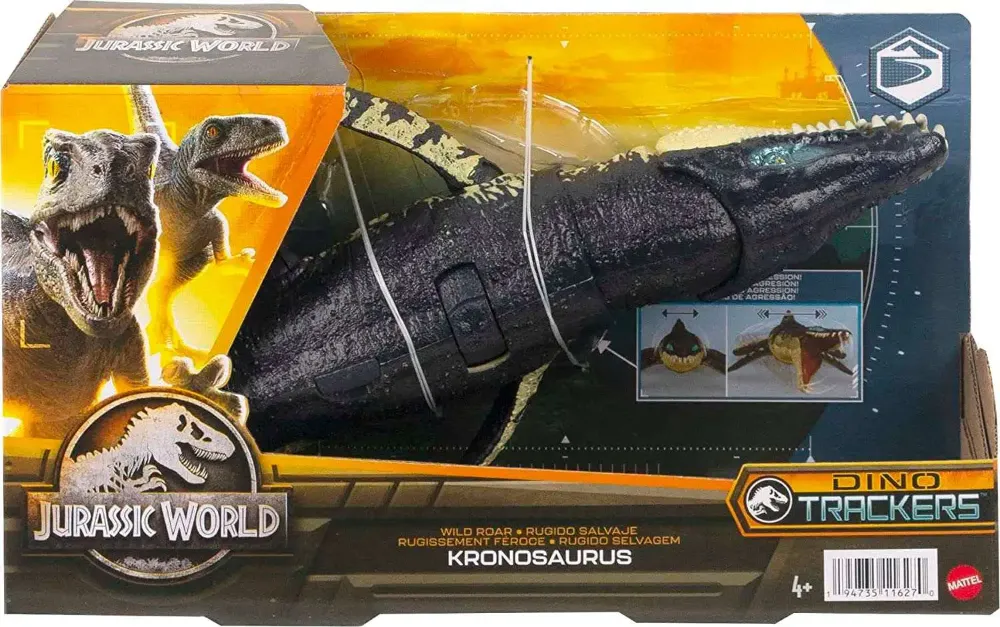
Kronosaurus was the sea monster of the first Wild Roar wave in Jurassic World Dino Trackers in 2022, alongside Eocarcharia, Dryptosaurus and Diabloceratops. It is a pliosaur, a short-necked, big-headed hunter from the Cretaceous seas, and the figure has a roar, a snapping side-to-side attack and four posable flippers. It has been a big hit in our house: our son already loved the Mosasaurus, and this one added the sounds that toy was missing. Here is what the figure looks like, what it does, and how to unlock it in the Jurassic World Play App.
🌊 Marine reptile🔊 Four roar sounds💥 Snapping side attack🧬 DNA scan code
Plasterosaurus: How Big Was Kronosaurus Really?
For decades Kronosaurus was sold as one of the biggest predators that ever lived, thanks to a famous skeleton at Harvard. Here is how that compares with today’s estimates and with the figure.
The Harvard skeleton, collected in Queensland in the early 1930s and put on display in 1959, is so heavily restored that it earned the nickname Plasterosaurus. It was given too many vertebrae, which stretched it by roughly two to three metres. A 2021 study went further and gave that skeleton a new name, Eiectus longmani, although most books and toys still call it Kronosaurus.
What Is Wild Roar?
Wild Roar is the mid-sized assortment of Mattel’s Dino Trackers line. Each figure has a roaring sound, a species-specific attack motion and movable joints, and runs on button cell batteries that come already installed. Wave 1 brought Kronosaurus, Eocarcharia, Dryptosaurus and Diabloceratops, and wave 2 added Orkoraptor, Irritator, Nigersaurus and Regaliceratops.
Wild Roar has carried on in every Jurassic World line since, with later figures adding lights and wheel-activated attacks.
Paint and Colours
Head, back, tail and tops of the flippers
Belly, jaw and jagged flipper edges
Streak around the eye
Teeth
Kronosaurus wears a strong two-tone scheme: a deep navy, almost black upper side and a pale cream underside, with the cream breaking up the edges of the flippers in a jagged, flame-like pattern. It is a smart countershading look for a sea hunter. The standout detail is a bright blue streak around each eye, which catches the light and gives the face real character, and the off-white teeth stand out well against the dark head.
Sculpt and Detail
Head and jaws
The head is long, low and crocodile-like, with a big jaw packed with conical teeth. The teeth are rounded rather than sharp, which matters with younger kids, and the skin around the snout is covered in fine scales and small scars. The open jaw makes the biggest impression when the attack is triggered.
Body and flippers
The body is long and torpedo-shaped, with a short neck, a short tail ending in a small fin, and four long, pointed flippers that can all be posed. In our experience it is very sturdy: it has survived plenty of rough play, which is the standard for recent Mattel figures. It has no plastic smell either.
Keep it out of the bath
Action Features and Articulation
✓ Snapping jaw✓ Four posable flippers★ Head swings side to side and bites★ Four roar sounds✗ Not for water play
The control on the back drives the whole front half: the head swings left and right and the jaws snap shut, while one of four roar sounds plays. It is great for play fights between figures. The sound runs on three LR44 button cells, which come installed in a new figure.
Size and Specs
Product code HLP18, sold in the HLP14 Wild Roar case. It came out in 2022 for ages 4 and up and needs three LR44 button cells, which are included. It pairs well with the Gigantic Trackers Elasmosaurus for a Dino Trackers ocean scene, with the Kronosaurus as the hunter.
Is It Worth Buying?
Yes, especially for kids who love sea creatures. In our house it was a blast from the start: it roars, it bites, it is tough, and it fills the gap for anyone who wanted the Mosasaurus to make some noise. The only real drawback is that the electronics keep it out of the bath.
It came out in 2022, so it is mostly found second hand now. Test the sounds before buying a used one, or plan on fitting three new LR44 batteries.
What we like
- Four roar sounds
- Fun side-to-side snapping attack
- Very sturdy, no sharp teeth
- Navy and cream paint with blue eyes
- Four posable flippers
Good to know
- Not suitable for water play
- Sound needs working batteries
- Visible joint behind the head
About Kronosaurus
Kronosaurus queenslandicus was named in 1924 by Heber Longman of the Queensland Museum, from a jaw fragment found near Hughenden in Queensland, Australia. The name honours Kronos, the Titan of Greek myth. It lived in the shallow inland sea that covered much of Australia in the Early Cretaceous, around 110 million years ago.
It was a pliosaur: a plesiosaur with a short neck, a huge head and four powerful flippers. Modern estimates put it at about 9 to 10.9 m long, smaller than the Harvard mount suggests but still a top predator that could take large fish, squid and other marine reptiles.
The family tree is being reworked. The Colombian species once called Kronosaurus boyacensis was moved to its own genus, Monquirasaurus, in 2021, so Kronosaurus is now generally treated as an Australian animal only.
How to Unlock Kronosaurus in the Jurassic World Play App
Open the Jurassic World Play App (it used to be called the Jurassic World Facts App), tap Scan and point your camera at the DNA code below. On the figure, the same code is on a small tag in the middle of the back.

Gallery

Frequently Asked Questions
It is about 12 inches (30 cm) long from snout to tail.
The control on its back swings the head left and right while the jaws snap, and one of four roar sounds plays.
No. It has batteries and electronics inside for the roar, so it is not suitable for bath or water play.
Modern estimates put it at about 9 to 10.9 m long. The famous 12.8 m Harvard skeleton was over-restored with too many vertebrae.
No. It was a pliosaur, a short-necked member of the plesiosaurs, a group of sea reptiles separate from dinosaurs.
Open the Jurassic World Play App, tap Scan and point your camera at the tag on the figure’s back, or at the copy of the code on this page.