
Home › Jurassic World Primal Ambush › Daspletosaurus Gigantic Thrashers
Gigantic Thrashers Review
Daspletosaurus Gigantic Thrashers
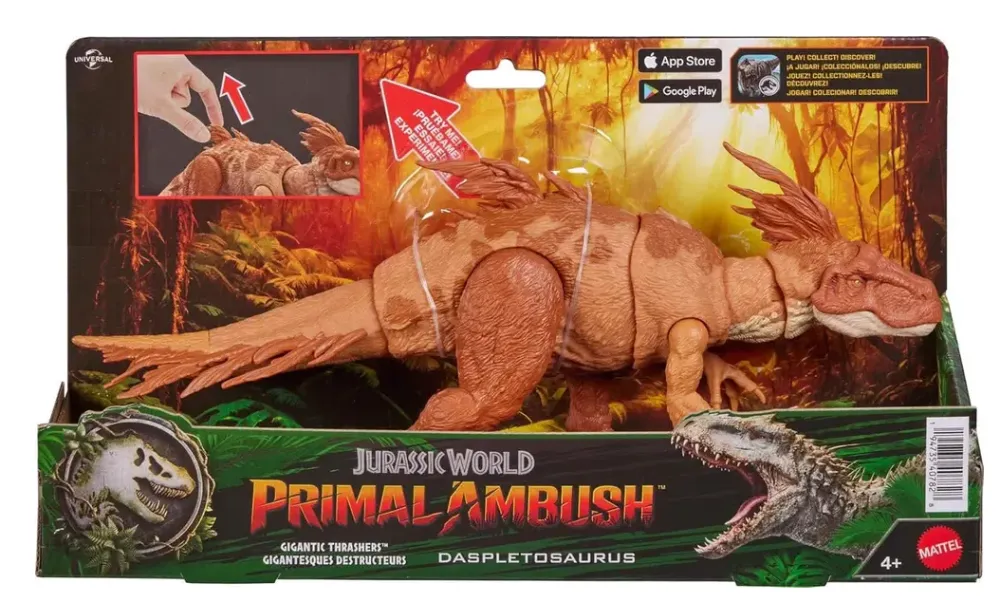
This is one of the strangest tyrannosaurs Mattel has made, and in hand it is simply amazing. The box says Daspletosaurus, the brawny cousin of T. rex, but the figure has three fingers on each hand, a wispy feather crest and plumage sprouting from its back and tail, so it looks more like an early, lightly built tyrannosaur relative. Accuracy aside, it is a showstopper: a crouched, feathered hunter with lips, a mouth that opens incredibly wide, rich earthy colours and an action feature that keeps surprising you. It is one of the most fun and distinctive big predators in the whole line.
⭐ New species for the Mattel line🪶 Feathered tyrannosaur💥 Rearing and turning strike📏 ~35 cm / 13.75 inGigantic Thrashers · Wave 1DNA scan code included
🦴 Is It Really a Daspletosaurus?
Many collectors think this sculpt started life as an Eotyrannus, a small early tyrannosaur relative from the Isle of Wight, before getting a new name on the box. That cannot be confirmed, but the figure does line up with Eotyrannus on more points than with the animal on the label.
As a Daspletosaurus it is not even close. The three-fingered hands are the giveaway, and they will bother anyone who knows their tyrannosaurs. As a feathered tyrannosaur of no particular species, it is a fresh look for the line.
Out of the Gigantic Thrashers Box
Gigantic Thrashers is the large-figure assortment of Primal Ambush, and wave 1 pairs this tyrannosaur with the club-tailed Shunosaurus. The box is the familiar Gigantic Thrashers design, just bigger than the standard figures. The back shows the figure, a few panels on its action feature and the Shunosaurus as its wave mate.
It is ready to play straight out of the tray, with nothing to assemble.
Colours & Paint
Head and most of the body
Top of the head, back and scattered patches
Lower jaw and throat
Legs, head crest and tufts on back and tail
Eyes with black pupils, and the teeth
Glossy tongue and mouth
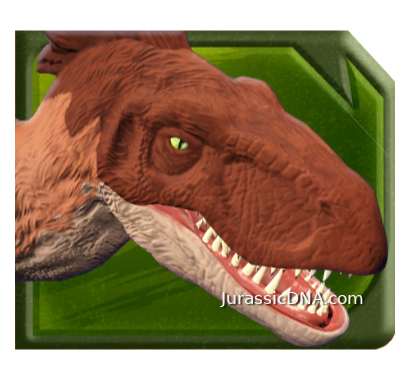
The scheme is warm and earthy. The head is an orange brown, darker on top, with a light tan lower jaw that runs down the throat and breaks up into the brown before it reaches the chest. The eye is yellow with a proper black pupil, which is always good to see. Inside, the tongue and the whole mouth are a glossy dark pink. The teeth and gums are one piece of yellowish plastic, so a pale line shows all the way round the gum, which looks a little artificial.
The body is a lighter orange brown, with darker patches on the back and scattered over the flanks. The legs, the head crest and the feather tufts on the back and tail are a slightly different brown, so there is colour variation from snout to tail tip. The patches are not identical on both sides, which feels natural rather than careless.
The claws on the hands are bare plastic with no gloss at all, while the foot claws at least get a gloss coat. Painted claws and more of the light tan along the belly would have lifted the figure further.
Sculpt Breakdown
Head, lips and crest
The most modern touch is the lips, which cover the teeth when the mouth is shut, as many palaeontologists now think tyrannosaurs did. The jawline has an odd, wavy curve to it, but the face is detailed and even carries sculpted cuts and scars below the nostril. Both the upper and lower jaw are hinged, so the mouth opens very wide, and the long teeth are made of soft plastic that looks sharp without being sharp.
A tall crest of wispy, soft rubbery feathers sweeps back from the top of the head. Feathers begin again at the back of the lower jaw and flow down the neck, mixing with patches of bare skin.
Plumage, legs and tail
Most of the body is covered in fine, wavy feathers that lie flat, a bit like an emu, growing slightly thicker in places. Extra tufts stand up in odd spots on the back and stick out from the sides of the tail, sculpted the same way as the head crest. They look strange but give the figure an unmistakable outline, a little like the feathered Hypsilophodon from an earlier Mattel line.
The arms are muscular and feathered, with a few feathers trailing from the elbow. The hands are unlike any other recent Mattel hand, with scutes along the fingers and long, soft claws, though the wrists face downward. On the legs there are a few bony bumps hidden among the thigh feathers, then a clear kneecap and calf, before the feathers give way to scales at the ankle. The toes have scutes and there is a sculpted dewclaw.
The pose is low and crouched, leaning toward the ground with the legs spread unusually wide for a Mattel figure. The tail, sadly, is too short.
Count the fingers
Action Feature & Articulation
✓ Upper and lower jaw✓ Two neck joints (turn right)✓ Arms forward and back✓ Legs forward and back✓ Tail up, down, side to side and swivel★ Rearing bite with a surprise turn✗ No ankle swivels✗ Feature can be fiddly
A joint across the middle of the body is the clue to the feature. Pull the upper body upward and the figure attacks in stages:
The sideways strike arrives when you least expect it, and that unpredictability is part of the fun. It uses the same system as the Shunosaurus from this wave, and it is a fresh idea from a line that keeps finding new tricks. It can be a little fiddly to get going, though.
The other joints are decent. The arms swing forward and back but not outward, the legs move forward and back without ankle swivels, and the tail moves up, down and side to side and swivels as well.
How Big Is the Gigantic Thrashers Daspletosaurus?
Oddly, the highest point of the figure is not its head but the feather tufts on its back. It sits squarely in the usual Gigantic Thrashers size range. The Wild Roar Sinraptor from the same line is a little smaller, mostly in length, and the earlier Gigantic Trackers Chilantaisaurus stands a bit taller. Its wave mate, the Shunosaurus, is almost exactly the same size, which makes the pair a natural match-up.
Next to an older Mattel Tarbosaurus the two tyrannosaurs could hardly look more different, a good sign of how far the line’s styling has moved. A real Daspletosaurus reached about 8.5 to 9 metres, so the figure works out at very roughly 1:25.
Final Verdict
Yes, the name on the box is a stretch. The three-fingered hands and heavy plumage point to an early tyrannosaur relative rather than the brawny Daspletosaurus, and purists will notice. But this is a figure you judge in hand, and in hand it is fantastic.
The lips are a modern touch, the double-hinged jaw opens impressively wide, and the feather work and unusual hands give it a look unlike any other Mattel tyrannosaur. The paint covers the figure from snout to tail with real variation, the eyes have proper black pupils, and the action feature, with its rearing bite and sudden sideways snap, keeps every play session unpredictable. It is big, characterful and a joy to pick up.
The small faults are easy to forgive: bare hand claws, a visible gum line, a short tail and a feature that can be fiddly to start. None of them stop this from being one of the standout figures of Primal Ambush and a must-have for any tyrannosaur fan.
✦ The Good
- Distinctive feathered look, no mutations
- Lips and a double-hinged, wide-opening jaw
- Inventive rearing and turning strike
- Paint variation from snout to tail
- Yellow eyes with black pupils
✦ The Not So Good
- Does not look like a Daspletosaurus
- Three fingers instead of two
- Short tail
- Bare hand claws and a visible gum line
- Feature can be fiddly
Meet the Real Daspletosaurus
A heavyweight tyrannosaur that ruled western North America several million years before T. rex appeared, and may even sit on the line of its ancestors.Why this species is worth knowing
The name. Charles Sternberg found the first skeleton near Steveville, Alberta, in 1921 and thought it was a new Gorgosaurus. Dale Russell described it properly in 1970 as Daspletosaurus torosus. Daspletosaurus means frightful lizard, and torosus is Latin for muscular or brawny.
Where and when. It lived on Laramidia, the western landmass of North America, between about 79 and 74 million years ago. D. torosus comes from Alberta, a later species, D. horneri, named in 2017, from Montana, and a third, D. wilsoni, was proposed in 2022 as a step between them. Some researchers think this chain of species led toward Tyrannosaurus itself.
Built for power. Adults reached about 8.5 to 9 metres and 2 to 3 tonnes, with a heavily built skull over a metre long and around six dozen large teeth. The arms were tiny with just two fingers, although proportionally they were the longest of any tyrannosaurid.
Skin and lips. A skin impression shows small scales a few millimetres across, and a 2017 study of D. horneri suggested large flat scales and a sensitive snout. A 2023 study of tooth wear concluded that tyrannosaurs like Daspletosaurus probably had lips covering their teeth, just as the figure does.
Life at the top. It probably hunted large plant-eaters such as Centrosaurus and Hypacrosaurus, and in some places shared its world with the lighter Gorgosaurus. A bonebed in Montana with three Daspletosaurus of different ages feeding on hadrosaurs hints that they may have gathered in groups.
Unlock the Daspletosaurus
How to unlock Daspletosaurus from Primal Ambush?
The DNA scan code is printed on the Daspletosaurus figure. Scan it with the Jurassic World Play App to add the Primal Ambush Daspletosaurus to your digital collection.
New figures sometimes reach shops before the app is updated, and then the code will not scan yet. If that happens, update the app and try again a little later. If the code on your figure has worn off or is hard to read, scan the copy on this page straight from your screen.
Daspletosaurus Gallery
Daspletosaurus FAQ
Mattel has not explained it. The real Daspletosaurus had two fingers on each hand, like T. rex. Three-fingered hands are typical of earlier tyrannosaur relatives such as Eotyrannus, which is why many collectors believe the sculpt was designed as one of them.
It is about 13.75 inches (35 cm) long and about 6 inches (just over 15 cm) tall at the feathers on its back, almost the same size as the Gigantic Thrashers Shunosaurus.
Pull the upper body upward and the neck and chest rear up as the jaws open. Every few pulls the head also snaps sharply to the right, so the attack changes as you play.
Probably not much. A skin impression of Daspletosaurus shows small scales, and big tyrannosaurs seem to have been mostly scaly. Feathers are much more likely on smaller, earlier relatives, so the figure’s plumage is a creative choice.
Daspletosaurus means frightful lizard. The first species, D. torosus, takes its second name from the Latin for muscular or brawny.
Open the Jurassic World Play App, tap Scan and point your camera at the DNA code printed on the figure, or at the copy on this page.