Home › Jurassic World Survival › Pachycephalosaurus Frenzy Pack
Frenzy Pack Review
Pachycephalosaurus Frenzy Pack
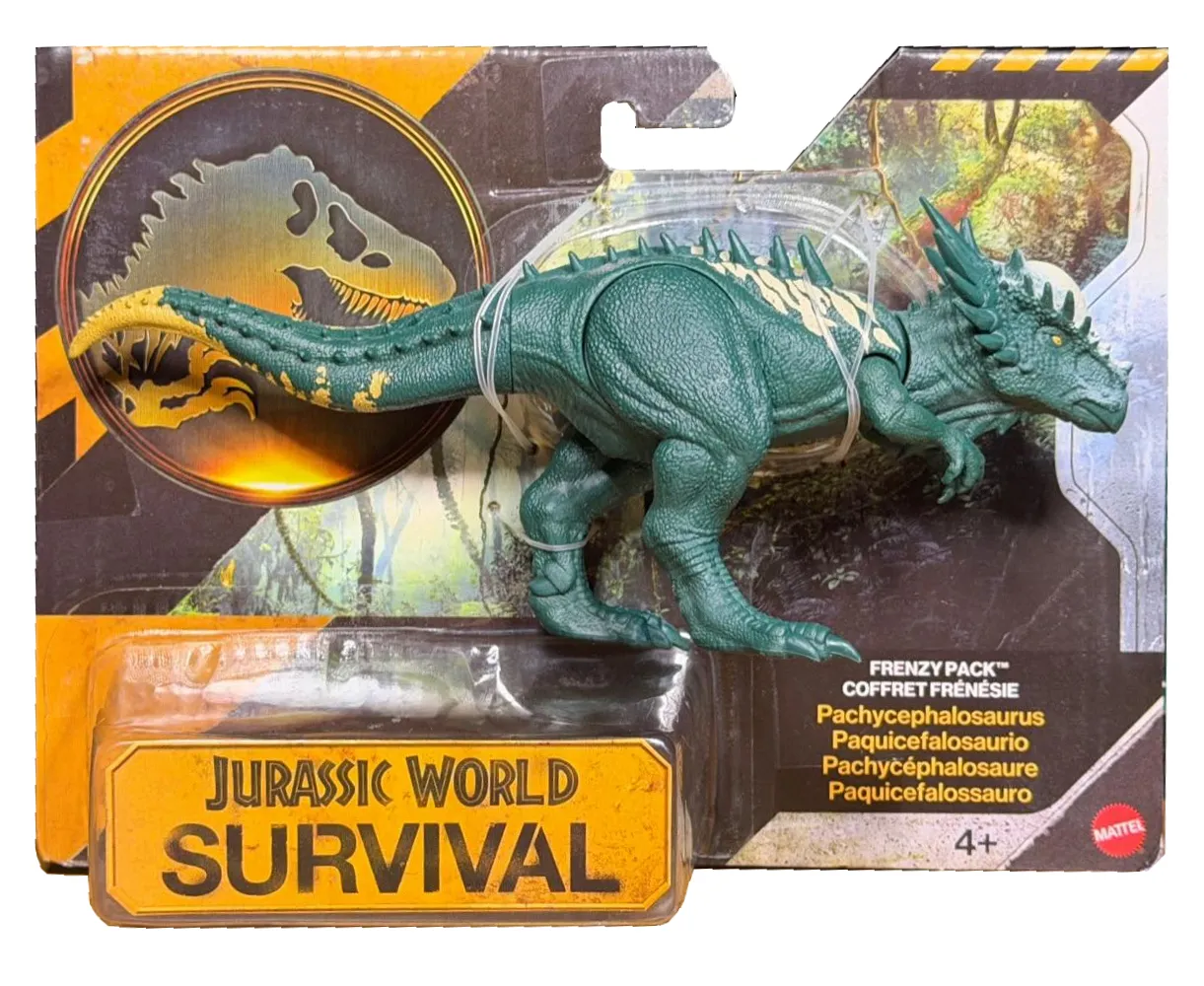
Every dinosaur toy carries an unspoken promise, and a Pachycephalosaurus makes only one: it lowers that reinforced skull, picks a target and runs at it. The figure that closes out the Survival assortment has one of the best sculpts in the whole line — and it cannot quite keep that promise.
🎨 Frenzy Pack sub-line📏 ~18.5 cm / 7.25 in🧸 6 articulation pointsMattel · 2026Scan code included
🧠 The Ram Test
Sculpt quality, paint coverage and box art all matter, but for this particular animal there is a test that comes before all of them, and it is one most toy companies quietly fail. Before we talk about scales, spikes or colour: did Mattel build a dome-head that can actually use its dome? A charging pose needs four things.
Three out of four is not a disaster, but the one that fails is the one that counts. A single swivel behind the skull — the kind of joint Mattel has been putting in dinosaur necks for years — would have turned a decent shelf piece into a figure that tells a story on its own.
What Is Frenzy Pack?
Frenzy Pack is one of several sub-lines inside Jurassic World Survival, alongside Wild Roar, Strike Attack, Gigantic Thrashers and the rest. It is the smaller, simpler tier — no sounds, no lights, no spring-loaded gimmick — so a figure stands or falls on its sculpt, its paint and its joints.
This one arrived in the closing assortment, which makes it comfortably the hardest figure in the range to find on a peg. Other Frenzy Pack releases on the site include Champsosaurus, Rhamphorhynchus and Scelidosaurus.
Paint & Colour Scheme
Body, limbs & tail
Back, flanks & shoulders
Dome & crown
Rear third of the tail
No painted pupil
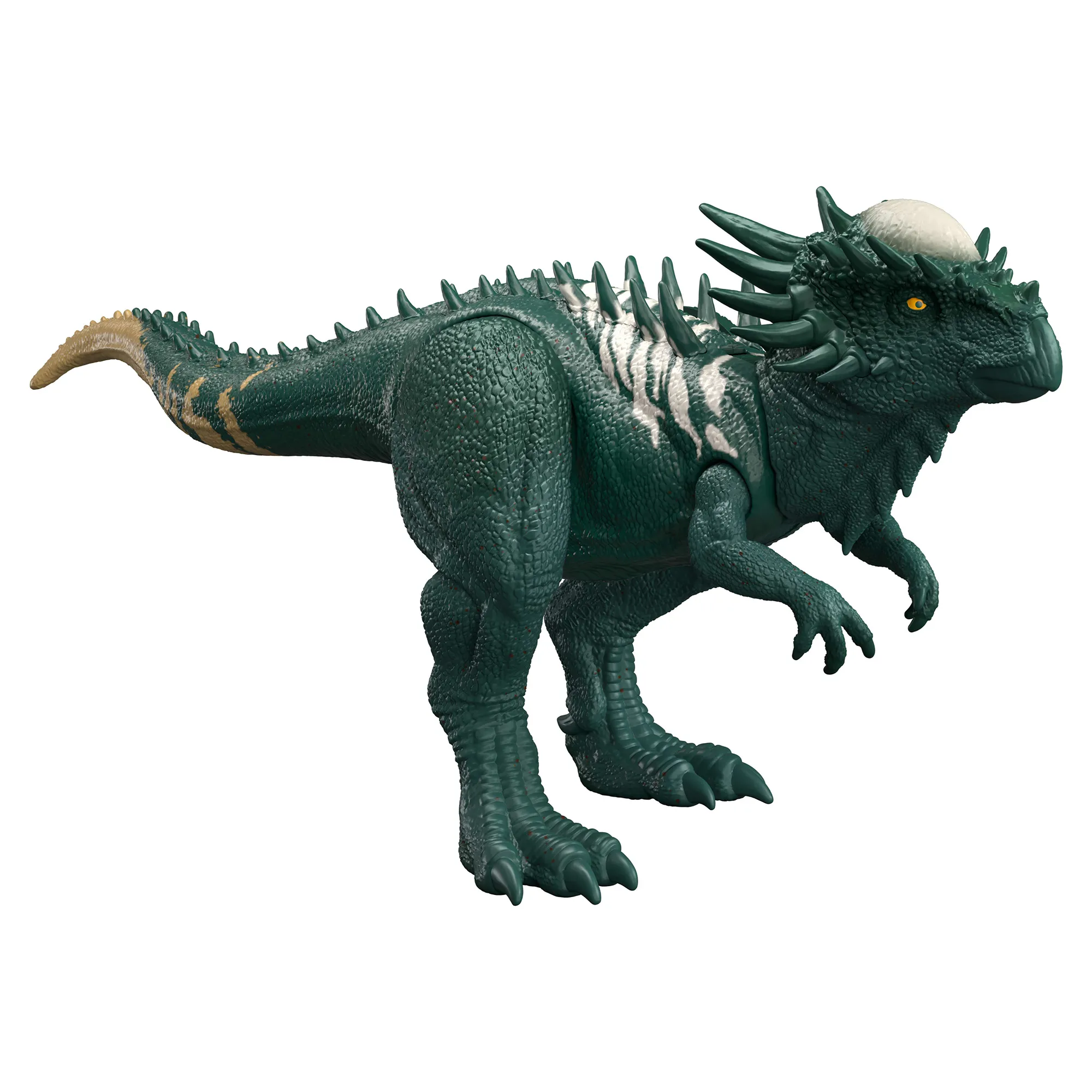
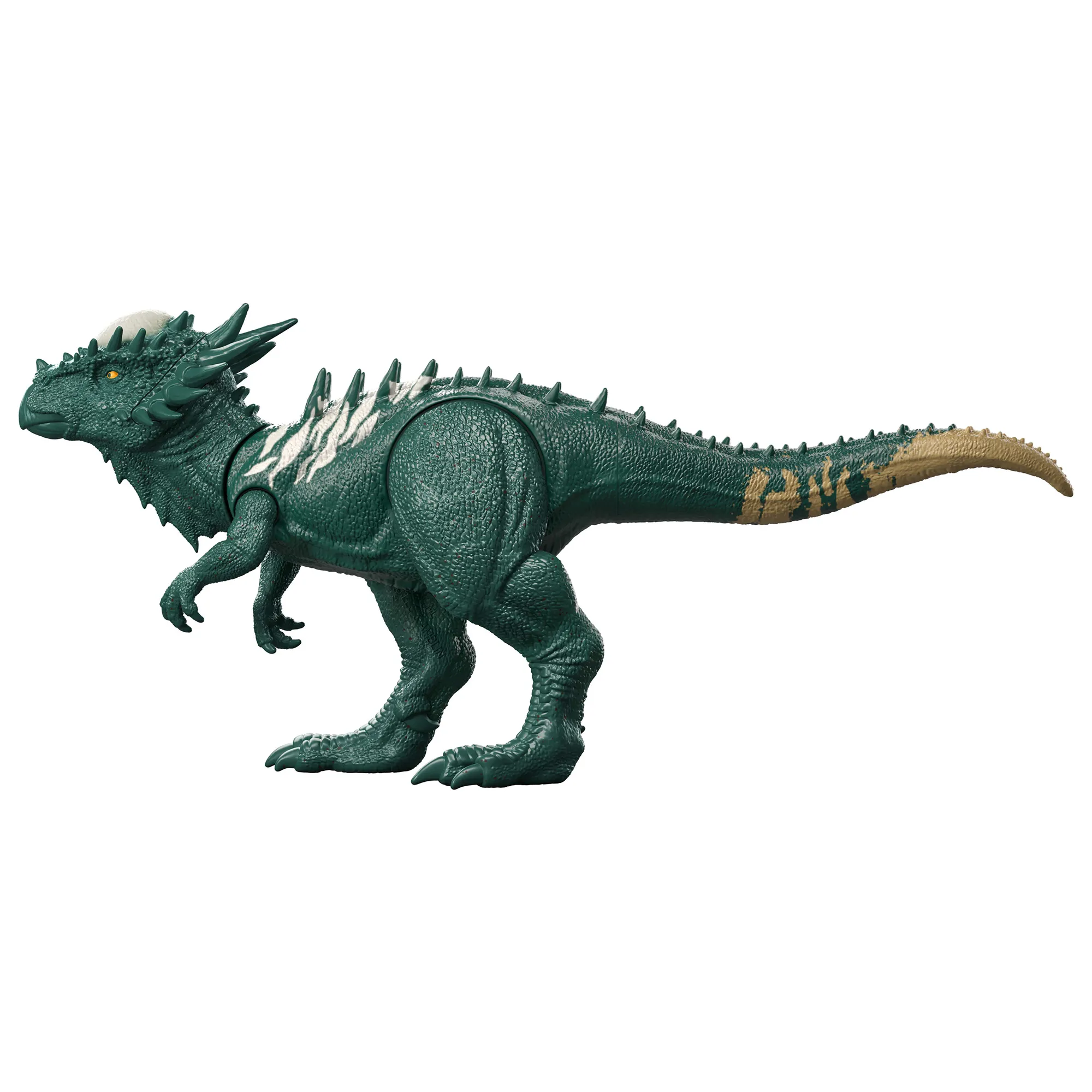
The base coat is a deep, slightly cool green — the kind of tone you associate with pine needles more than with reptiles. Over the top of the head, and concentrated across the dome, sits a paler wash that brightens as it reaches the crown, which does a good job of drawing the eye to the animal’s most important feature.
A second light tone patterns across the back from roughly the shoulder line to just short of the hips, spilling down the flanks and toward the arms. Then the application simply stops. The middle and rear of the body are left as unbroken base green until the tail, where a yellow creeps up from the underside and takes over the final third, finishing at the very tip.
The eyes get a yellow application with no separate black pupil. Normally that is a problem, but here the dark green around the socket shows through the centre and does the work of a pupil by accident — it holds up at arm’s length. The claws, despite their excellent sculpted shape, are left entirely unpainted.
The Sculpt
The head
Set the articulation aside and the tooling here is some of the most confident work in the line, and the head rewards close inspection more than anything else on the figure. Mattel has layered several different surface treatments across a fairly small area: fine standard scaling over most of the face, raised bumpy osteoderms climbing toward the brow, and then the spiked crown that erupts across the top of the skull and rings the dome itself.
Down at the front, the beak carries crisp definition rather than the soft rounded shape these smaller figures usually get. Underneath the jaw there is loose, sagging throat skin with its own crop of small spikes pushing through, and the wrinkling continues into folds just behind the lower jaw where the neck begins. These are the details that normally get sanded away at this price point.
Spines, bulk and tail
Running from the base of the skull all the way to the tail tip are two rows of spines flanking the spine, largest across the shoulders and upper back before tapering down the tail. The body carries visible bulk, with real muscle mass through the chest and thighs — whatever you make of the mutated design direction, the figure reads as physically powerful in a way a conventional Pachycephalosaurus usually does not.
The tail is the quiet highlight. Rather than the straight rubber sausage these figures often get, this one sweeps into an elegant curve that gives the whole silhouette movement even when the legs are locked in a neutral stance.
Softer limbs, sharper claws
Articulation
✓ Neck — raises and lowers✓ Left arm✓ Right arm✓ Left leg✓ Right leg✓ Tail swivel★ Soft-material limbs (slight flex)✗ Skull tilt✗ Arms do not swing outward✗ No action feature
Six functional points is respectable for the size class, and having both arms and both legs move independently is more than several figures in this same wave manage. The limitation is in the type of movement rather than the count: everything hinges on a single forward-and-back axis, so the figure can walk and lean but cannot twist, reach sideways or angle its head. The tail swivel adds a little life, and the softer limb material lets you nudge a leg slightly out of plane, but that is flex rather than real articulation.
On most figures a fixed head is a minor annoyance. On this species it removes the animal’s entire identity. The dome is not decoration, it is the whole point, and a dome that cannot be pointed is just a lumpy hat. That is the difference between a toy a child poses and a toy a child stands on a shelf.
Size & Specs
Against a standard Velociraptor the two occupy essentially the same footprint, but the Pachycephalosaurus sits lower and broader — where the raptor stands tall and narrow, this one hugs the ground, which reads correctly for the animal and makes the pair look good together rather than redundant. Against the Hammond Collection release it is very close on overall size, with the Hammond version appearing slightly taller mainly because of how it is posed. If you already own that one, this is a stylistic alternative rather than an upgrade or a downgrade.
Verdict: 3.6 / 5
This is the sculptor’s figure of the wave and the painter’s disappointment of the wave, in one box. The tooling is dense, confident and full of small decisions that did not have to be made at this price, and the move to softer limb material produces the sharpest, most convincing claws Mattel has managed on a basic figure in some time.
What holds it back is the gap between what the sculpt sets up and what the rest of the figure delivers. Paint stops halfway down the body, the best colour on the palette appears only on the tail, and the fixed skull takes the one pose this animal is defined by off the table entirely. It is a fun figure. It came very close to being a memorable one.
One group should stop reading and just buy it: anyone who repaints. The sculpt carries far more information than the factory paint acknowledges — the scale variation, the osteoderm clusters, the spike bases, the throat folds, the foot scutes are barely picked out at all. A dark wash and a light drybrush would transform it in an evening, and those large flat green areas along the flanks and tail give a full repaint unusually generous canvas.
✦ What Works
- Outstanding head sculpt with layered scale, osteoderm and spike detail
- Soft-moulded limbs allow genuinely sharp, realistic claws and toes
- Powerful, bulky build that gives the animal real presence
- Elegantly curved tail adds movement to the silhouette
- Recognisable as its species despite the heavy restyling
- Six independent points of articulation, good for the size class
- An exceptional base for anyone who repaints
✦ What Doesn't
- No skull joint, so a proper ramming pose is impossible
- Paint coverage thins out badly through the mid body
- The best colour on the figure appears only at the tail tip
- Claws left unpainted despite excellent sculpting
- Poor balance, tips over unless carefully crouched
- Arms cannot swing outward from the body
- Genuinely difficult to find at retail
About the Pachycephalosaurus
Pachycephalosaurus wyomingensis was among the last dinosaurs standing. It walked the floodplains of western North America in the final stretch of the Late Cretaceous, roughly 70 to 66 million years ago, sharing the Hell Creek and Lance environments with Tyrannosaurus and Triceratops right up to the asteroid impact.
At somewhere around 4.5 metres long it was the largest known member of its family, but the measurement everyone remembers is the roof of its skull, which thickened into a solid bony dome up to about 25 centimetres deep, ringed with knobs and short spikes. It walked on two legs, balanced by a stiffened tail, and its small leaf-shaped teeth suggest a mixed diet of soft plants and possibly insects or other small fare.
Did they really headbutt? This has been argued over for decades. Early sceptics pointed out that the dome’s internal structure and the neck’s geometry looked poorly suited to absorbing direct frontal impacts, and suggested the whole structure was built for display — perhaps even covered in keratin bristles rather than presented as bare bone. The counter-evidence arrived through injury records: surveys of pachycephalosaur skulls found lesions and healed damage concentrated on the domes at rates far higher than in comparable dinosaur skulls, which is difficult to explain unless those domes were being struck. The consensus now leans toward genuine combat, though flank-butting and shoving contests may have been more common than the head-on collisions of popular imagination.
The identity puzzle. Two other named dinosaurs, Dracorex and Stygimoloch, have been argued to be nothing more than juvenile and subadult stages of Pachycephalosaurus itself, with the flat spiky skull of the youngster gradually remodelling into the tall smooth dome of the adult. Not everyone accepts this, and it remains genuinely contested — but if it holds, three famous dinosaurs collapse into one animal growing up.
How to Unlock It
How do you unlock the Pachycephalosaurus Frenzy Pack in the Jurassic World Survival collection?
The code is printed on the underside of the figure, in the usual position on the belly between the legs. Open up your Jurassic World Play App (previously known as the Jurassic World Facts App), press the Scan button and point it towards the DNA code here:
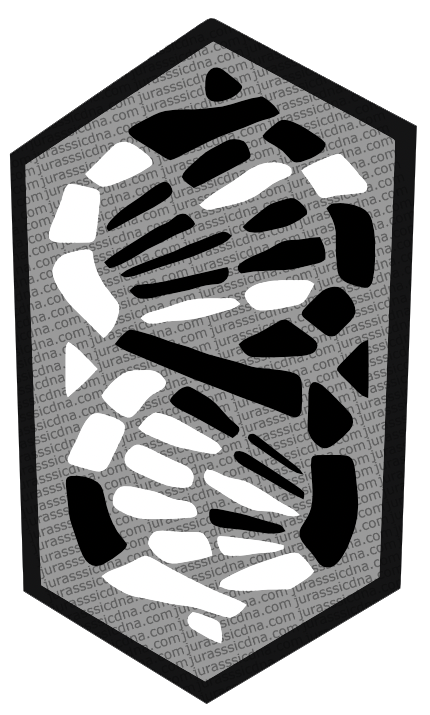
Photo Gallery
Frequently Asked Questions
Yes. The code is printed on the underside of the figure, in the usual place on the belly between the legs. Scanning it unlocks the creature in the Jurassic World Play App. If the printed code on your figure is smudged or worn, scan the copy in the unlock section above instead.
It measures a shade over 7.25 inches (roughly 18.5 cm) from snout to tail tip, stands about 2.75 inches (7 cm) to the top of the hip, and reaches roughly 3.25 inches (8.3 cm) to the top of the head in a natural stance. That puts it squarely in Mattel’s basic size class, alongside figures like the standard Velociraptor.
Not convincingly. The neck raises and lowers, but there is no separate joint where the skull meets the neck, so the dome never tilts forward to point at a target. You can get the body into a charging lean, but the head stays looking ahead rather than down at whatever it is supposed to be hitting.
No. There is no button, lever or spring-loaded gimmick on this one. Everything it does, it does through plain articulation, which is part of why the missing skull joint is felt so strongly.
It arrived in the closing wave of the Survival assortment, which shipped in smaller quantities than the launch waves and was thinly distributed. Case packs carrying it turned up rarely at general retail, so most collectors ended up tracking it down through online sellers rather than finding it on a peg — budget accordingly and expect to pay a premium over sticker price.
It is one of the best bases in the line. The sculpt carries far more surface detail than the factory paint acknowledges, so almost any wash, drybrush or full repaint will bring out texture that is already moulded in. The large unbroken green areas across the flanks and tail give you plenty of room to work, and painting the claws alone makes a visible difference.
They are very close in overall size, with the Hammond release looking marginally taller depending on how it is posed. The two are not really competing: the Hammond version aims at a grounded, film-accurate look while this one is a deliberately exaggerated reinterpretation. Owning both is not redundant.