
Home › Jurassic World Rebirth › Ankylosaurus Wild Roar
Wild Roar Review
Ankylosaurus Wild Roar
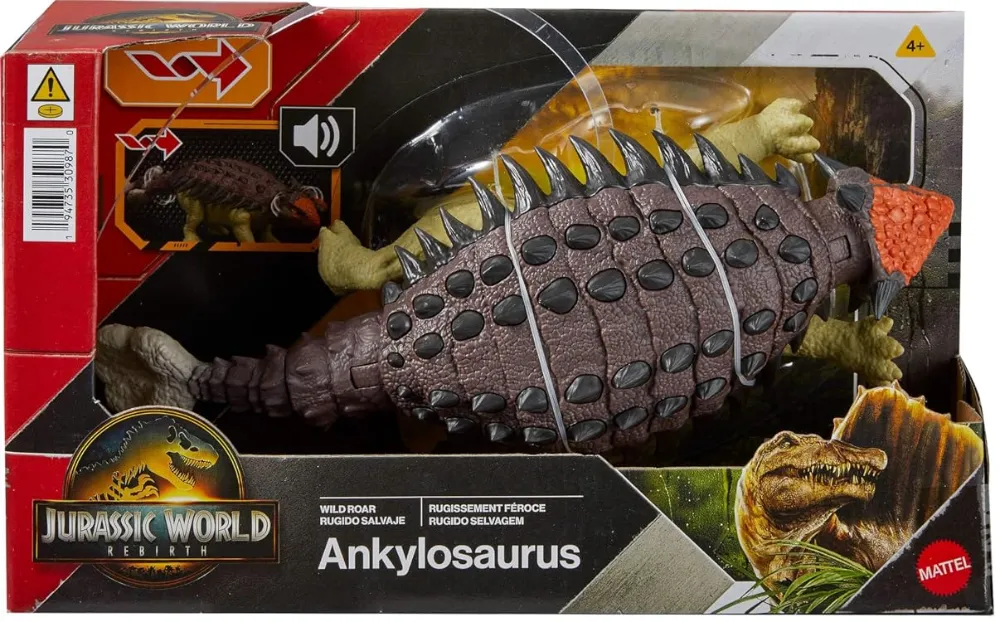
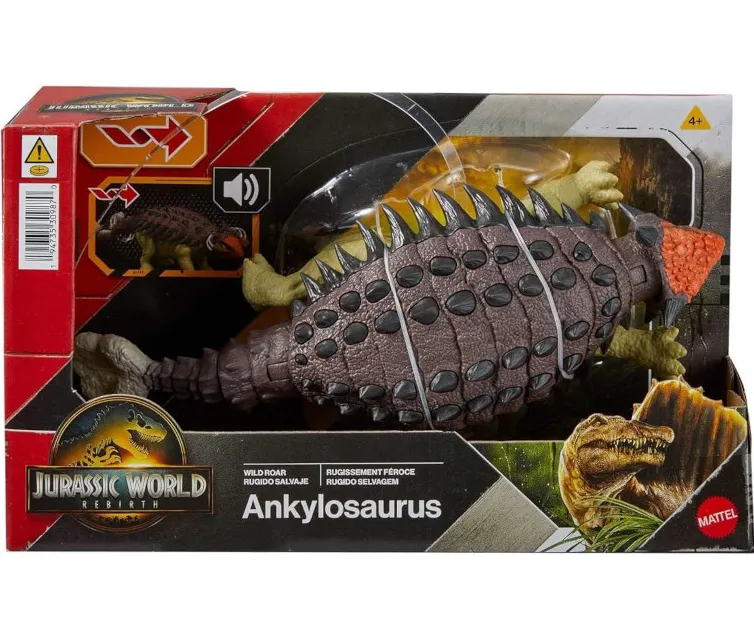
Mattel has made so many Ankylosaurus figures over the years that we fully expected this one to be the filler of the Rebirth Wild Roar wave. It turned out to be one of the strongest figures in it. The body is chunkier than any Wild Roar Ankylosaurus before it, the orange and brown paint looks far better in person than any photo suggests, and almost every armour plate, spike and leg is covered in fine detail. It looks and feels massive in the hand, and it more than justifies the purchase.
⭐ Chunkier updated sculpt🎨 Painted head to tail🛡️ Soft, toe friendly spikes💥 Head butt attack + roarMattel · 2025Scan code included
🛡️ Dominion vs Rebirth Head-to-Head
The obvious figure to measure this one against is the Dominion Roar Strikers Ankylosaurus from 2022. It was a perfectly fine dinosaur, but it looked like most of the releases before it and nothing about it stood out. The head spikes were unpainted, the beak was bare and the tail club had no colour of its own. The Rebirth version fixes nearly every one of those complaints.
Side by side, the difference is mostly paint and bulk. The Dominion figure reads as a generic armoured dinosaur. The Rebirth figure has a face you notice first, a body that looks heavy enough to be an Ankylosaurus, and a club that actually looks like a weapon.
What Is Wild Roar?
Wild Roar is Mattel’s mid-size format: figures larger than Strike Attack, with posable legs, a sound effect and an attack you control through the tail. Move the tail up and down and the figure performs its species specific attack with a roar. Twist the tail and the direction of the attack changes, so the same move can come from above or from the side.
For an Ankylosaurus that attack is a head butt, which is a fun twist on an animal best known for its tail club. Other Rebirth Wild Roar figures reviewed on the site include the Baryonyx, the Maiasaura and the Nasutoceratops.
Paint & Colour Scheme
Head armour
Back, flanks & tail
Spikes & osteoderms
Belly & legs
Tail club
Eye
The paint is the reason this figure works, and it looks so much better in person than online. A warm orange red covers the armoured top of the head and face, then breaks up just below the eye into a rich chocolate brown that carries across the back, the flanks and down the tail. On paper orange and brown sounds like an odd pairing for an Ankylosaurus. On the shelf it looks completely right.
The spikes and the raised osteoderms are picked out in a dark charcoal, so every row of armour reads clearly instead of disappearing into the base colour. Underneath, the belly and legs switch to a pale sage tone, which gives the figure real depth when you look at it from the side. At the far end, the tail club is lighter than the tail itself, so the animal’s signature weapon actually stands out for once.
This is one of the most fully painted Ankylosaurus figures Mattel has produced. It is not perfect, but the misses are small.
Sculpt & Detail
A chunkier, heavier body
Out of the box it is clear this Ankylosaurus borrows some parts from earlier releases, but the body is noticeably chunkier and more imposing. The silhouette is wider and meatier, closer to the low, tank-like animal it is meant to be, and it feels heavier in the hand than its footprint suggests.
Like most of the Rebirth line, the sculpt is a step up from the versions before it. The tiny details are everywhere, on the head, the armour, the spikes, the tail and even the legs, and they make play with it feel a lot more immersive.
Armour you can count
The head is a highlight. The nostrils are cleanly sculpted, the scales are large and well defined, and the heavy plating over the skull looks properly formidable. The beak is sculpted in a closed position and shaped convincingly.
Moving back, the rows of armour and spikes that run the length of the back are crisp from end to end, the kind of surface that would come alive even more with a dark wash. The spikes along the sides are painted individually. The legs get the same attention, with thighs, calves, knees, ankles and feet all clearly sculpted, which is more than most quadrupeds in this price range receive.
Spikes that spare your feet
Articulation & Action Feature
✓ Front legs, forward, back and outward✓ Rear legs, forward and back★ Tail up and down, head butt★ Twist tail, side to side attack✓ Extra tail swivel✓ Loud, clear roar✗ Rear legs a little jerky✗ Slight ankle tilt on one foot
All four legs move freely. The front legs swing forward and back and can also kick outward from the body, which helps the figure settle into a wide, braced stance. The rear legs move forward and back, though the joints are a touch jerky rather than smooth, and one ankle on our figure sits with a slight tilt.
The action feature is the standard Wild Roar setup, with the head and tail linked. Move the tail up and down and the head drives forward in a head butt while the roar plays. Twist the tail and the attack switches to a side to side swing. Push the head and the tail club swings, so it works in both directions. A second swivel further along the tail adds a little extra posing freedom. The roar is loud, clear and more defined than on older Wild Roar figures.
Size & Specs
At about 9.6 inches long and just over 3 inches tall, the footprint is in line with every Wild Roar Ankylosaurus that came before it. What changes is the bulk. The wider body and heavier legs make this one look bigger than its measurements suggest, and on the shelf it holds its own next to the other Wild Roar figures in the wave.
For an animal that reached 6 to 8 metres, that works out at roughly 1:30 scale, which is about right for the line. It will not dwarf your theropods, but it no longer looks like the small armoured sidekick of earlier waves either.
Our Verdict
We have owned a lot of Mattel Ankylosaurus figures, and this is the first in a while that genuinely surprised us. The orange and brown colour scheme is distinctive, the chunkier sculpt looks more imposing than anything before it, and full paint from the head to the tail club at this price is something the Dominion version never delivered.
The misses are small. There is no black pupil, the claws are bare, the colour change into the tail is abrupt on one side and the rear leg joints could be smoother. The soft spikes are a quiet bonus for anyone who has ever stepped on an Ankylosaurus in the dark.
If you already have a shelf of Ankylosaurus figures, this is still the one worth adding. If you only want one, make it this one.
✦ What Works
- Distinctive orange and brown colour scheme
- Painted from the head all the way to the tail club
- Dark painted spikes and osteoderms make the armour read clearly
- Chunkier, more imposing body sculpt
- Lighter tail club that finally stands out
- Crisp armour and scale detail from head to feet
- Fun head butt attack that changes direction
- Soft spikes that will not hurt bare feet
✦ What Doesn't
- No black pupil in the yellow eyes
- Claws left unpainted
- Abrupt colour change into the tail on one side
- Rear leg joints a little jerky
- Slight ankle tilt on one foot
About the Ankylosaurus
Low, wide and armoured almost everywhere, with a club on the tail heavy enough to break bone. Ankylosaurus is the reason people call armoured dinosaurs living tanks.Why the figure needs that bulk
Where and when. Ankylosaurus magniventris lived in western North America at the very end of the Cretaceous, about 70 to 66 million years ago. Its fossils come from rock formations such as Hell Creek and Lance in the United States and Scollard in Canada, which means it shared its world with Tyrannosaurus, Triceratops and Edmontosaurus.
The name. Ankylosaurus means “fused lizard”, a reference to the armour plates fused to its skull and body. The species name magniventris means “great belly”. It was named by Barnum Brown in 1908.
Built like a tank. Estimates put it at around 6 to 8 metres long and roughly 4.8 to 8 tonnes, making it one of the largest armoured dinosaurs ever found. Its body was covered in bony plates called osteoderms, including half rings of armour over the neck, and even the area above its eyes carried protective bone.
The club. The tail ended in a large bony club. It was probably used to defend against predators and may also have been swung in fights between rival Ankylosaurus.
What it ate. It had a broad beak at the front of its mouth and small, leaf shaped teeth behind it, ideal for cropping low plants. Inside the skull, looping nasal passages may have helped it manage heat and water or shape its calls.
Surprisingly rare. For such a famous dinosaur, very little of it has been found. There are only a handful of partial skeletons and no complete one, so every reconstruction, including Mattel’s, fills in some gaps from its close relatives.
Unlock the Ankylosaurus
Code worn off the foot?
The DNA scan code for Rebirth Wild Roar figures is printed on the foot. Scan it with the Jurassic World Play App to add the Ankylosaurus to your digital collection.
If the code on your figure has been rubbed away by play, scratched or covered by a sticker, scan the copy below straight from your screen. That is exactly what JurassicDNA is for: the complete free scan code database is right here, with no sign-up and no paywall.

Ankylosaurus Gallery

Ankylosaurus FAQ
It is about 9.6 inches (around 24.5 cm) long and just over 3 inches (about 8.5 cm) tall. That is the usual Wild Roar footprint, but the chunkier body makes it look bigger than earlier Wild Roar Ankylosaurus figures.
Partly. It reuses some parts from earlier releases, but the body is noticeably chunkier and more detailed, so it looks and feels like a different, more imposing figure.
Move the tail up and down and the head performs a head butt while the figure roars. Twist the tail and the attack changes to a side to side swing. The head and tail are linked, so pushing the head swings the tail club too.
It is a clear upgrade. The Dominion Roar Strikers version had unpainted head spikes, a bare beak and no separate colour on the tail club. The Rebirth figure is painted from head to tail, has dark painted spikes, a lighter club and a chunkier body.
No. The spikes and armour plates look sharp but are soft to the touch, so this figure is much kinder to bare feet than older Ankylosaurus toys.
Mattel prints the code on the foot of Rebirth Wild Roar figures. Scan it with the Jurassic World Play App. If the code on yours is worn or hard to read, you can scan the copy on this page straight from your screen.
Yes. Ankylosaurus magniventris lived in western North America about 70 to 66 million years ago, alongside Tyrannosaurus and Triceratops. It reached roughly 6 to 8 metres long and was covered in bony armour, with a large club at the end of its tail.
Yes. We scored it 4.0 out of 5. It is arguably the best mainline Ankylosaurus Mattel has made, with only small misses such as unpainted claws and no black pupils.