
Home › Jurassic World Primal Ambush › Magnosaurus Frenzy Pack
Frenzy Pack Review
Magnosaurus Frenzy Pack
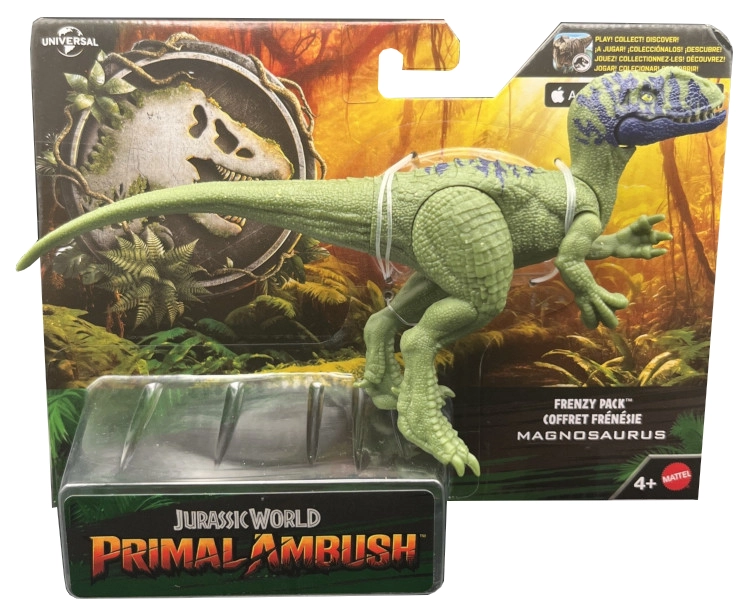
After a run of spiky, heavily mutated releases, the Primal Ambush Magnosaurus is a welcome surprise: a plain, honest theropod that looks like a dinosaur first and a toy second. It is the first Magnosaurus Mattel has ever made, an obscure Middle Jurassic predator from England, and the sculpt does it justice. The paint is another story. Most of the figure is a single dark green, and that holds back what could have been one of the standout Frenzy Packs of the wave.
⭐ First Mattel Magnosaurus🦖 No spikes, no mutations📏 ~21 cm / 8.25 inFrenzy Pack · Wave 1Product code JPG81Scan code included
🦴 How Does It Compare to the Real Magnosaurus?
This is Mattel’s first Magnosaurus, so there is no older figure to measure it against. The fairer test is the fossil record, and here Mattel had very little to work with: the only skeleton is a partial one, so most of the figure is educated guesswork.
With so little to go on, nobody can point at this figure and say it is wrong. What Mattel has done is build a believable mid-sized megalosaur: balanced proportions, a sensible head and no invented armour. That restraint is exactly why it works.
What Is a Frenzy Pack?
Frenzy Pack is the entry level assortment in Primal Ambush: small figures with simple joints, no electronics and no button-triggered feature. The Magnosaurus sits right where you would expect, in the same size class as Frenzy Packs, Danger Packs and Attack Packs from earlier lines, and about the size of a standard Mattel Velociraptor.
It shares the first Frenzy Pack wave with the Bagaceratops, the Thescelosaurus and a repainted Minqaria. Next to the wildly stylised Bagaceratops, it could hardly be more different.
Paint & Colour Scheme
Body, legs & tail
Lower jaw, face, neck & a stripe on the back
Sparse speckles on arms & legs
Eye, with dark blue pupil
Tongue
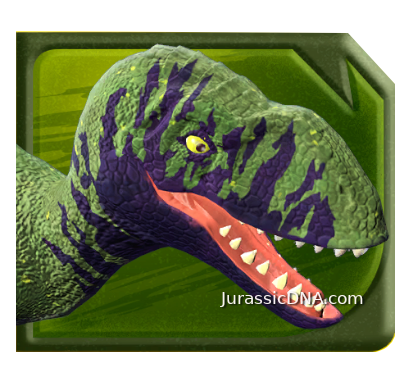
The paint is where this figure falls short. Almost everything is one fairly dark green. A blue band runs along the lower jaw, climbs up the side of the face and fades out partway down the neck, and a brief strip of the same blue appears along the back before ending just past the hips. A handful of yellow speckles are scattered over the arms and legs, but so sparsely that you have to look for them. The tail has no paint at all.
Inside the mouth, the tongue is pink with a nice glossy finish, but the pink stops there and does not carry up to the roof of the mouth. The teeth paint is sloppy, with white running over the gums. The eye is green with a dark blue pupil, which reads almost like black from a normal viewing distance, so it works better than it sounds.
Box art vs the figure in hand
The wave line-up on the back of the box shows a noticeably different Magnosaurus from the one inside. Whether that is an early prototype or a second colour variant is not yet clear, but honestly, the lighter green and red version on the card looks like the more interesting of the two.
Sculpt & Detail
A head with lips and a crocodile crown
The head is a strong start. The scales are crisp and lively, and they get larger along the lower jaw. On top of the skull the texture changes to something rougher and almost crocodilian, before settling back into a finer version of the facial scales down the back of the neck. The throat underneath is nicely detailed too.
The jaw opens to show individually sculpted teeth and a glossy tongue, and when it closes it shuts neatly behind sculpted lips, a modern touch that is good to see on a Mattel theropod. The one real flaw is a gap where the jaw hinges. It is visible whether the mouth is open or closed, and there is no angle that fully hides it.
Arms, body, legs and tail
The arms carry very fine scales on the upper part and larger, scute-like scales below the elbow, with good muscle definition throughout. The fingers have scutes as well, and there is extra material between them that makes the hands look almost webbed. Whether that is intentional or a moulding choice, it is an unusual detail. The claws are well sculpted but left unpainted, and the wrists face inward rather than palms down, which Mattel does not always get right.
Across the belly the skin stays crisp, with a faint hint of the rib cage. A row of larger, crocodile-like scutes follows the spine from the neck down the back and fades out about halfway along the tail. The thighs carry the same heavier scutes, then the texture becomes finer through the knee, shin and calf. The feet have scutes down the toes and sculpted dewclaws, again with no paint. The tail has a long, elegant curve that looks especially good from behind.
A breath of fresh air
Articulation
✓ Opening jaw✓ Neck, up and down✓ Arms, forward and back✓ Legs, forward and back✓ Tail swivel★ Wrists not pronated✗ Neck barely dips down
Articulation is standard Frenzy Pack fare. The jaw opens, the arms and legs swing forward and back, and the tail swivels. The neck moves up and down, though it only drops a little below its resting position. That lower limit happens to give a natural, level walking pose, and tilting the head up lets the Magnosaurus look skyward or call out. It is not a lot of movement, but it covers the basics for play.
Size & Specs
Nose to tail, the Magnosaurus measures just under 8.25 inches, stands about 3 inches at the hip and just under 3.5 inches to the top of the head. That is squarely Frenzy Pack size, in line with the Danger Packs and Attack Packs of earlier lines, and it stands almost exactly as tall as a standard Mattel Velociraptor.
The real animal was around 4 metres long, so the figure works out at roughly 1:19. That makes it a little large for a strict 1:30 shelf, but for a predator that was only modest in size it looks right among the other small theropods.
Our Verdict
The Magnosaurus is a lot of fun. It is the first time this species has made it into plastic, and Mattel resisted the urge to cover it in spikes or turn it into a mutant. The sculpt is crisp and detailed from the crocodile-textured skull to the curve of the tail, the head has lips, and the wrists are correct.
What holds it back is the paint. One dark green covers nearly everything, the blue markings stop at the neck, the yellow speckles are barely there, and the tail and claws get nothing. Add sloppy teeth paint and a visible gap at the jaw hinge, and it ends up looking flatter than the sculpt deserves, especially when the brighter version printed on the box looks so much better.
If you collect British dinosaurs or just want a straightforward theropod in the line, it is an easy pick. A wash or a repaint would turn it into something special.
✦ What Works
- First Mattel Magnosaurus
- A traditional theropod with no spikes or mutations
- Crisp, varied skin texture from head to tail
- Sculpted lips that close neatly over the teeth
- Glossy pink tongue
- Wrists not pronated
- Elegant tail curve
✦ What Doesn't
- Mostly one flat dark green
- No paint at all on the tail
- Sloppy paint on the teeth
- Visible gap at the jaw hinge
- Claws and dewclaws unpainted
- Neck barely tilts downward
About the Magnosaurus
An English predator that spent most of a century filed under Megalosaurus, and one of the oldest members of the group that later produced Allosaurus and T. rex.Why this species is worth knowing
Where and when. Magnosaurus nethercombensis lived in what is now southern England during the Middle Jurassic, in the Bajocian stage, about 175 million years ago. Its bones come from the Inferior Oolite near Nethercomb, north of Sherborne in Dorset.
The name. Magnosaurus simply means “large lizard”. The German palaeontologist Friedrich von Huene first described the fossils in 1923 as a new species of Megalosaurus, then gave them their own genus in 1932.
Known from very little. The only skeleton is partial and may belong to an animal that was not fully grown. It includes pieces of the lower jaws, vertebrae from the back and tail, parts of the hip, and natural casts of the thigh and shin bones. Everything else about its appearance, including the head, arms and skin, has to be reconstructed.
How big? One estimate gives a length of about 4 metres and a weight of around 175 kg. A more recent study suggests an animal of about half a tonne that stood over a metre tall at the hip.
An early megalosaur. A detailed restudy in 2010 placed Magnosaurus in the Megalosauridae, the family of Megalosaurus, and described it as the oldest certain tetanuran, the large group of theropods that includes most later meat-eating dinosaurs and, eventually, birds.
Unlock the Magnosaurus
How to Unlock the Primal Ambush Magnosaurus?
The DNA scan code is printed on the Magnosaurus figure. Scan it with the Jurassic World Play App to add the Magnosaurus to your digital collection.
If the code on your figure has worn away with play, been scratched or hidden by a sticker, scan the copy here straight from your screen.
Magnosaurus Gallery
Magnosaurus FAQ
Yes. Magnosaurus had never been made by Mattel before this Primal Ambush Frenzy Pack, product code JPG81. It is a brand new sculpt and a brand new species for the Jurassic World line.
It is just under 8.25 inches (about 21 cm) long, about 3 inches (7.5 cm) tall at the hip and just under 3.5 inches (9 cm) to the top of the head. That is standard Frenzy Pack size, about the same as a regular Mattel Velociraptor.
The wave picture on the back of the box shows a light green Magnosaurus with red markings, while the figure inside is dark green with blue markings in a different pattern. It may be an early prototype colour or a second variant, which has not been confirmed.
As accurate as anyone can say. The real Magnosaurus is known only from a partial skeleton, so most of its appearance is guesswork. Mattel made a believable mid-sized megalosaur with no invented spikes or armour, which suits the fossil evidence well.
No, but they were closely related. Magnosaurus was first described as a species of Megalosaurus in 1923 and was given its own genus in 1932. Both belong to the Megalosauridae and lived in the Middle Jurassic of England.
Estimates vary. One puts it at about 4 metres long and around 175 kg, while a more recent study suggests about half a tonne and over a metre tall at the hip. The only skeleton may be from an animal that was not fully grown.