

Home › Jurassic World Primal Ambush › Thescelosaurus Frenzy Pack
Frenzy Pack Review
Thescelosaurus Frenzy Pack
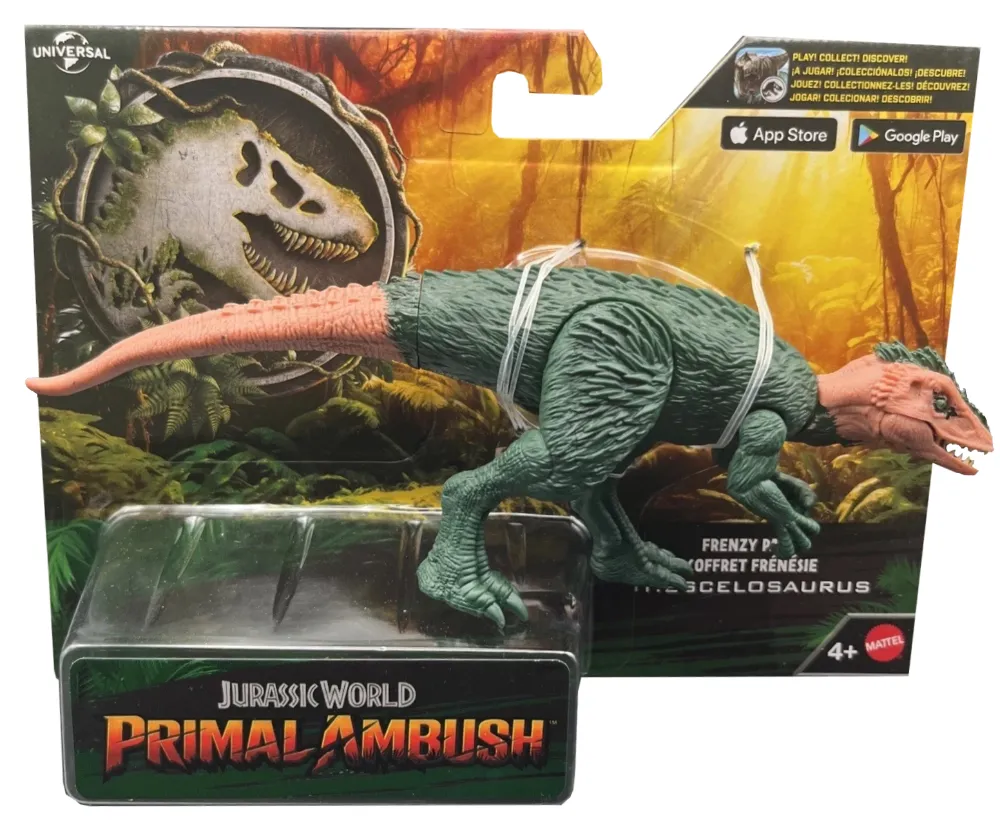
Thescelosaurus finally joins the Mattel line, and it is a strange one. The real animal was a sturdy little plant-eater that lived alongside T. rex, but this Frenzy Pack figure has the shaggy feathers, crouched pose and sharp teeth of a small predator. It is not mutated and carries no spikes, and the detail is genuinely good, from the textured skin to some of the most lifelike eyes Mattel has painted in a while. It just does not look much like a Thescelosaurus. As a Frenzy Pack it is nothing new or especially impressive, but it is still a solid little figure for the collection.
⭐ First Mattel Thescelosaurus🪶 Feathered sculpt📏 ~20 cm / 7.75 inFrenzy Pack · Wave 1Product code JPG80Scan code included
🦴 How Does It Compare to the Real Thescelosaurus?
This is Mattel’s first Thescelosaurus, so the only fair test is the real animal. Thescelosaurus is known from several good skeletons, so there is a reasonable picture of how it was built, and the figure strays from it in some obvious ways.
With the mouth closed, you can just about see the Thescelosaurus in it. Open the jaw and it turns into a predator. It is not mutated or spiked like many Survival figures, but Mattel has given a plant-eater the look of a hunter, and that is hard to overlook.
What Is a Frenzy Pack?
Frenzy Pack is the entry level assortment in Primal Ambush: small figures with simple joints, no electronics and no button-triggered feature. The box is the same design as the Magnosaurus, with a checklist of the whole wave across the top of the back.
Thescelosaurus shares the first Frenzy Pack wave with the Bagaceratops, the Magnosaurus and a repainted Minqaria. It is the only small two-legged plant-eater in the group, which makes the predator styling all the more surprising, since collectors usually want herbivores as prey for their carnivores.
Paint & Colour Scheme
Feathers, head crest, arms and legs
Face and the end of the tail
Around the eyes and speckles in the plastic
Glossy eyes
Tongue and inside of the mouth
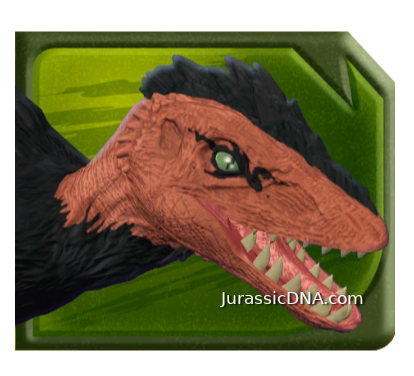
The best part of the paint is the face. A warm pink covers the head, with a little black creeping out around the eye sockets and dark speckles moulded into the plastic itself for some variation. The eyes are the standout: a lighter green than the body, neatly painted and finished with a gloss coat. They are among the most lifelike eyes on any recent Mattel figure.
The rest of the body is a deep, almost Christmas-tree green. It is plain, but it suits the feathers. The pink returns on the last part of the tail, which ties the two ends of the figure together. A few small feathers on the back of the head are left unpainted, and none of the claws on the hands or feet are painted either.
Inside the mouth things get messy. The tongue is a reddish tone with good texture, and the inner skin is red too, but the teeth are where the paint falls apart. Some are not painted at all, there is stray black on the upper teeth, and the lower teeth have blotches of paint spilling onto the tongue. It looks careless, and it is a shame on a figure whose face is otherwise so well done.
Sculpt & Detail
A predator's head on a plant-eater
The skin texture on the head is crisp and vibrant, and a crest of green feathers runs up and over the top of the skull. More feathers start at the throat, with a few hanging off the lower jaw. The jaw opens to show a textured tongue and a full set of sharp teeth, which is the clearest sign that this sculpt was designed as a hunter. Oddly, with the mouth open the lower jaw looks much longer than the upper, yet the two close together perfectly.
Feathers, arms, legs and tail
Most of the body is covered in long, wavy, emu-like feathers, which turn into more bird-like layered feathering across the back. The texture is decent rather than fine, with little detail inside each feather, but it reads well at arm’s length. On the arms the feathers stop just past the elbow and give way to scaly skin, with scutes down the fingers and sculpted claws. The legs follow the same idea: feathers over the thighs, then sharp, detailed skin below the knee, scutes on the toes, long claws and dewclaws.
The tail is feathered up to the swivel joint, then switches to pink skin with a few scutes along the top and more of the dark speckling. From behind it has a natural curve, and both sides of the figure look much the same apart from which leg is forward.
Not mutated, just miscast
Articulation
✓ Opening jaw✓ Neck, up and down✓ Arms, forward and back✓ Legs, forward and back✓ Tail swivel✗ No extra joints beyond the basics
Articulation is standard Frenzy Pack fare: an opening jaw, a neck that moves up and down, arms and legs that swing forward and back, and a swivel joint near the base of the tail. It is not a lot, but it is enough to set up a walking pose, lower the head to the ground or raise it to look around. Lifting the head also makes the figure look a little less like a stalking predator.
Size & Specs
Stretched out from snout to tail with the head lowered, the Thescelosaurus measures about 7.75 inches, just under 20 cm. It stands about 2.75 inches tall in that pose and about 3 inches with the head raised. That is right in the usual Frenzy Pack range.
Next to the Magnosaurus from the same wave it is only slightly smaller. Against a standard Mattel Velociraptor it is close in overall size, but its low, crouched pose makes it look smaller than it really is. The real animal was about 3 to 4 metres long, so the figure works out at very roughly 1:17.
Our Verdict
There is a lot to like up close. The skin and feather textures are crisp, the pink face is attractive and the glossy green eyes are some of the most lifelike Mattel has produced in a long time. It is also refreshing that the line resisted spikes and mutations for once, and having a first Mattel Thescelosaurus at all is a nice addition.
The trouble is that it does not really look like a Thescelosaurus. The sharp teeth, crouched stance and predatory styling turn a plant-eater into a hunter, which also makes it less useful as prey for your carnivores. The paint inside the mouth is sloppy, the claws are left bare and the green body is fairly plain.
As a Frenzy Pack it is nothing you have not seen before and not especially impressive, but it is still a good enough figure to add to the collection, especially if you want every species in the wave.
✦ What Works
- First ever Mattel Thescelosaurus
- Lifelike glossy green eyes
- Crisp skin and feather texture
- Attractive pink face and tail tip
- No spikes or mutations
✦ What Doesn't
- Looks like a predator, not a plant-eater
- Sharp meat-eater teeth
- Sloppy paint on the teeth and tongue
- Unpainted claws and head feathers
- Plain green body
About the Thescelosaurus
Thescelosaurus was one of the very last dinosaurs, living alongside T. rex and Triceratops right up to the asteroid impact.Why this species is worth knowing
Where and when. Thescelosaurus neglectus lived in western North America at the very end of the Cretaceous, about 68 to 66 million years ago. Its fossils come from the Hell Creek and Lance formations in the United States and from rocks of the same age in Canada.
The name. Charles Gilmore of the Smithsonian named it in 1913. Thescelosaurus means “wondrous lizard”. The species name, neglectus, refers to the first skeleton, which sat unopened in a museum crate for more than twenty years before anyone studied it.
What it looked like. It was 3 to 4 metres long, much of that tail, and stood roughly waist-high to a person. It walked on two sturdy hind legs, had short arms with five-fingered hands, a long, low head with a narrow beak and small cheek teeth for chewing plants, and a stiffened tail. Its build points to a strong, steady animal rather than a sprinter.
Heart and brain. A specimen nicknamed “Willo” was announced in 2000 as preserving a fossilised heart, but later studies concluded the lump was a mineral concretion. More recent work on its skull found large smell centres and poor hearing, a mix seen in animals that dig, so Thescelosaurus may have spent part of its life in burrows.
Unlock the Thescelosaurus
How to unlock Thescelosaurus from Primal Ambush?
The DNA scan code is printed on the Thescelosaurus figure. Scan it with the Jurassic World Play App to add the Primal Ambush Thescelosaurus to your digital collection.
New figures sometimes reach shops before the app is updated, and then the code will not scan yet. If that happens, update the app and try again a little later. If the code on your figure has worn off or is hard to read, scan the copy on this page straight from your screen.
Thescelosaurus Gallery
Thescelosaurus FAQ
Yes. The Primal Ambush Frenzy Pack Thescelosaurus (JPG80) is the first Thescelosaurus Mattel has made for its Jurassic World toy line.
Not very. The real Thescelosaurus was a sturdy plant-eater with a narrow beak and small cheek teeth. The figure has sharp meat-eater teeth, shaggy feathers and a crouched, predator-like pose. With the mouth closed it is closer to the real animal.
It is about 7.75 inches (just under 20 cm) long from snout to tail and about 3 inches (8 cm) tall with the head raised, typical for a Frenzy Pack and only slightly smaller than the Magnosaurus from the same wave.
The jaw opens, the neck moves up and down, the arms and legs swing forward and back, and the tail swivels. There are no electronics or action features.
Yes. Thescelosaurus lived in western North America about 68 to 66 million years ago, in the same environments as Tyrannosaurus rex, Triceratops and Edmontosaurus.
Open the Jurassic World Play App, tap Scan and point your camera at the DNA code printed on the figure, or at the copy on this page.