
Home › Jurassic World Primal Ambush › Bagaceratops Frenzy Pack
Frenzy Pack Review
Bagaceratops Frenzy Pack
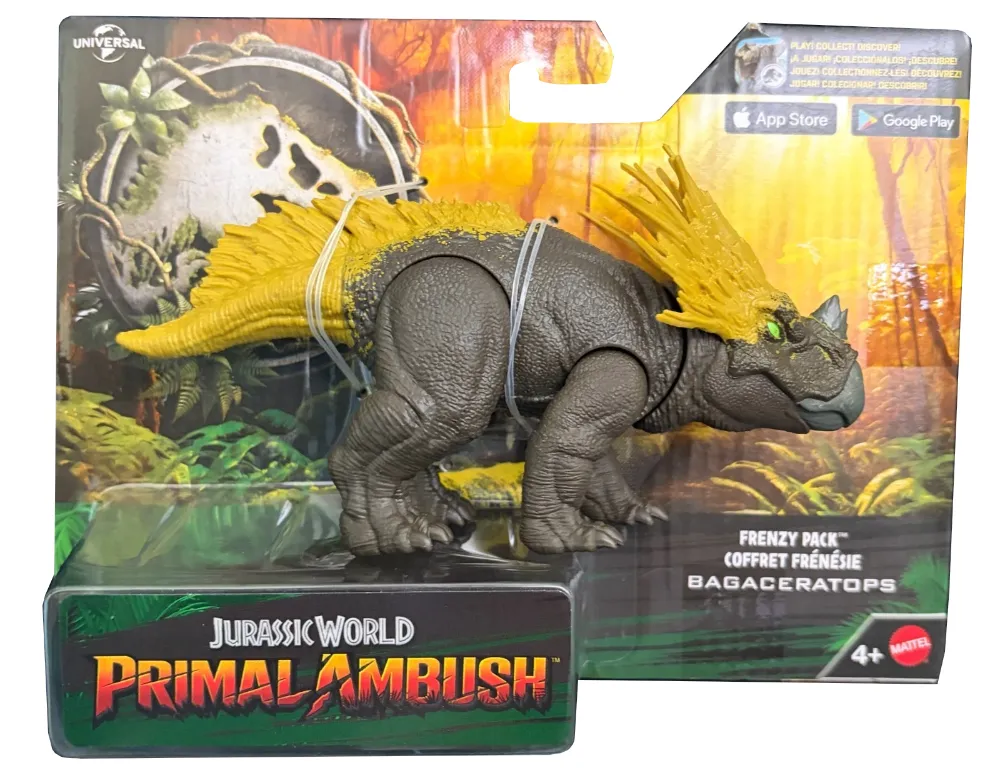
Small horned dinosaurs from the Gobi desert rarely get the toy treatment, so seeing Bagaceratops land in the first Primal Ambush Frenzy Pack wave was a genuine surprise. I have ordered couple of early ebay copies among which this is the first one we will review. Its wave mates stay fairly close to their real animals. This one, however, does not. Mattel has squashed the body, bulked it up and planted a tall crest of quills where you would expect a neat frill. It is eye-catching and unlike any other ceratopsian in the range.
⭐ First Mattel Bagaceratops🪶 Crown of soft quills📏 ~16 cm / 6.25 inFrenzy Pack · Wave 1Product code JPG83Scan code included
🦴 How Does It Compare to the Real Bagaceratops?
This is Mattel’s first Bagaceratops, so there is no earlier release to measure it against. The more useful check is the animal itself.
Mattel has shown it can do this family faithfully: its earlier Protoceratops looked very much like the real animal. So the Bagaceratops was clearly a design choice rather than a limit of the format. Kids will probably love the wild look. Collectors who want an accurate Gobi ceratopsian may feel the species deserved a more grounded first figure.
What Is a Frenzy Pack?
Frenzy Pack is the entry level assortment in Primal Ambush: small figures with simple joints, no electronics and no button-triggered feature. The Bagaceratops sits in exactly the same size class as Frenzy Packs, Danger Packs and Attack Packs from earlier lines, and it lines up almost perfectly with the old Mattel Battle Damage Triceratops figures.
It shares the first Frenzy Pack wave with the Thescelosaurus, the Magnosaurus and a repainted Minqaria.
Paint & Colour Scheme
Body & head speckles
Face wash & nostrils
Quills, frill back & tail
Beak & snout horn
Eyes
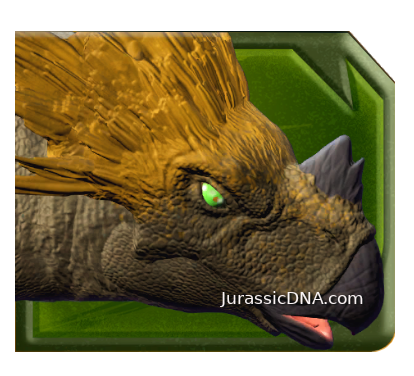
The best paint idea on this figure is subtle. A yellowish brown wash has been worked into the face so it settles in the folds and cracks of the skin texture, and even inside the nostrils. It picks out the sculpt and adds a realism Frenzy Pack figures rarely get. The beak and snout horn are a soft grey, and the eye is a bright green with a dark brown pupil, which reads almost as well as black against such a light colour.
Brown speckles break up across the top of the head. They look great, and we would have loved to see them continue over the quill crown or across a plain frill. Yellow returns at the back of the frill and on the quills, and at the other end the brown body colour breaks up into the tail before the yellow takes over again. Some yellow even seeps into the brown, so the change is gradual rather than the hard line Mattel often uses.
Sculpt & Detail
A crown of quills, not a frill
The head is where the design gets bold. From the front, the frill seems to vanish behind a thicket of tall, pointed shapes that rise out of the skull, and our first impression was a spiked mane. Turn the figure around, though, and the real frill is right there, with neatly scaled skin on its back surface. The spikes are actually quills sprouting from the frill’s edge, and the same quills run down the back and along the top of the tail.
Once you read them as quills, the look makes more sense. It gives the head an almost feathered, bristly feel, which is easier to accept than a frill turned into a pincushion. It is still pure invention, and it would sit more comfortably in the mutant-heavy Survival range than in a wave of mostly grounded animals.
Face, body and legs
Below the crest, the face is good work. The beak has fine, crisp detail, a small horn sits on the snout, the nostrils are cut cleanly and the scales are mostly large across the face, tightening into finer texture along the lower jaw near the beak. The skin under the neck has its own texture, different from the upper side, which keeps the throat from looking flat.
The body is the strangest part. It is short, deep and stocky, as if a normal ceratopsian had been pushed together from both ends, and there is barely any neck to speak of. The skin texture across the torso is crisp and lively, and the legs have convincing muscle, especially the thick back legs. On every leg the large upper scales give way to a completely different texture below the elbow or knee. Toes and claws are sculpted, but none of the claws are painted.
Soft where it counts
Articulation
★ Neck, up and down, wide range✓ Front legs, forward and back✓ Back legs, forward and back✓ Tail swivel✗ No action feature
This is basic Frenzy Pack articulation, but the neck is a real highlight. It lifts surprisingly high and dips low, and the movement is smooth, so the figure can go from grazing to alert in a second. The legs swing forward and back and the tail swivels. That is enough for simple play and for a natural looking pose on the shelf.
Size & Specs
From beak to tail tip the figure measures about 6.25 inches, stands about 2.75 inches at the back and reaches about 3 inches at the tips of the quills. That puts it squarely in the standard Frenzy Pack, Danger Pack and Attack Pack size class, and it matches the old Mattel Battle Damage Triceratops figures almost exactly, so it slots neatly into an existing small herbivore display.
The real Bagaceratops was only about 1 to 1.5 metres long, so this is one of the few Frenzy Pack figures that ends up close to the scale of the bigger figures in the line rather than far below it.
Our Verdict
This one took us a while to make up our minds about, and in the end the positives win. Getting Bagaceratops in plastic at all is a big plus for the range. The detail is crisp, the colours are pleasant, the face wash is a clever touch, the neck joint is better than it needs to be and the soft quills make it a safe, hands-on figure.
What holds it back from a higher score is how far it strays from the real animal. The squashed body, the quill crown and the uneven paint between the two sides are hard to ignore.
Treat it as a bold, stylised take on a rare Gobi ceratopsian and it earns its place on the shelf. If you want a strictly accurate horned dinosaur, this is not the one.
✦ What Works
- First Mattel Bagaceratops
- Crisp, vibrant skin detail
- Yellow wash in the facial texture adds realism
- Fine beak detail and painted snout horn
- Soft, gradual colour change into the tail
- Smooth neck joint with a wide range
- Soft quills, safe for small hands
✦ What Doesn't
- Very far from the real animal
- Compressed, overly bulky body
- Quill crown hides the frill from the front
- Pupil missing on one eye
- Uneven wash from one side to the other
- Claws left unpainted
About the Bagaceratops
Not a giant horned dinosaur, but a small, beaked plant eater from the Gobi, and one of the most common dinosaurs in the rocks where it was found.Why this species is worth knowing
Where and when. Bagaceratops rozhdestvenskyi lived in the Gobi region of Asia during the Late Cretaceous, about 72 to 71 million years ago. Its fossils come from the Barun Goyot Formation in Mongolia and the Bayan Mandahu Formation in Inner Mongolia, China.
The name. Bagaceratops means “small horned face”, combining the Mongolian word baga, meaning small, with the Greek for horned face. It was named in 1975 by the palaeontologists Teresa Maryanska and Halszka Osmolska.
Small and common. At about 1 to 1.5 metres long and roughly 23 to 45 kg, it was a small animal. It is the most common dinosaur in the Barun Goyot Formation, and expeditions there recovered many skulls of juveniles and young adults, which makes it an important species for studying how small horned dinosaurs grew up.
A Protoceratops cousin. Bagaceratops belonged to the protoceratopsids, the same family as the famous Protoceratops. Its frill was smaller, and unlike Protoceratops it had no teeth at the very front of the upper jaw, just a parrot-like beak.
One animal, many names. A 2019 study concluded that several dinosaurs described under other names, including Magnirostris and Platyceratops, were actually Bagaceratops at different ages or with individual variation.
Unlock the Bagaceratops
How to Unlock the Primal Ambush Bagaceratops?
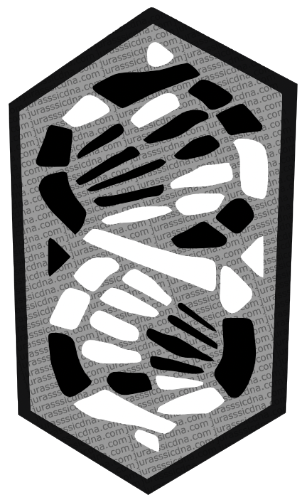
The DNA scan code on the Bagaceratops is printed on the back leg. Scan it with the Jurassic World Play App to add the Bagaceratops to your digital collection.
If the code on your figure has worn away with play, been scratched or hidden by a sticker, scan the copy here straight from your screen.
Bagaceratops Gallery
Bagaceratops FAQ
Yes. Bagaceratops had never been made by Mattel before this Primal Ambush Frenzy Pack, product code JPG83. It is a brand new sculpt and a brand new species for the Jurassic World line.
It measures about 6.25 inches (16 cm) from beak to tail tip, stands about 2.75 inches (7 cm) at the back and about 3 inches (8 cm) to the top of the quills. That is the usual size for Frenzy Pack, Danger Pack and Attack Pack figures.
Yes, but you only see it clearly from behind. From the front, a crown of tall quills rises out of the frill and hides its outline, which is why many people first read it as a spiky mane. The quills are soft and rubbery, not hard plastic.
Not very. The real Bagaceratops was a small, Protoceratops-like animal with a short, plain frill. Mattel compressed the body, made it bulkier and added quills over the head, back and tail, so the figure is a stylised take rather than a reconstruction.
The code is printed on the back leg. Scan it with the free Jurassic World Play App to add the Bagaceratops to your collection. If the code is worn or hard to read, scan the copy on this page instead.
Bagaceratops was about 1 to 1.5 metres long and weighed roughly 23 to 45 kg. It lived in the Gobi region of Mongolia and northern China about 72 to 71 million years ago and was a close relative of Protoceratops.