Home › Jurassic World Survival › Estemmenosuchus & Claire Gyrosphere Escape Pack
Legacy Collection Reimagined Review
Estemmenosuchus & Claire Gyrosphere Escape Pack Review A face only a mother could love, a body you can squeeze, and a paint job that reaches straight back to a toy shelf in 1994
Let us get the obvious out of the way. The Estemmenosuchus in this box is ugly. Not misjudged-sculpt ugly, not bad-toy ugly, but properly, confidently ugly.
That is precisely why we like it, and it is why a fair chunk of the collecting community walked straight past this set without a second look. Their loss. What is inside the box is one of the most interesting Mattel releases of the year, and the reason has almost nothing to do with whether the creature is pretty.
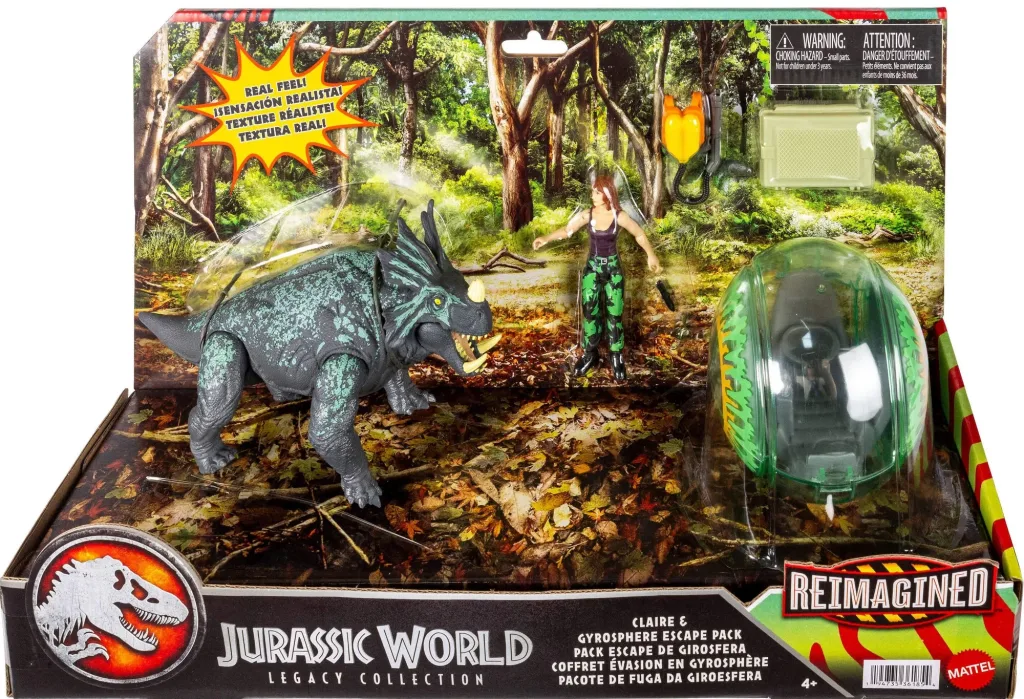
⭐ First Mattel Estemmenosuchus📏 ~19 cm / 7.5 inReal Feel rubber body3-piece packMattel · 2026Scan code included
📦 What Is Actually In The Box
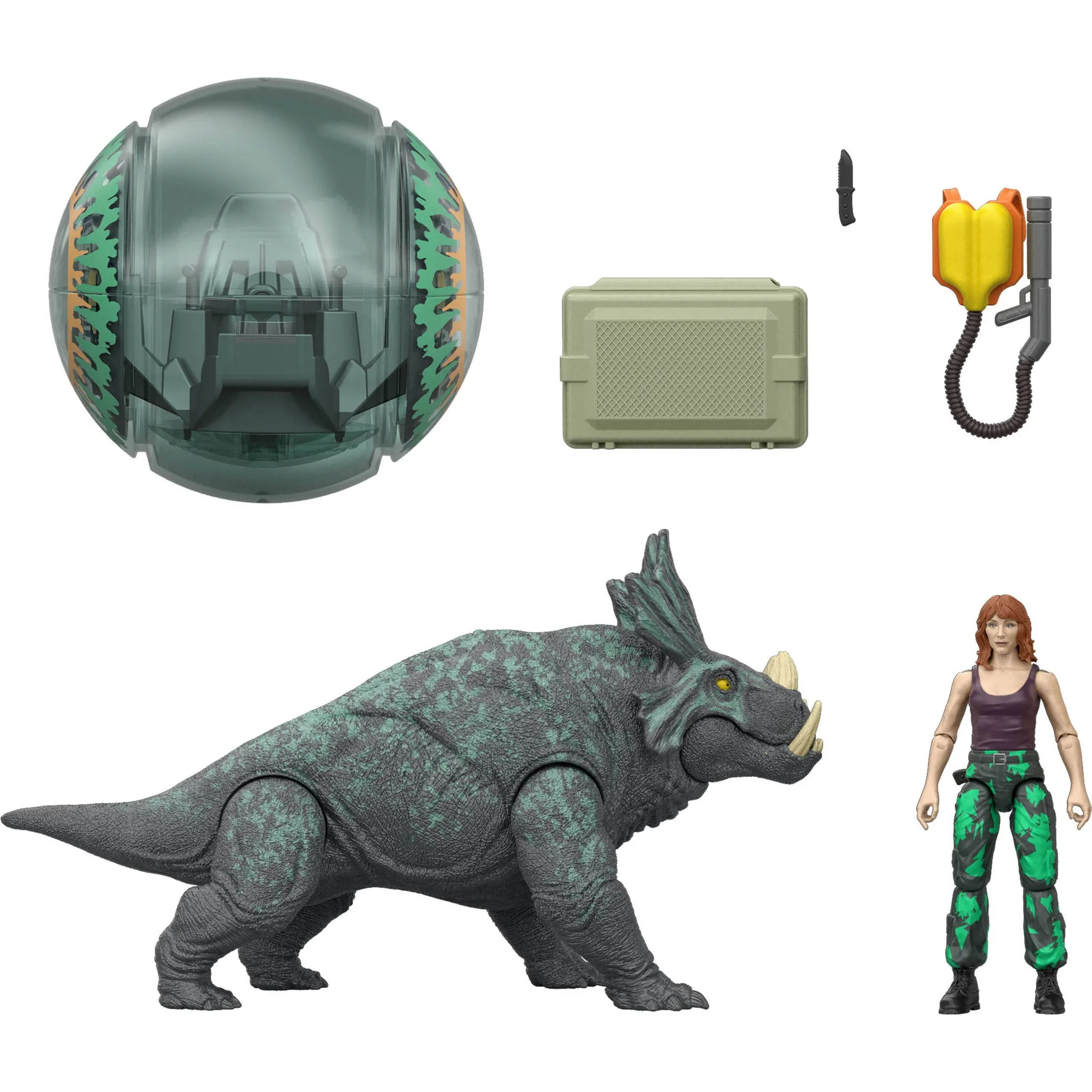
Three pieces plus accessories, and the interesting part is that all three are worth having. This is not a creature with two pieces of filler packed around it.
Yes, It Is Ugly. Here Is Why That Is The Point.
Mattel did not invent this face. Estemmenosuchus really did look like this, or near enough, and the fossil skull is every bit as peculiar as the toy. Complaining that the figure looks odd is a bit like complaining that a warthog looks odd: the objection is with the animal, not with the sculptor.
What Mattel has actually done is take a genuinely strange creature, push the proportions a little further for shelf presence, and then commit to it completely. There is no half-hearted smoothing over of the awkward bits. The bosses on the skull are big, the body is heavy and low, and the whole thing looks like something that would shoulder you out of the way at a watering hole. That is a design decision, not an accident.
There is a second reason this matters. Mattel almost never makes prehistoric animals from outside the dinosaur roster, and when it does, the choices tend to be crowd pleasers. Choosing a Permian oddity with no film appearance and no built-in audience is a small act of faith. If sets like this sell, more of them get made. If they sit on pegs, the roster stays narrow.
Where The Hard Plastic Ends And The Squeeze Begins
This is a Real Feel release, which means part of the figure is moulded in a soft rubberised material rather than rigid plastic. Mattel does not make the division obvious on the packaging, so here is exactly how it breaks down once you have it in hand.
The rubber section runs unbroken from the base of the skull to the tip of the tail. Squeeze the body and it compresses properly, with a faint hiss of air escaping around the leg joints as it does — not a fault, but audible enough that you notice it the first few times.
The soft body brings a bonus nobody advertised: because the torso and tail flex, you get a small amount of posability out of parts that have no joints in them at all. The tail in particular can be nudged into a gentle S curve and will hold it. That is not articulation in any formal sense, but it is more than a rigid figure of this type would offer.
Sculpt And Paint
The Head, Where The Argument Is Won Or Lost
The skin across the face carries dense, fine texture that reads properly under raking light, with clearly defined nostrils and a small horn on the snout picked out in the same pale tone as the teeth. Above the eyes the skull erupts into that elaborate crown of bony growths — the feature that gives the animal its name, and the feature that makes people recoil.
The eyes get a green application with grey standing in for a pupil rather than a painted black dot. On a lighter figure that would look blank, but the surrounding tones are dark enough that it reads correctly at normal viewing distance.
The jaw is a plain hinge with no gimmick attached, and it is better for it. It opens genuinely wide and, more importantly, it closes properly, with the upper and lower jaws meeting cleanly rather than leaving the permanent gap that afflicts so many action-feature mouths. Inside, the tongue is well textured with a pale pink application, and the teeth are moulded with real definition, including some fine surface detail on the larger ones.
A Colour Scheme Borrowed From 1994
The paint is the deliberate nostalgia hit. Over a grey base, a pale blue green is splattered across the body in irregular patches, working through the face, over the crown of the skull, down the flanks, across the belly and out into both sets of legs. It thins out as it approaches the tail and eventually gives up entirely, leaving the last stretch in plain grey.
Splatter patterns are a risky technique because they can easily read as a factory mistake, but the density here is judged well and the effect is convincingly organic, like an animal that has been lying in something. The claws are left unpainted, which is the one real omission, though they do carry a soft satin sheen that stops them looking like bare plastic.
Then And Now: The Kenner Connection
Kenner put an Estemmenosuchus on shelves during the original Jurassic Park toy run of the 1990s, one of a handful of non-dinosaurs the line quietly slipped into the roster alongside oddities like Scutosaurus. That figure is the clear ancestor of this one, and the reference is not subtle once you know to look for it.
- Grey body with pale blue-green markings
- Simpler, blockier sculpt typical of the era
- Rigid plastic throughout
- Roughly the same overall length as the new figure
- A genuine oddity on the peg at the time
- The same colour relationship, applied as splatter
- Dramatically more surface texture and muscle definition
- Real Feel rubber through neck, body and tail
- Nearly identical footprint, so the two display as a pair
- Still an oddity, and still the better for it
Set the two side by side and the lineage is obvious. The modern figure is unambiguously the better sculpt, but the older one holds its own on charm, and the fact that they match in size feels deliberate rather than coincidental.
Articulation, Claire And The Gyrosphere
Five conventional points on the creature, all four legs swinging forward and back and rotating through a full circle. It is basic, but for a quadruped of this build there is not much more to ask for, and the soft body quietly picks up some of the slack. A neck joint would have been welcome, since a head that could turn would add a lot of character to a creature whose whole appeal is its head.
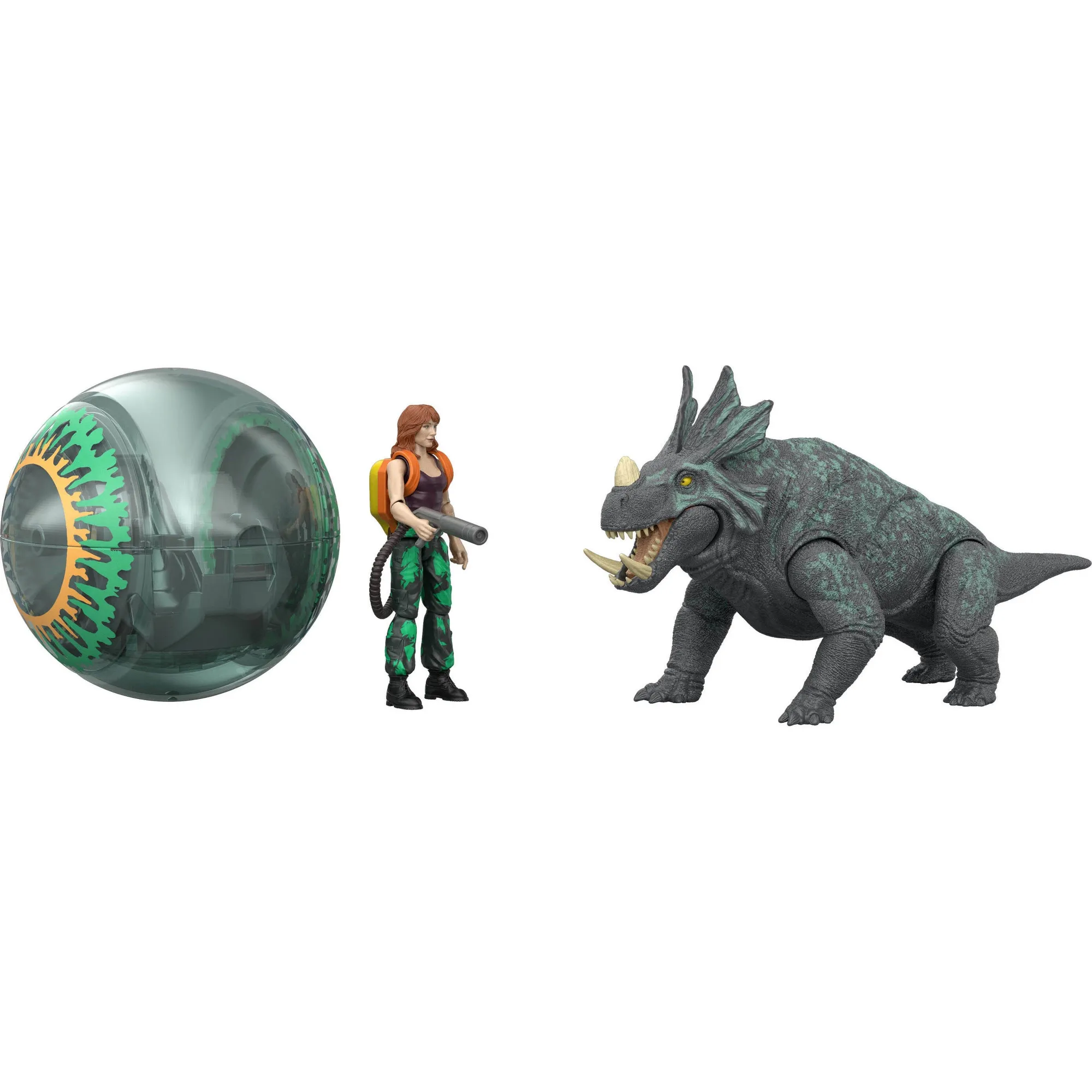
Claire deserves more attention than she will get. Human figures in this range are usually the part you tolerate to get the creature. Not this time. The likeness is approximate rather than exact, but it reads as the right character, helped by decal eyes, a painted mouth and a genuinely well sculpted head of hair with proper wave and volume to it. She wears a purple tank top applied with clean edges and slight sculpted creasing, over cargo trousers in a dark military green broken up with a pale green pattern scattered across them.
The detail worth singling out is on the belt. The buckle is picked out in grey, the belt itself in dark green, and the individual loops are painted to match whichever section of trouser they sit on — a loop crossing a pale patch is painted pale while its neighbour over a dark patch stays dark. That is a level of care almost nobody will consciously notice and everybody will subconsciously register. Her boots are cleanly sculpted and finished in black, with a small holster moulded at the back for the included knife.
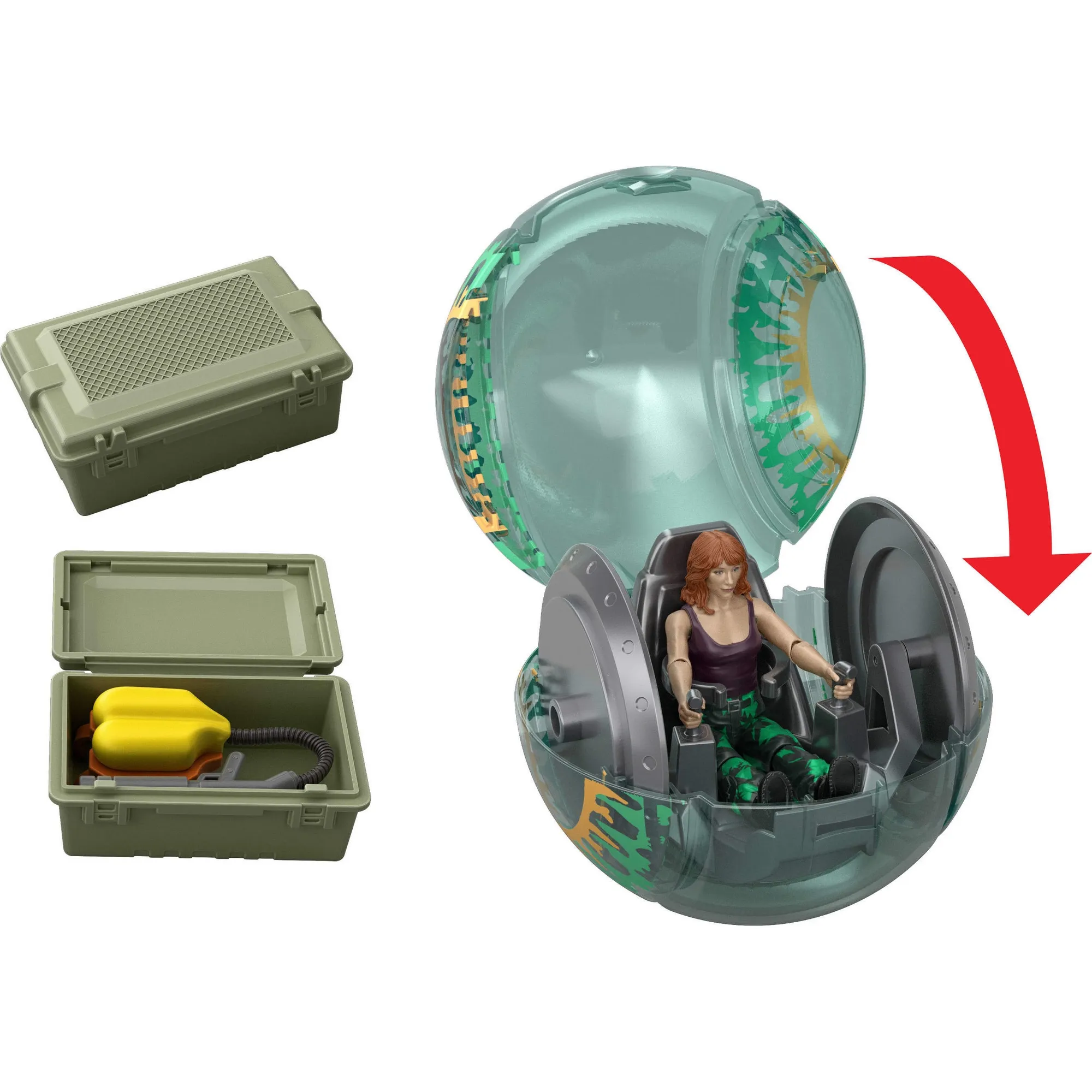
Accessories cover that knife, a harness rig with a hose running back to a pair of yellow tanks with orange strapping, and a hard carry case that genuinely opens and has moulded detail inside and underneath. The rig is serviceable rather than finely detailed, but the case is a nice touch: it holds the smaller pieces, which means they are less likely to vanish under the sofa within a week.
And the gyrosphere. Structurally this is the gyrosphere Mattel has produced before, so there are no surprises in the engineering — the hatch opens on top, Claire drops inside, the moulded seat and control panel stay upright as the sphere rolls, and the wheels turn smoothly. What is new is the finish: most of the sphere is moulded in translucent green, with light green and yellow graphics across the side panels that give it a distinctly retro, almost arcade-cabinet look. It is easily the most eye-catching version of this accessory to date, and it happens to sit very comfortably next to the creature’s own colour scheme.
Size And Specifications
Length alone undersells it. This is a thickset, heavy-bodied animal, and next to figures of similar measurement it looks considerably more substantial. It comes out larger than both Mattel’s standard-size Scutosaurus and the Hammond Collection version, which makes it the biggest non-dinosaur the brand has produced in this scale.
A note for customisers: like the Survival Pachycephalosaurus, this is a figure whose sculpt carries more information than its paint acknowledges, and that splattered scheme is begging to be reinterpreted. The unpainted claws alone are a five minute improvement. The catch is availability — a three-piece set like this is not the easiest thing to buy two of, so if Mattel ever puts the species out as a single-carded release, that is the one to practise on.
Verdict: 4.3 / 5
Judge this set by the creature on the front of the box and you will walk past it, which is exactly what a lot of people have done. Judge it by what is actually in the plastic tray and it turns out to be one of the more thoughtfully assembled releases of the year: a species that has never been made before, a material experiment that genuinely works, a paint scheme with a real reason behind it, and a human figure that is a cut above the usual filler.
The things holding it back are modest. There is no neck joint, the claws went unpainted, the tooth paint strays a little, and the gyrosphere is a familiar part in a new colour rather than anything new. None of that touches the central appeal.
So yes, this creature is so ugly that only its mother could love it. Buy it anyway. Ugly animals need homes too, and this one comes with a very good Claire.
What Works
- First ever Estemmenosuchus in the Mattel line
- Real Feel rubber body flexes and holds a gentle pose
- Sculpted detail stays crisp across the material change
- Splattered paint scheme is a genuine Kenner throwback
- Jaw opens wide and closes cleanly with no gap
- Claire is one of the best human figures in the range
- Belt loops painted to match the trouser pattern beneath
- Opening carry case keeps the small accessories together
- Translucent green gyrosphere is the sharpest version yet
What Does Not
- No neck joint on the creature
- Claws left unpainted
- Slight sloppiness in the tooth paint
- Pink does not extend to the roof of the mouth
- Splatter pattern fades out before the tail
- Gyrosphere is an existing mould in a new colour
- Air audibly escapes the body when squeezed
The Real Estemmenosuchus
It is not a dinosaur, and it is not a crocodile. The name translates roughly as crowned crocodile, which is doubly misleading. Estemmenosuchus was a therapsid, part of the synapsid lineage that eventually produced mammals. Put plainly: it is closer to you than it is to a Tyrannosaurus.
It came first, by a very long way. This animal lived in the middle Permian, somewhere around 265 to 270 million years ago, in what is now the Perm region of Russia. That places it tens of millions of years before the earliest dinosaurs appeared. It was long gone before the Mesozoic began, and it did not die with the dinosaurs but in the far larger extinction that closed the Permian.
The crown was real. Two species are recognised, E. uralensis and E. mirabilis, and both carry elaborate bony outgrowths projecting from the skull above the eyes and out from the cheeks. They are usually interpreted as display structures for recognising rivals and impressing mates, possibly used in shoving contests as well. Mattel has exaggerated them, but the underlying weirdness is entirely authentic.
Big, heavy, and probably a plant eater. The larger of the two, E. uralensis, reached roughly 4.5 metres in length, while E. mirabilis stopped nearer 3 metres. Either way this was a genuinely bulky animal, several hundred kilograms of low-slung bone and muscle. It is most often reconstructed as a herbivore, though the mixed dentition — prominent canines alongside blunter teeth further back — has led some researchers to read it as an omnivore that was not especially fussy.
And here is the detail that suits this figure perfectly. Fossilised skin impressions attributed to Estemmenosuchus show a smooth surface with glandular structures and no scales at all. In other words, this animal’s skin was already heading in a mammal-like direction hundreds of millions of years ago. Mattel giving it a soft, slightly rubbery body is a coincidence, but it is a very fortunate one.
Want To Unlock Estemmenosuchus In The Play App?
The DNA scan code for this set is printed on the underside of the Estemmenosuchus figure. Scan it with the Jurassic World Play App to add the creature to your collection.
If the code on your figure is worn, scratched or hidden under a price sticker, you can scan the copy hosted free in our database instead — straight from the screen. That is what JurassicDNA is here for.
Estemmenosuchus & Claire Gyrosphere Escape Pack Gallery
Frequently Asked Questions
Three main pieces plus accessories: a Real Feel Estemmenosuchus, a fully articulated Claire Dearing figure, and a translucent green gyrosphere with an opening top hatch. Claire also comes with a knife, a harness rig with hose and tanks, and a hard carry case that opens and can store the smaller pieces.
No, and it is not a crocodile either despite the name. Estemmenosuchus was a therapsid, part of the synapsid group that eventually gave rise to mammals. It lived during the Permian period, tens of millions of years before the first dinosaurs walked, and was extinct long before the Mesozoic began.
Because the real animal did. Estemmenosuchus had a bulky, low-slung body and a skull covered in bony outgrowths projecting above the eyes and out from the cheeks. Mattel has pushed the proportions further for effect, but the fundamental oddness is authentic rather than invented. It is a face only a mother could love, and it is supposed to be.
It refers to the soft rubberised material used for part of the body. Here the head and all four legs are conventional hard plastic, while the neck, torso and tail are soft and squeezable. The sculpted skin detail is just as crisp on the rubber as on the hard plastic, which is unusual and worth noting.
Roughly 7.5 inches, about 19 cm, from snout to tail tip. It stands around 2.25 inches (5.5 cm) to the top of the hip and about 4 inches (10 cm) to the top of the head crest. It is much bulkier than its length suggests and comes out slightly larger than Mattel’s Scutosaurus releases.
Yes. Kenner produced an Estemmenosuchus for the original 1990s Jurassic Park line, one of several non-dinosaurs it slipped into the roster. Choosing the species at all is a nod to that era, and the grey body with pale blue-green markings closely echoes the original. The two are also very similar in size, so they display well together.
No. There is no button, spring or gimmick. Everything it does comes from plain articulation plus the flex of the soft body, which is part of why the jaw closes so cleanly: there is no mechanism forcing it to sit open.
On the underside of the Estemmenosuchus figure. Scan it with the Jurassic World Play App to unlock the creature. If your printed code is damaged or obscured, you can scan the free copy hosted in our database instead.