
Home › Jurassic World Dino Trackers › Triceratops Habitat Defender
Habitat Defender Figure Guide
Triceratops Habitat Defender
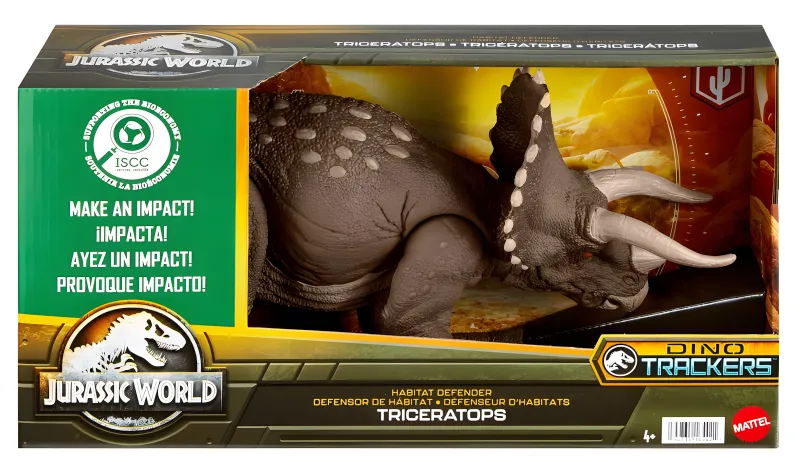
The Habitat Defender Triceratops (HPP88) is the big Triceratops fans had been waiting for: about 43 cm long, at roughly 1/18 scale, with an opening jaw and a richly detailed sculpt. Part of the Jurassic World Dino Trackers line with a desert habitat theme, it is made with 60% certified recycled plastic. Here is what the figure looks like, the great Triceratops identity debate, and how to unlock it in the Jurassic World Play App.
🦏 Big 43 cm Trike👄 Opening jaw♻️ 60% recycled plastic🧬 DNA scan code
The Case of the Missing Torosaurus
In 2010, scientists made a surprising claim: Torosaurus, a horned dinosaur with a huge holey frill, might not be its own species at all, but simply a fully grown Triceratops. The debate went to court, palaeontology style.
What Is Habitat Defender?
Habitat Defender is a large, non-electronic Triceratops in the Dino Trackers line. Instead of lights or sounds, it focuses on size and detail: it is much bigger than earlier Mattel Triceratops figures and has posable legs, tail, head and an opening jaw. The packaging places it in a desert habitat and highlights that it is made with 60% ISCC-certified plastic using a mass balance approach.
Like every Dino Trackers figure, it has a hidden tracking code for the Jurassic World Play App.
Paint and Colours
Most of the body and frill
Throat and belly
Around the eyes and frill edge
Horns and beak
A classic Jurassic Park look. The Triceratops is a rich chocolate brown, close to the one in the 1993 film, with a lighter brown throat and belly. Mahogany tones blend in around the eyes and frill edge, the horns and beak are khaki, and the burnt-orange eyes give it a fired-up expression.
Sculpt and Accuracy
Head and frill
The head is huge, about 15 cm on its own, just as the real Triceratops had one of the largest skulls of any land animal. The beak and horns are deeply grooved, the frill is covered in pebbly scales, and the jaw opens, a feature collectors had long asked for.
Body and skin
The whole figure is covered in small scales, with wrinkles around the joints and larger bony bumps along the back, legs and tail. The toenails are separate pieces in a darker brown. At about 1/18 scale, it shows how big Triceratops really was: closer to an elephant than a rhino.
Bristles on the tail?
Articulation
✓ Opening jaw✓ Moving head✓ Posable legs and tail✗ No sounds or action
The head moves up, down and side to side with a wide range, and the jaw opens. The front legs turn at the shoulders, the back legs at the hips, and the tail (inserted after unboxing) swivels and lifts. There are no batteries, sounds or attack features: this is a figure built for detail and display.
Size and Scale
For ages 4 and up. Product code HPP88.
Is It Worth Buying?
The Habitat Defender Triceratops is one of the best Triceratops figures Mattel has made. It is big, beautifully detailed, nicely painted and finally has an opening jaw. It makes a perfect opponent for any large T. rex. If you want sounds and action features, look elsewhere, but for display and play it is a standout.
It is still fairly easy to find, often on sale.
What we like
- Big, impressive 1/18 scale
- Superb sculpted detail
- Opening jaw and moving head
- Made with 60% recycled plastic
Good to know
- No sounds or attack action
- Limited leg articulation
- Some back bumps left unpainted
About Triceratops
Triceratops horridus was named in 1889 by Othniel Charles Marsh, who at first mistook a pair of its horns for those of a giant bison. The name means three-horned face.
It lived at the very end of the Cretaceous, around 68 to 66 million years ago, in western North America, alongside Tyrannosaurus rex. Adults reached about 8 to 9 m long and 6 to 12 tonnes, with a skull that could be over 2 m long.
Its horns and frill were probably used for display and for fights with rivals, and also for defence. Some Triceratops bones even show bite marks from T. rex.
How to Unlock Triceratops in the Jurassic World Play App
Open the Jurassic World Play App (it used to be called the Jurassic World Facts App), tap Scan and point your camera at the DNA code below. The same code is hidden on the figure.

Frequently Asked Questions
About 43 cm (17 inches) long and 19 cm tall at the hips, roughly 1/18 scale.
No. It has no electronics or batteries. It is a large posable figure with an opening jaw.
Plastic, with 60% ISCC-certified plastic using a mass balance approach, as stated on the packaging.
About 8 to 9 m long and 6 to 12 tonnes, with a skull over 2 m long.
That idea was proposed in 2010, but most scientists now think Torosaurus is a separate animal.
Open the Jurassic World Play App, tap Scan and point your camera at the code on the figure, or at the copy of the code on this page.