Home › Jurassic World Dino Trackers › Regaliceratops Wild Roar
Wild Roar Figure Guide
Regaliceratops Wild Roar
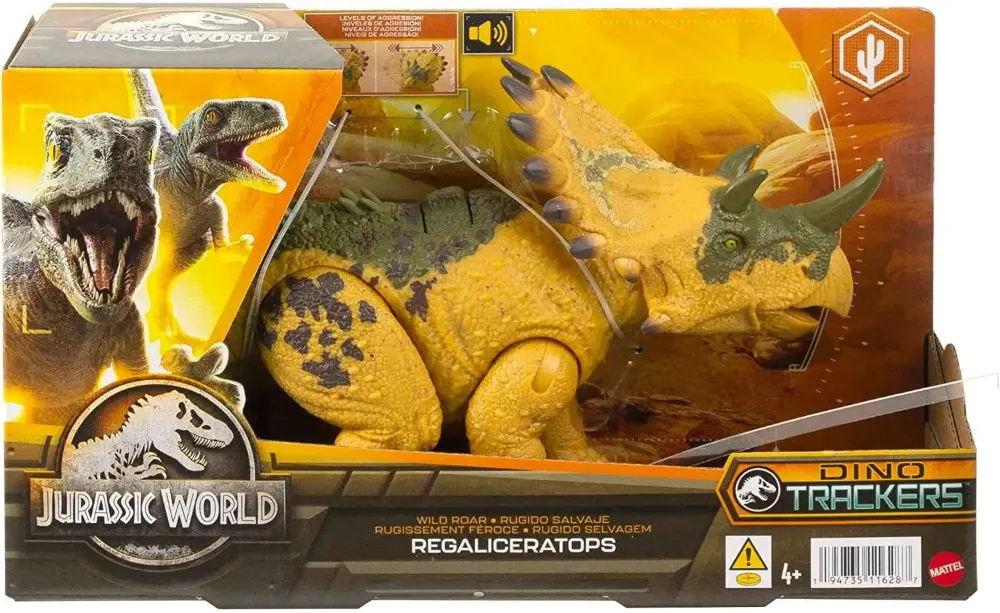
Regaliceratops joined Jurassic World Dino Trackers in the second Wild Roar wave in 2023, alongside Orkoraptor, Irritator and Nigersaurus. Its name means royal horned face, after the crown of big plates around its frill, and the real skull was nicknamed Hellboy. Mattel’s figure is a mustard and olive horned dinosaur with a purple-tipped crown, a roar and a head butt. Here is what it looks like, where the nickname came from, and how to unlock it in the Jurassic World Play App.
👑 Crown-shaped frill🔊 Roar sound💥 Head butt🧬 DNA scan code
Meet Hellboy
Before it had a scientific name, the only skull of Regaliceratops already had a nickname. The team that dug it up called it Hellboy, for two good reasons.
When it was formally named in 2015, the scientists chose something grander: Regaliceratops, royal horned face, for the crown of plates around its frill.
What Is Wild Roar?
Wild Roar is the mid-sized assortment of Mattel’s Dino Trackers line. Each figure has a roaring sound, a species-specific attack motion triggered by pressing on the hips, and movable joints, and runs on button cell batteries that come already installed. Wave 1 brought Eocarcharia, Dryptosaurus, Kronosaurus and Diabloceratops, and wave 2 added Regaliceratops, Orkoraptor, Irritator and Nigersaurus.
Wild Roar has carried on in every Jurassic World line since, with later figures adding lights and wheel-activated attacks.
Paint and Colours
Head, frill, legs and belly
Back, spines and top of the tail
Frill plate tips and blotches on the hips
Horns
A bold, regal colour scheme. The head, frill, legs and belly are a warm mustard yellow, while an olive green band runs along the back and down the tail. The tips of the big frill plates are a deep plum purple, which makes the crown pop, and the same purple appears as dark blotches on the hips.
Sculpt and Detail
Head and crown
The frill is ringed with big, rounded plates like the points of a crown, the feature the real animal is named for. There is a nose horn and a pair of curved brow horns above the eyes. The beak is sharp and parrot-like, as on all horned dinosaurs.
Body and spines
The body is stocky with four thick legs, and a row of long, thin quills runs down the back and the top of the tail. Those quills are Mattel’s styling: only the skull of Regaliceratops has been found, so nothing is known about its back or tail.
Horn check
Action Features and Articulation
✓ Legs forward and back★ Press the hips: head butt★ Roar sound✓ Batteries included
Press down on the back above the hips and the head swings up in a horn-first head butt, while the figure roars. With its wide crown frill, it makes a great defender against the predators of the Wild Roar range. The sound runs on three LR44 button cells, which come installed in a new figure.
Size and Specs
Product code HLP19, sold in the HLP14 Wild Roar case, for ages 4 and up. It needs three LR44 button cells, which are included. For a horned dinosaur display, pair it with the wave 1 Diabloceratops.
Is It Worth Buying?
Regaliceratops is a great pick for kids who love Triceratops and want something with a bit more flair. The crown frill and purple tips look fantastic, the head butt is easy to trigger, and the Hellboy story is a fun one to share. Collectors get one of the few toys of this species, even if the brow horns and back quills take some liberties.
It is mostly found second hand now. Test the roar before buying a used one, or plan on fitting three new LR44 batteries.
What we like
- Striking crown-shaped frill
- Bold mustard, olive and purple paint
- Roar plus head butt
- Rare species in toy form
Good to know
- Brow horns longer than the real ones
- Back quills are invented
- Sound needs working batteries
About Regaliceratops
Regaliceratops peterhewsi was named in 2015 by Caleb Brown and Donald Henderson of the Royal Tyrrell Museum. Its skull, more than 1.5 m long, was spotted in 2005 by geologist Peter Hews, who saw the snout sticking out of a cliff along the Oldman River in southern Alberta, Canada. The species name honours him.
It lived about 68 million years ago, near the end of the Cretaceous, and is estimated at about 5 m long and 1.5 tonnes. It was a chasmosaurine, a close relative of Triceratops, but its big nose horn and tiny brow horns are more typical of the other branch of horned dinosaurs, the centrosaurines.
That makes it a striking example of convergent evolution: two separate groups evolving a similar horn style independently.
How to Unlock Regaliceratops in the Jurassic World Play App
Open the Jurassic World Play App (it used to be called the Jurassic World Facts App), tap Scan and point your camera at the DNA code below. On the figure, the same code is on a small tag on the back.

Frequently Asked Questions
About 13 inches (33 cm) long and about 5.7 inches (14.5 cm) tall.
Press down on the back above the hips and the head swings up in a head butt while the figure roars.
Its short, stubby brow horns reminded the team of the comic character Hellboy, and the skull was very hard to dig out of a cliff above the Oldman River.
Royal horned face, after the crown of large plates around the edge of its frill.
About 5 m long and 1.5 tonnes. It lived in Alberta, Canada, about 68 million years ago.
Open the Jurassic World Play App, tap Scan and point your camera at the tag on the figure’s back, or at the copy of the code on this page.