Home › Jurassic World Dino Trackers › Orkoraptor Wild Roar
Wild Roar Figure Guide
Orkoraptor Wild Roar
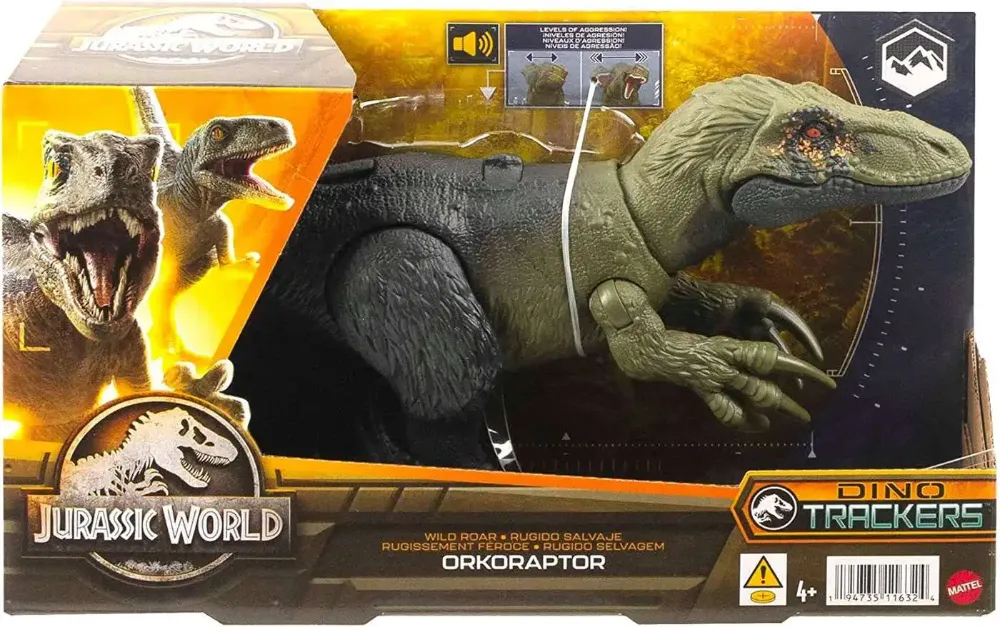
Orkoraptor joined Jurassic World Dino Trackers in the second Wild Roar wave in 2023, alongside Nigersaurus, Irritator and Regaliceratops. It is a little-known meat-eater from the far south of Patagonia, and this is one of the only toys of it ever made. Mattel’s figure is a dark, speckled hunter with big hooked hand claws, a roar and a rearing bite. Here is what it looks like, how much of it is actually known from fossils, and how to unlock it in the Jurassic World Play App.
🦖 Rare species in toy form🔊 Roar sound💥 Rearing bite🧬 DNA scan code
Fossil Inventory: Found vs Imagined
Orkoraptor is known from only a handful of bones, so most of any Orkoraptor toy has to be filled in from its relatives. Here is what has actually been dug up.
✓ Teeth
✓ Some tail vertebrae
✓ Part of a lower leg bone
★ Big hooked hand claws
★ Head shape and crest
★ Colours and skin
The big claws are a sensible guess. Orkoraptor is now placed with the megaraptorans, a group of South American and Australian hunters known for huge claws on their hands, such as Megaraptor itself.
What Is Wild Roar?
Wild Roar is the mid-sized assortment of Mattel’s Dino Trackers line. Each figure has a roaring sound, a species-specific attack motion triggered by pressing on the hips, and movable joints, and runs on button cell batteries that come already installed. Wave 1 brought Eocarcharia, Dryptosaurus, Kronosaurus and Diabloceratops, and wave 2 added Orkoraptor, Nigersaurus, Irritator and Regaliceratops.
Wild Roar has carried on in every Jurassic World line since, with later figures adding lights and wheel-activated attacks.
Paint and Colours
Back, hips, legs and tail
Head, neck, chest and arms
Bands across the tail
Speckles across the face
Eyes and inside of the mouth
Orkoraptor has a two-tone look that shifts from front to back. The head, neck, chest and arms are an olive khaki, which darkens into charcoal over the hips, legs and tail. Pale cream bands ring the tail, gold speckles cover the face, and red eyes give it a hungry stare. It is a natural camouflage pattern for a forest hunter.
Sculpt and Detail
Head and jaws
The head is long and low, with a pebbly, speckled texture and a mouth full of white teeth against a red gum line. The jaw opens wide during the attack, which is when the figure looks its fiercest.
Arms and claws
The arms are long and strong, each ending in three large, hooked black claws, the standout feature of the sculpt. The legs are long and lean with dark, clawed feet, so the figure stands in a forward-leaning hunting pose.
A name from the river
Action Features and Articulation
✓ Opening jaw✓ Posable arms✓ Legs forward and back★ Press the hips: rearing bite★ Roar sound
Press down on the back above the hips and the head rears up and lunges with the jaws wide open, while the figure roars. Combined with the big clawed arms, it makes for a dramatic pounce in play fights. The sound runs on three LR44 button cells, which come installed in a new figure.
Size and Specs
Product code HLP21, sold in the HLP14 Wild Roar case, for ages 4 and up. It needs three LR44 button cells, which are included. Its long, low build makes it a good match for Irritator from the same wave.
Is It Worth Buying?
Orkoraptor is a great pick for collectors who want rare species, since almost no other toy of it exists. Kids get a mean-looking hunter with big claws, a roar and a rearing bite that is easy to trigger, and the two-tone speckled paint looks good on a shelf.
It is mostly found second hand now. Test the roar before buying a used one, or plan on fitting three new LR44 batteries.
What we like
- Rare species in toy form
- Big hooked hand claws
- Roar plus rearing bite
- Speckled two-tone paint
Good to know
- Most of the look is guesswork
- Visible joint at the waist
- Sound needs working batteries
About Orkoraptor
Orkoraptor burkei was named in 2008 by Fernando Novas, Martín Ezcurra and Agustina Lecuona, from bones Novas found in 2001 near Lake Viedma in Santa Cruz Province, southern Patagonia, Argentina. It is one of the southernmost meat-eating dinosaurs known from South America.
Its unusual teeth first led its describers to think it was a small-bodied coelurosaur, but later studies placed it with the megaraptorans, a group of lightly built hunters with big hand claws. It is estimated at about 6 m long and around 500 kg.
Its exact age is still debated. It lived in the Late Cretaceous, but studies of the rocks around the site have given dates ranging from the middle of the period to near its end.
How to Unlock Orkoraptor in the Jurassic World Play App
Open the Jurassic World Play App (it used to be called the Jurassic World Facts App), tap Scan and point your camera at the DNA code below. On the figure, the same code is on a small tag above the hips.

Frequently Asked Questions
About 11 inches (28 cm) long and about 5 inches (13 cm) tall.
Press down on the back above the hips and the head rears up and lunges with the jaws open while the figure roars.
Toothed river thief, from Orr-Korr, the Aonikenk name for the La Leona River near where it was found.
Only a few skull pieces, teeth, some tail vertebrae and part of a lower leg bone. The rest of its body is reconstructed from relatives.
About 6 m long and around 500 kg, based on comparisons with its relatives.
Open the Jurassic World Play App, tap Scan and point your camera at the tag above the figure’s hips, or at the copy of the code on this page.