
Home › Jurassic World Dino Trackers › Irritator Wild Roar
Wild Roar Figure Guide
Irritator Wild Roar
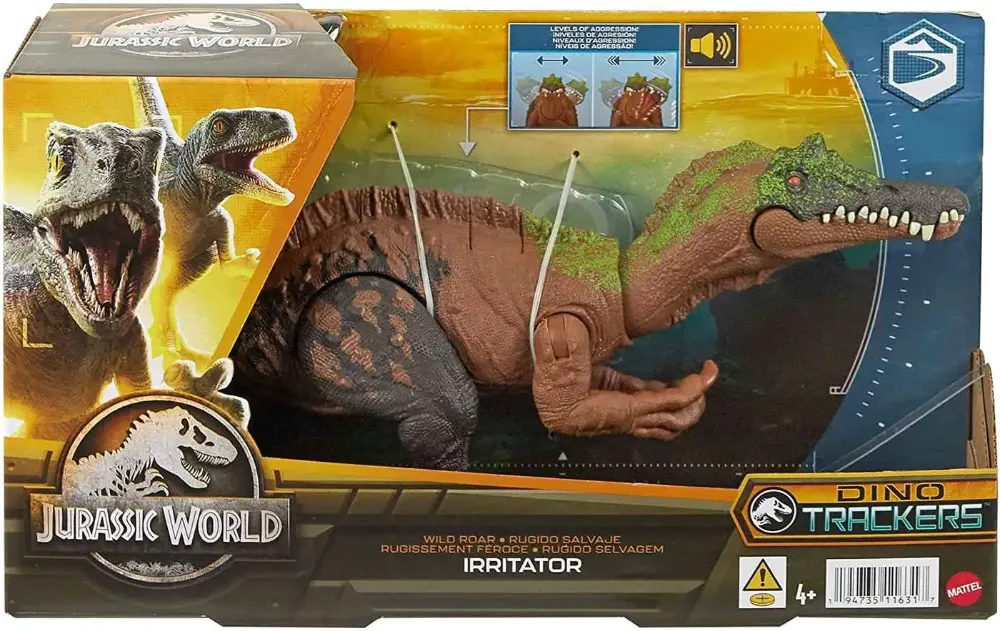
Irritator joined Jurassic World Dino Trackers in the second Wild Roar wave in 2023, alongside Orkoraptor, Nigersaurus and Regaliceratops. It is a spinosaur from Brazil, a long-snouted fish hunter related to Spinosaurus, with one of the best backstories in palaeontology. Mattel’s figure is a rust-brown hunter with a crested head, a finned black tail, a roar and a snapping bite. Here is what it looks like, how it got its name, and how to unlock it in the Jurassic World Play App.
🐟 Spinosaur fish hunter🔊 Roar sound💥 Snapping bite🧬 DNA scan code
Case File: The Doctored Skull
Irritator is the only dinosaur named after how its scientists felt. Here is the story, case-file style.
What Is Wild Roar?
Wild Roar is the mid-sized assortment of Mattel’s Dino Trackers line. Each figure has a roaring sound, a species-specific attack motion triggered by pressing on the hips, and movable joints, and runs on button cell batteries that come already installed. Wave 1 brought Eocarcharia, Dryptosaurus, Kronosaurus and Diabloceratops, and wave 2 added Irritator, Orkoraptor, Nigersaurus and Regaliceratops.
Wild Roar has carried on in every Jurassic World line since, with later figures adding lights and wheel-activated attacks.
Paint and Colours
Body, neck and arms
Tail fin, legs and spots
Head crest and top of the neck
Teeth
A warm, earthy scheme. Most of the body is a rust brown scattered with dark spots, fading into a charcoal black tail and legs. The head and the top of the neck carry an olive-yellow wash, which makes the crest stand out, and a row of off-white teeth runs along the long snout. It looks like an animal that hunts along muddy riverbanks.
Sculpt and Detail
Head and crest
The long, narrow, crocodile-like snout is the right shape for a spinosaur, lined with straight conical teeth for gripping fish. A spiky crest runs from the top of the head down the neck. The crest is Mattel’s styling rather than science: the bump that early researchers took for a head crest turned out to be a loose bone fragment.
Body and tail
A low ridge runs along the back, and the tail ends in a tall, black, paddle-like fin, the look made famous by recent studies of Spinosaurus. The arms are strong with big thumb claws, and the dark legs are long and slim.
Is the finned tail right?
Action Features and Articulation
✓ Opening jaw✓ Posable arms✓ Legs forward and back★ Press the hips: snapping bite★ Roar sound
Press down on the back above the hips and the long snout lunges forward and snaps, like a spinosaur grabbing a fish, while the figure roars. The sound runs on three LR44 button cells, which come installed in a new figure.
Size and Specs
For ages 4 and up. Its long tail fin makes it one of the longer figures in the wave, and it pairs well with Orkoraptor as a rival predator.
Is It Worth Buying?
Irritator is a good pick for spinosaur fans who already have a Spinosaurus and Baryonyx and want the full family. The rust and black paint looks great, the finned tail gives it a strong silhouette, and the snapping bite is easy to trigger. Its strange name makes it a favourite with kids too.
It is mostly found second hand now. Test the roar before buying a used one, or plan on fitting three new LR44 batteries.
What we like
- Spinosaur with a famous backstory
- Long, accurate spinosaur snout
- Roar plus snapping bite
- Striking finned tail
Good to know
- Head crest is not supported by fossils
- Tail fin is borrowed from Spinosaurus
- Sound needs working batteries
About Irritator
Irritator challengeri lived in the Early Cretaceous, around 110 million years ago, in what is now north-east Brazil. Its skull most likely comes from the Romualdo Formation of the Araripe Basin, famous for beautifully preserved fossil fish, but the exact site is unknown because the fossil was sold by dealers.
When it was first described in 1996, the skull was still mostly hidden in rock and plaster, and it was even mistaken for a crested maniraptoran. After full preparation, a 2002 study showed it was a spinosaurid, related to Spinosaurus, Baryonyx and Suchomimus. It is one of the smaller members of the family, often estimated at around 6 to 8 m long.
Another Brazilian spinosaur, Angaturama, was named from a snout tip found in the same rocks the same year. Many scientists think the two may be the same animal, and if so, Irritator is the name that stands.
How to Unlock Irritator in the Jurassic World Play App
Open the Jurassic World Play App (it used to be called the Jurassic World Facts App), tap Scan and point your camera at the DNA code below. On the figure, the same code is on a small tag above the hips.

Frequently Asked Questions
Press down on the back above the hips and the long snout lunges forward and snaps while the figure roars.
Three LR44 button cells, which come installed in a new figure.
Fossil dealers had lengthened the skull’s snout with plaster before selling it. The scientists who described it in 1996 named it after the irritation they felt on discovering this.
Probably not. What was first thought to be a crest turned out to be a loose bone fragment, so the figure’s crest is artistic styling.
In 2023, in wave 2 of Wild Roar for Jurassic World Dino Trackers. Its product code is HLP22.
Open the Jurassic World Play App, tap Scan and point your camera at the tag above the figure’s hips, or at the copy of the code on this page.