Home › Jurassic World Dino Trackers › Borealopelta Danger Pack
Danger Pack Figure Guide
Borealopelta Danger Pack
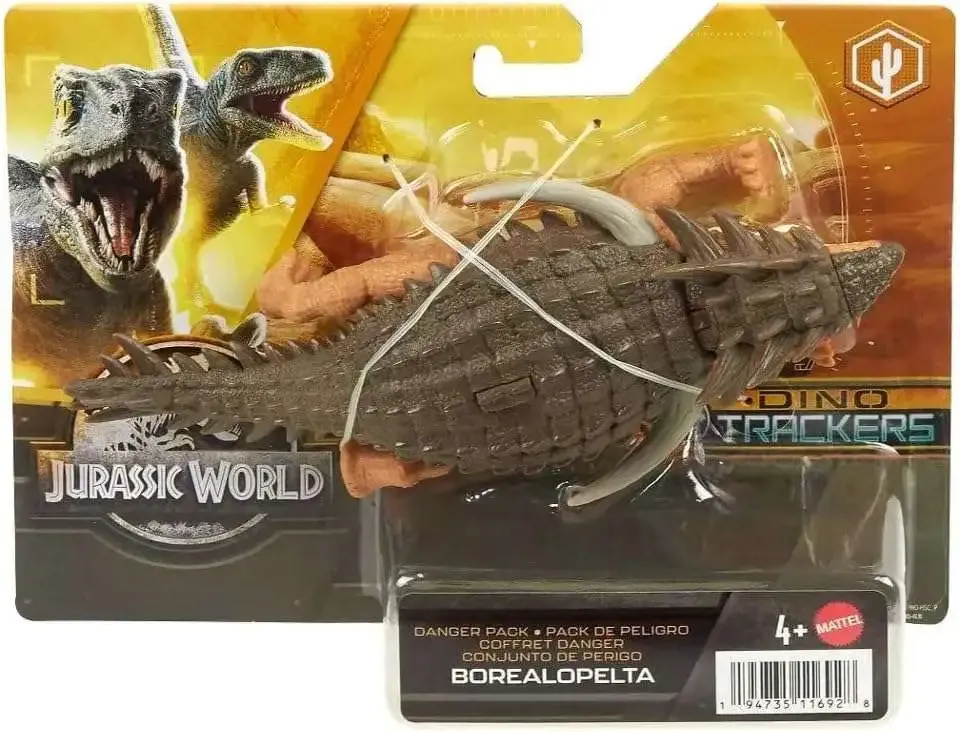
Borealopelta joined Jurassic World Dino Trackers in Danger Pack wave 3 in 2023, alongside Dakosaurus and Pyroraptor. It is based on one of the most famous fossils of recent years: an armoured dinosaur so well preserved that scientists could work out the colour of its skin. Mattel’s figure is a compact, spiky tank with big shoulder spines and posable legs. Here is what it looks like, how its colours compare with the fossil, and how to unlock it in the Jurassic World Play App.
🛡️ Armoured nodosaur🎨 Real colours known🔋 No batteries🧬 DNA scan code
Colour Check: The Fossil vs the Figure
For almost every dinosaur, toy colours are pure guesswork. Borealopelta is different. Chemical traces in its fossilised skin point to a reddish-brown pigment on its back and a lighter belly, a camouflage pattern called countershading. Here is how Mattel’s paint compares.
The pattern is right: dark on top, light underneath. The figure’s back is greyer than the reddish brown the fossil points to, but it is one of the few dinosaur toys where you can check the colours against real evidence at all.
What Is Danger Pack?
Danger Pack is the smaller, battery-free assortment of Mattel’s Dino Trackers line, built around animals that lived, hunted or moved in groups. The figures have movable joints and a hidden tracking code for the app, but no sounds or motorised attacks. Wave 3 brought Borealopelta, Dakosaurus and Pyroraptor.
Danger Pack has continued in later Jurassic World lines, and it is the easiest way to build a big Dino Trackers collection on a budget.
Paint and Colours
Armoured back, neck and tail
Legs, belly and face
Big shoulder spines
A simple, earthy scheme with a clear split. The whole armoured top is a grey brown, while the legs, belly and the sides of the face are a warm peach tan. The two big shoulder spines are picked out in pale grey, so they stand out against the darker armour like horns.
Sculpt and Detail
Armour and spines
The back is covered in rows of bony plates, sculpted with fine texture. Two long, curved spines jut from the shoulders, the signature feature of Borealopelta, and shorter spikes run along the sides, neck and tail. The real fossil has exactly this kind of large shoulder spine, so the sculpt is a good match.
Head and legs
The head is small and low, with armour plates over the top. The legs are short and sturdy with clawed feet, giving the figure a low, wide stance like a living tank.
Not a Sauropelta
Action Features and Articulation
✓ Movable legs✓ Hidden tracking code✓ No batteries needed✗ No sound or attack motion
Like every Danger Pack figure, Borealopelta keeps things simple: movable legs for posing and play, no electronics, and a tracking code hidden on the figure for the app. Its tough, spiky build makes it a natural defender against the small predators in the Danger Pack range.
Size and Specs
Sold in the HLN49 Danger Pack assortment, for ages 4 and up. It is one of the smaller Dino Trackers figures, so it is a cheap way to add an armoured dinosaur to the collection.
Is It Worth Buying?
Borealopelta is a great pick for anyone who loves armoured dinosaurs, and an especially good one for curious kids, because its real-life story is amazing: a dinosaur mummy found in a mine, with its skin and colours preserved. The figure is sturdy, needs no batteries and the big shoulder spines look great.
It came out in 2023 and is mostly found second hand now.
What we like
- Accurate big shoulder spines
- Dark back, light belly like the fossil
- Sturdy and battery free
- Amazing real-life story
Good to know
- No sound or attack motion
- Back greyer than the real reddish brown
- Small size
About Borealopelta
On 21 March 2011, heavy equipment operator Shawn Funk was digging at the Suncor Millennium oil sands mine in northern Alberta, Canada, when he hit something unusual. It turned out to be the front half of an armoured dinosaur, preserved in three dimensions with its skin and armour still in place.
Royal Tyrrell Museum technician Mark Mitchell then spent more than 7,000 hours over about six years freeing it from the rock. When it was named in 2017, the species was called Borealopelta markmitchelli, northern shield, in his honour. It is often described as the best-preserved armoured dinosaur ever found.
It lived about 110 million years ago, was a nodosaur around 5.5 m long and 1.3 tonnes, and seems to have been washed out to sea after it died. Its stomach contents were preserved too, showing that it ate mostly ferns. Not every scientist is convinced by the colour evidence, but the specimen remains one of the most remarkable dinosaur fossils ever found.
How to Unlock Borealopelta in the Jurassic World Play App
Open the Jurassic World Play App (it used to be called the Jurassic World Facts App), tap Scan and point your camera at the DNA code below. On the figure, the same code is on a small tag on the back.

Frequently Asked Questions
No. Danger Pack figures have no electronics. Borealopelta has movable legs and a hidden tracking code for the app.
Chemical traces in its skin suggest a reddish-brown back and a lighter belly, a camouflage pattern called countershading.
Heavy equipment operator Shawn Funk, at the Suncor Millennium oil sands mine in Alberta, Canada, in March 2011.
It honours Mark Mitchell, the Royal Tyrrell Museum technician who spent more than 7,000 hours freeing the fossil from the rock.
About 5.5 m long and 1.3 tonnes. It lived about 110 million years ago.
Open the Jurassic World Play App, tap Scan and point your camera at the tag on the figure’s back, or at the copy of the code on this page.