
Home › Jurassic World Dino Trackers › Dakosaurus Danger Pack
Danger Pack Figure Guide
Dakosaurus Danger Pack
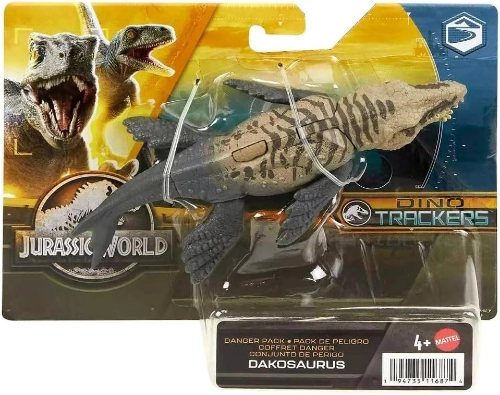
Dakosaurus swam into Jurassic World Dino Trackers in 2023 as part of the third wave of Danger Pack figures. It is not a dinosaur at all but a sea-going relative of crocodiles, with flippers, a shark-like tail fin and a mouthful of big teeth. Mattel gave it a striking tan and slate-grey paint job with dark tiger stripes, an opening jaw and jointed flippers. Here is what the figure looks like, how accurate it is, and how to unlock it in the Jurassic World Play App.
🌊 Marine reptile🐊 Sea crocodile relative💥 Opening jaw🧬 DNA scan code
Built for the Open Sea: How Accurate Is It?
Dakosaurus belonged to the metriorhynchids, crocodile relatives that left the riverbanks behind and became fully at home in the sea. Four features gave them away, and here is how the figure handles each one.
The snout is the one point to argue about. The South American species, D. andiniensis, had a famously short, deep snout that earned it the nickname Godzilla. The figure’s longer, lower snout is closer to the European D. maximus, which is a perfectly fair choice.
What Is Danger Pack?
Danger Pack is the smallest and most affordable assortment in Mattel’s Dino Trackers line. The figures have no batteries or electronics, just movable joints and a hidden DNA tracking code, and the line mixes carnivores, herbivores, flying reptiles and sea creatures. Dakosaurus arrived in wave 3 alongside Borealopelta and Pyroraptor.
The Danger Pack name has carried on through every Jurassic World line since, so it is the easiest assortment to collect side by side across the years.
Paint and Colours
Head, neck and upper back
Tiger stripes over the neck and back
Flippers, belly, rear body and tail fin
Inside of the mouth
Teeth
The paint splits the animal in two. The front half, from snout to mid back, is a sandy tan covered in dark brown tiger stripes, while the flippers, belly and tail fade into a cool slate grey. It reads like countershading on a real sea predator: lighter and patterned up top where it meets the sunlit water, plain and dark below. The red mouth and cream teeth add just enough colour when the jaw is open.
Sculpt and Detail
Head and teeth
The head is long and crocodile-like, with the eye set high on the side and a heavy brow. The jaw hinges wide open to show a red mouth lined with big cone-shaped teeth, and the textured skin around the jaw gives the face plenty of detail for a small figure.
Body, flippers and tail
The body is long and streamlined, with fine scale texture and no bony plates. All four limbs are broad, ridged paddles, and the tail ends in a tall crescent fin. It is a convincing swimmer, and it looks right posed on its belly as if gliding through the water.
Where is the DNA code?
Action Features and Articulation
✓ Opening jaw✓ Neck joint✓ Front flippers✓ Back flippers★ Hidden DNA tag✗ Tail does not move✗ No action feature
Danger Pack figures keep things simple. Dakosaurus has an opening jaw, a joint where the neck meets the body, and jointed front and back flippers, so it can be posed diving, turning or lunging at prey. There is no spring-loaded action feature, sound or battery, which keeps the price down and makes it easy for younger kids to play with.
Size and Specs
Danger Pack figures are hand-sized, small enough for a pocket or a travel bag. Dakosaurus fits in well next to the other Danger Pack sea reptiles, and it makes a natural smaller companion for the bigger Wild Roar Kronosaurus from the same line.
Is It Worth Buying?
Dakosaurus is a great pick if your collection is short on sea creatures. It is one of very few toys of a sea crocodile, the paint is among the best in the Danger Pack range, and the jointed flippers make it fun to swim around the bath or the floor.
It came out in 2023, so look for it second hand today. Check that the DNA tag on the back is intact if you want to scan it straight from the toy.
What we like
- A rare sea crocodile in toy form
- Striking tan, stripe and grey paint
- Accurate tail fin and paddles
- Wide opening jaw
- Small and affordable
Good to know
- No action feature or sound
- The tail does not move
- Front flippers a bit oversized
- Teeth lack the real serrations
About Dakosaurus
Dakosaurus was a metriorhynchid, one of a family of crocodile relatives that spent their whole lives at sea. It lived from the Late Jurassic into the very start of the Cretaceous, roughly 157 to 140 million years ago. The name was coined by Friedrich von Quenstedt in 1856 for big teeth first found in Germany, and it means biting lizard.
Two species are widely accepted. D. maximus swam the shallow seas of Europe, with fossils from Germany, England, France and Switzerland, while D. andiniensis lived off what is now Argentina and had a remarkably short, deep snout. Both reached around 4 to 5 m long, with skulls close to 1 m.
Its big, serrated teeth and powerful bite suggest it hunted large prey, including other marine reptiles, which put it near the top of the food chain in its seas.
How to Unlock Dakosaurus in the Jurassic World Play App
Open the Jurassic World Play App (it used to be called the Jurassic World Facts App), tap Scan and point your camera at the DNA code below. The same code is on the small tag in the middle of the figure’s back.

Gallery


Frequently Asked Questions
No. Dakosaurus was a metriorhynchid, a sea-going relative of crocodiles. It lived alongside dinosaurs but belonged to a completely different group of reptiles.
Its jaw opens, its neck has a joint, and all four flippers move. It has no spring-loaded action feature, sound or batteries.
It came out in 2023 in wave 3 of the Jurassic World Dino Trackers Danger Pack assortment, alongside Borealopelta and Pyroraptor. Its product code is HLN57.
Both accepted species reached around 4 to 5 m long, with a skull approaching 1 m.
From the Late Jurassic into the earliest Cretaceous, roughly 157 to 140 million years ago, in the seas of Europe and South America.
On a small tag in the middle of its back. Scan it with the Jurassic World Play App, or scan the copy on this page.