
Home › Jurassic World Primal Ambush › Becklespinax Venomous Bite
Venomous Bite Review
Becklespinax Venomous Bite
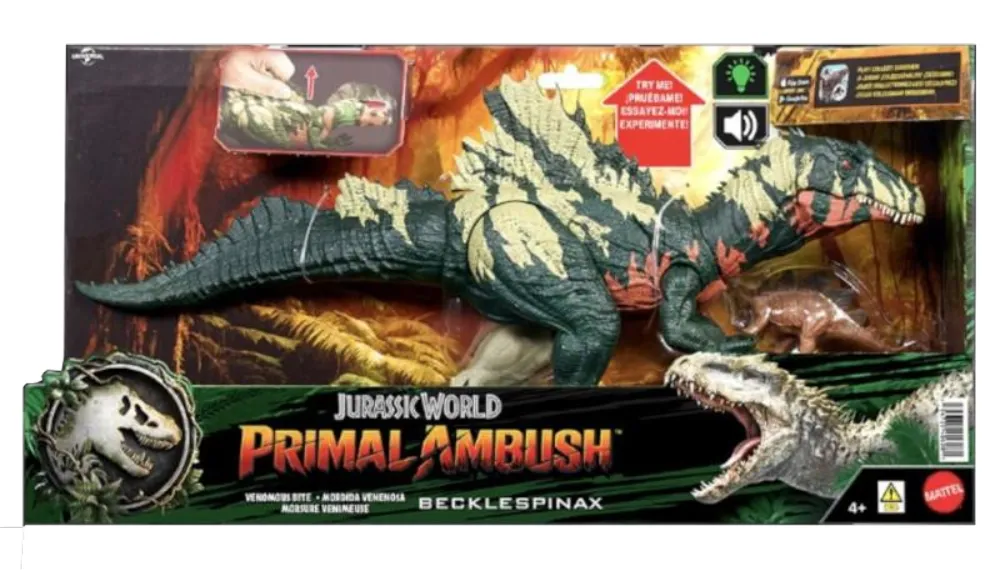
This is only the second Becklespinax in Mattel’s main Jurassic World line, and it is a big, mean-looking one. The Venomous Bite figure is stretched, spiky and painted in a very dark green with pale bands and a coral-pink underside, and its neck glows green when it strikes. It is far from a museum reconstruction, but it is easily one of the most striking large figures in Primal Ambush, and it is the kind of toy that makes kids take a step back the first time it lights up and roars.
💀 Exaggerated sculpt💡 Light-up neck and mouth🔊 Roar soundsVenomous BiteLarge figure · 44.5 cm longDNA scan code included
🔍 Old vs New: Two Very Different Becklespinax
The first Mattel Becklespinax, Battle Roarin’, went for a natural look. Venomous Bite goes the other way. Here is how the two compare.
If you want a Becklespinax that looks like a real animal, the Battle Roarin’ figure is still the one to find. If you want one that looks like it could take over the whole shelf, this is it.
Why This Stylised Take Works
Mattel’s exaggerated designs do not always land, but this one does. The sculpt leans into the idea of a venomous predator, and the paint, lights and size all back it up.
The box shows it attacking a small Stegosaurus, and the back advertises the Gigantic Thrashers figures. If you like the older version too, see our Battle Roarin’ Becklespinax guide.
Colours & Paint
Body, arms, feet and tail
Bands on the face, back and thighs
Lower jaw, throat and belly
Eyes
Teeth
Light-up panels in the neck
This has more paint than most Mattel figures from the last few years. The base is a very dark green that looks almost black in photos but is clearly green in hand. Over it runs a pale tan that shifts between yellow, cream and a hint of green, set out in bold bands across the face, the back and the thighs.
A coral pink fills the lower jaw and runs along the throat and belly, then breaks up into stripes along the sides. The pink stops at the hips, and the tail is dark green all the way to the tip, so the back half looks a little plainer than the front.
One nice touch: the legs are painted differently on each side. One leg is mostly pale with green at the bottom, while the other is green almost all the way through. The eyes are a glossy red with a dark pupil. The claws are glossed but not painted, which is the one thing the paint job is missing.
Sculpt Breakdown
Head and jaws
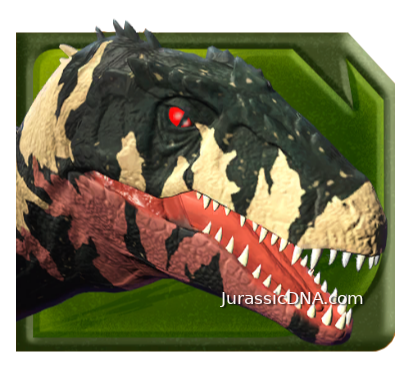
The head is long and low with crisp scales, especially along the lower jaw. Some of the detail on the upper jaw is softened by the pale paint, but it shows up well close up. The teeth are made from a softer material and look sharp, and the curved, textured tongue and glossy pink mouth add a lot when the jaws are open.
Body, hump and tail
Ridges and small spikes run down the neck and over a raised, sail-like hump on the back, a nod to the tall spines of the real fossil. The arms and legs have strong muscle definition, with skin folds on the thighs and scutes down the fingers and toes. The tail keeps the ridges going right to the tip, with a different scale texture underneath.
Collector tip
Venomous Bite Feature & Articulation
✓ Head snaps to the side✓ Green lights and roar sounds✓ Opening jaw✓ Arms, legs and swivel ankles✓ Tail moves up, down and side to side✗ Neck turns one way only✗ Unpainted claws
Pull the lever shown on the front of the box and the head snaps hard to one side while the neck lights up green and the figure roars. It takes a moment to work out, but once you have it, it is a satisfying strike. In the dark the green light also shows inside the mouth and through the teeth, which looks great.
Articulation is better than you might expect on a figure this size. The jaws open, the arms move forward, back and out, the legs swing forward and back with a little outward movement, and the ankles swivel. The tail moves up, down and side to side and can swivel too. The neck only really turns one way, because that is how the strike works.
Specs at a Glance
At about 44.5 cm long and 21 cm tall, this is a large figure that towers over most standard Mattel dinosaurs. It is about the same length as the Battle Roarin’ Becklespinax, but the bigger hump makes it a little taller.
Final Verdict
Becklespinax is one of those species Mattel keeps getting right. The Venomous Bite version is not accurate and does not try to be, but the sculpt is full of detail, the paint is some of the best in the line, and the green lights give it a menacing look that fits the venom theme.
In our house it was an instant hit. It is huge, it looks scary, and the light-up roar is the first thing everyone wants to try. A bit more pink running into the tail and painted claws would have made it close to perfect.
If you only want accurate dinosaurs, this one will not change your mind. For everyone else, and especially for kids who want a big villain for their Primal Ambush battles, it is an easy pick.
✦ The Good
- Huge, imposing figure
- Some of the best paint in the line
- Detailed sculpt from head to tail
- Green lights in the neck and mouth
- Good articulation with swivel ankles
✦ The Not So Good
- Very stylised, not accurate
- Claws are not painted
- Pink ends at the hips
- Neck only turns one way
Meet the Real Becklespinax
Three back bones, found in Sussex in the 1850s, are all we have of Becklespinax, and they are the reason the Crystal Palace Megalosaurus has a hump.Why this species is worth knowing
Where and when. Becklespinax was a large meat-eating theropod from the Early Cretaceous of England, living around 135 million years ago. Its fossils were found near Battle in East Sussex by the collector Samuel Husbands Beckles.
Three bones, tall spines. The animal is known from just three connected back vertebrae. Their spines are several times taller than the bone below them, so the living animal had a ridge, hump or low sail along its back.
The Crystal Palace hump. Richard Owen thought the bones came from the shoulders of Megalosaurus, so the Crystal Palace Megalosaurus statue was given a raised hump to match.
Many names. The bones were filed under Megalosaurus, then Altispinax, and in 1991 George Olshevsky named them Becklespinax. Some researchers now argue that Altispinax dunkeri is the correct name. With so little material, estimates of its length run from about 5 to 8 metres.
Unlock the Becklespinax
How to unlock Becklespinax from Primal Ambush?
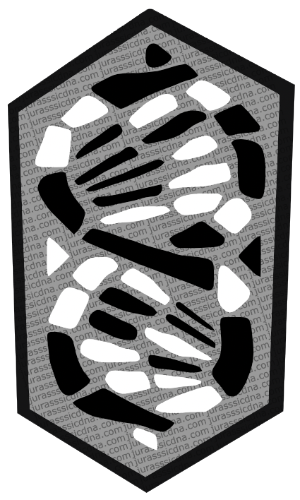
The DNA scan code is printed on the Becklespinax figure. Scan it with the Jurassic World Play App to add the Primal Ambush Becklespinax to your digital collection.
If the code on your figure is worn or hard to read, scan the copy on this page straight from your screen.
Becklespinax Gallery
Becklespinax FAQ
It is about 44.5 cm (17.5 in) long and about 21 cm (8.25 in) tall to the top of the hump, so it is a large figure.
Yes. When you trigger the strike, the neck glows green, the light shows inside the mouth and through the teeth, and the figure makes roar sounds.
Battle Roarin’ has a natural look and a wheel-driven head strike. Venomous Bite is more exaggerated, has a darker green and pink paint scheme, a slightly taller hump, and a sideways head strike with lights.
The name Becklespinax was given in 1991 to three tall-spined vertebrae from Sussex. Some researchers argue that the older name Altispinax dunkeri belongs to the same fossils, so you will see both names used.
It means Beckles’ spine. It honours Samuel Husbands Beckles, who found the fossils in the 1850s, and refers to the tall spines on its back vertebrae.
Open the Jurassic World Play App, tap Scan and point your camera at the DNA code printed on the figure, or at the copy on this page.