
Home › Jurassic World Epic Evolution › Dimetrodon Danger Pack
Danger Pack Figure Guide
Dimetrodon Danger Pack Two-Pack
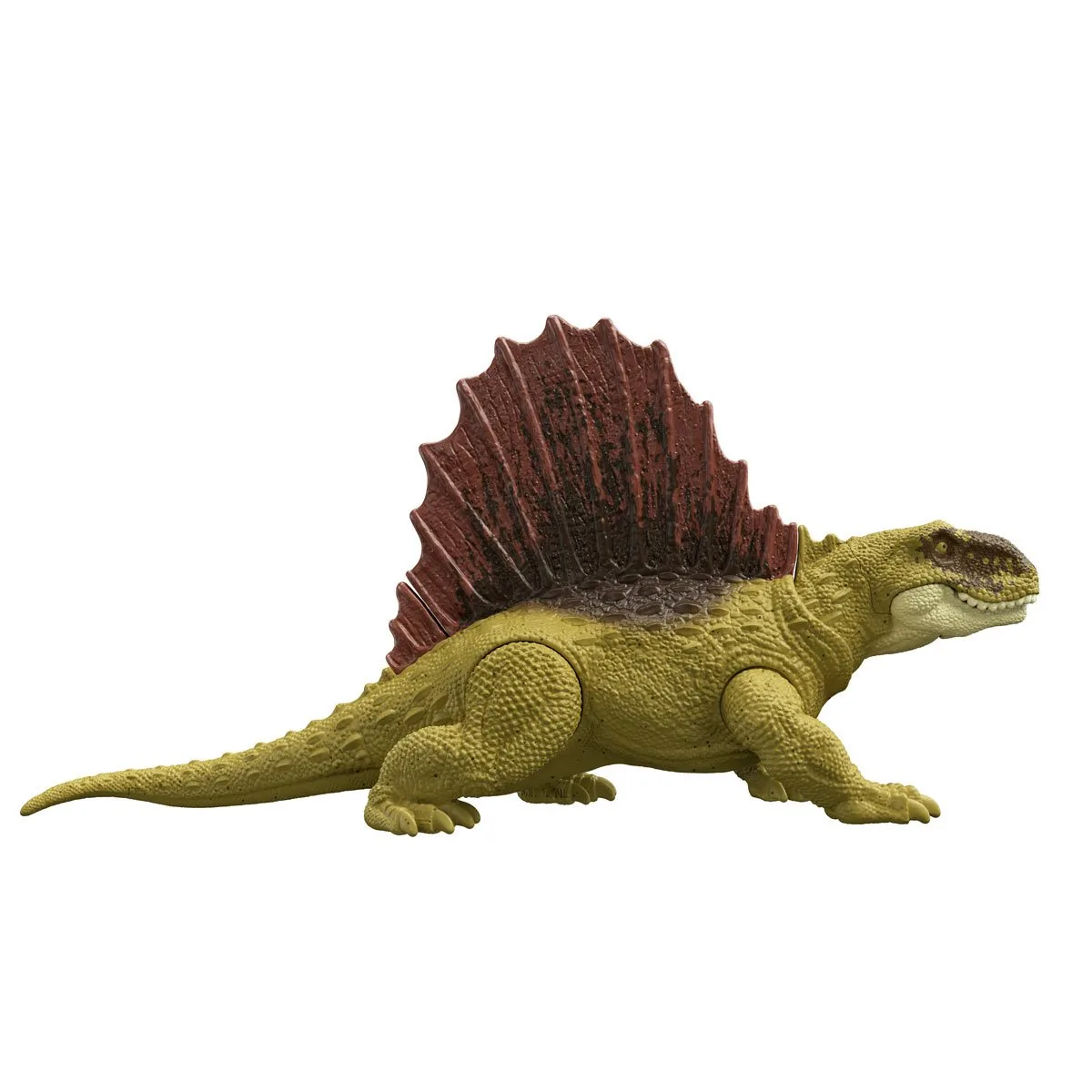
Dimetrodon is the sail-backed animal everyone thinks is a dinosaur, yet it lived more than 40 million years before the first dinosaurs and is actually closer to mammals. In Epic Evolution it comes in a Danger Pack two-pack with Velociraptor Blue, as a yellow-green figure with a tall maroon sail. Here is what the figure looks like, why it is not a dinosaur, and what we know about its DNA code.
Sail-backedTwo-packNo batteries🧬 DNA scan code
Family Ties: Closer to You Than to T. rex
Dimetrodon is a synapsid, part of the group that later gave rise to mammals.
One clue is in its skull: a single opening behind each eye, the same arrangement found in mammals.
What Is the Blue and Dimetrodon Pack?
This is a special Danger Pack two-pack in the Epic Evolution line, pairing the film raptor Blue with a Dimetrodon. Like other Danger Pack figures they have movable joints and no sounds or motorised attacks, so no batteries are needed.
It was sold as a two-pack rather than in the numbered Danger Pack waves, so it can be harder to find than single figures.
Paint and Colours
Body, legs and tail
Sail
Stripes on the sail
Belly
A bright, simple scheme. The body is a yellowish green, the tall sail is a deep maroon with red-brown stripes along the spines, and the belly is a paler yellow.
Sculpt and Detail
Head and jaw
The head is deep with a long jaw full of teeth, including bigger canine-like teeth near the front.
Sail and body
The sail is supported by long spines rising from the back, sculpted as a tall fin. Dimetrodon stands low on four sprawling legs with a long tail.
Figure vs fossil
Action Features and Articulation
✓ Posable legs✓ Tall sculpted sail✓ No batteries needed✗ No sound or attack motion
Dimetrodon keeps the Danger Pack formula: posable legs and no electronics. It comes boxed with Velociraptor Blue.
Size and Specs
Sold with Velociraptor Blue, for ages 4 and up. Look for the green body and maroon sail.
Is It Worth Buying?
Dimetrodon is a classic prehistoric animal and a great way to show kids that not everything with scales was a dinosaur. Together with Blue, the two-pack is good value. Its DNA code is still to be confirmed.
It came out in 2024 as a Danger Pack two-pack.
What we like
- Classic sail-backed animal
- Comes with Blue
- Bold maroon sail
- No batteries
Good to know
- Not a dinosaur
- DNA code not confirmed yet
- No sound or attack motion
About Dimetrodon
Dimetrodon was named in 1878 by Edward Drinker Cope from fossils found in Texas. The name means two-measure teeth, because it had teeth of different sizes.
It lived in the Early Permian, about 295 to 272 million years ago, in what is now the United States and Germany. The largest species reached about 4.6 m long.
Dimetrodon was the top predator of its time, hunting amphibians, fish and other synapsids.
How to Unlock Dimetrodon in the Jurassic World Play App
We have not confirmed the DNA code for this figure yet. The image below is a placeholder until we add the real code.

Frequently Asked Questions
No. It is a synapsid, more closely related to mammals than to dinosaurs.
A Danger Pack two-pack with Velociraptor Blue.
In the Early Permian, about 295 to 272 million years ago, long before dinosaurs.
The largest species reached about 4.6 m long.
No one is sure. It may have helped control body temperature or been used for display.
We have not confirmed it yet. We will add it to this page as soon as we do.