Home › Jurassic World Dino Trackers › Zuniceratops Strike Attack
Strike Attack Figure Guide
Zuniceratops Strike Attack
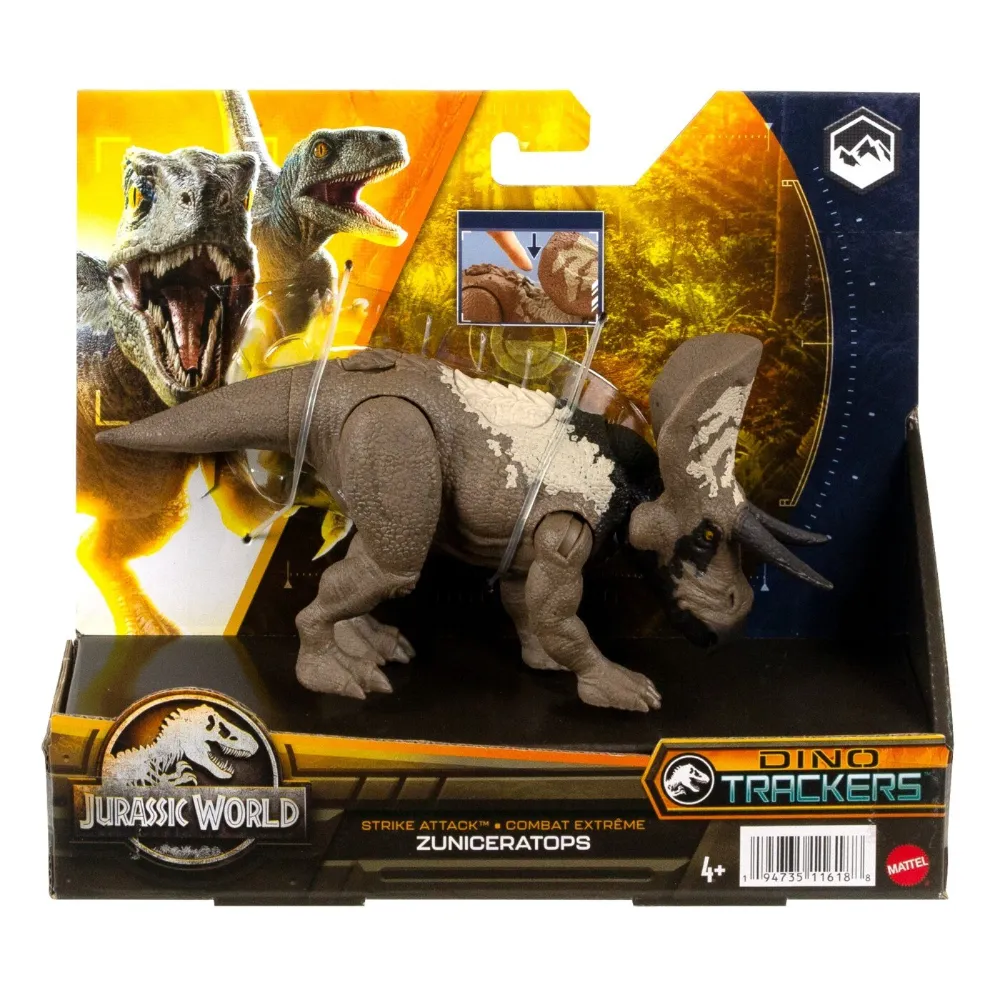
Zuniceratops was one of the first Jurassic World Dino Trackers figures, part of the 2022 Strike Attack wave alongside Herrerasaurus and Genyodectes. It is an early horned dinosaur from New Mexico with long brow horns and no nose horn, and it was discovered by an 8-year-old boy. Mattel’s figure is a brown, frilled ceratopsian with a press-to-charge strike action. Here is what it looks like, the young fossil hunter who found it, and how to unlock it in the Jurassic World Play App.
🦏 Brow horns💥 Strike action🔋 No batteries🧬 DNA scan code
Found by an 8-Year-Old
Most new dinosaurs are found by professional scientists. Zuniceratops was spotted by a child, and the species is named after him.
The species name christopheri honours him. So if you love hunting for fossils, keep looking: the next new dinosaur could be yours.
What Is Strike Attack?
Strike Attack is the action assortment of Mattel’s Dino Trackers line. Each figure has one built-in strike move: press the button on its back and it lunges into an attack, no batteries needed. They also have movable joints and a hidden tracking code for the app. The first Strike Attack wave brought Zuniceratops, Herrerasaurus and Genyodectes.
Strike Attack has continued in later Jurassic World lines, and Zuniceratops has returned in new versions since.
Paint and Colours
Body, legs and tail
Frill and back patches
Horns, beak and neck band
Eyes
Earthy and natural. The body is a taupe brown dotted with small dark speckles, while the frill and patches along the back are a lighter sand colour with a cracked-earth pattern. A dark chocolate band crosses the neck behind the frill, matching the long horns and the hooked beak, and a yellow eye peers out from a dark patch.
Sculpt and Detail
Horns and frill
Two long, curved horns sweep forward over the eyes, and there is no horn on the nose, which matches the real Zuniceratops. Behind them rises a tall, broad frill. The beak is hooked like a parrot’s, perfect for snipping tough plants.
Body and legs
The body is stocky with four sturdy legs and clawed feet, shown with the head lowered as if about to charge. The tail is short and thick. Overall it looks like a small, early version of the giant horned dinosaurs that came later.
First with brow horns
Action Features and Articulation
✓ Press-to-strike action✓ Movable joints✓ Hidden tracking code✗ No sounds
Press the button on Zuniceratops’s back and it swings into a horn strike, as if charging a rival. It is purely mechanical, so there are no batteries to replace, and the joints let you pose it between attacks. The tracking code is hidden on the figure for the app.
Size and Specs
For ages 4 and up. Zuniceratops has been made several times in Jurassic World Strike Attack, so check for the Dino Trackers logo and the brown and sand colours to be sure you have this 2022 version.
Is It Worth Buying?
Zuniceratops is a great pick for kids who love horned dinosaurs and want something that does more than stand still. The horn-strike action is fun, the earthy paint looks natural, and it needs no batteries. Its real-life story, found by an 8-year-old, makes it a favourite to share with young fossil fans.
It came out in 2022 and is mostly found second hand now.
What we like
- Brow horns and no nose horn, like the real animal
- Fun horn-strike action
- Natural, earthy paint
- No batteries needed
Good to know
- Only one action
- No sounds
- Easy to mix up with later versions
About Zuniceratops
Zuniceratops christopheri was named in 1998 by Douglas Wolfe and James Kirkland, from fossils found in the Moreno Hill Formation of west-central New Mexico. The name means Zuni horned face, in honour of the Zuni people of the region, and christopheri honours its young discoverer.
It lived in the Late Cretaceous, around 93 to 89 million years ago. It was a small plant-eater, roughly 3 to 3.5 m long and around 100 to 150 kg, with a long, low snout, a broad frill with two large openings, and a pair of brow horns but no nose horn.
One skull and bones from several individuals are known. It sits between small early horned dinosaurs like Protoceratops and the giant ceratopsids, and suggests that the big horned dinosaurs may have evolved in North America.
How to Unlock Zuniceratops in the Jurassic World Play App
Open the Jurassic World Play App (it used to be called the Jurassic World Facts App), tap Scan and point your camera at the DNA code below. The same code is on a small tag on the figure.

Frequently Asked Questions
No. The strike action is mechanical: press the button on its back and it swings into a horn strike.
Christopher James Wolfe, aged 8, in 1996 in New Mexico. The species name christopheri honours him.
Zuni horned face, in honour of the Zuni people who live in the region where it was found.
No. It had two brow horns but no nose horn, and it is the earliest known horned dinosaur with brow horns.
About 3 to 3.5 m long and around 100 to 150 kg, much smaller than Triceratops.
Open the Jurassic World Play App, tap Scan and point your camera at the tag on the figure, or at the copy of the code on this page.