Home › Jurassic World Dino Trackers › Dilophosaurus Strike Attack
Strike Attack Figure Guide
Dilophosaurus Strike Attack
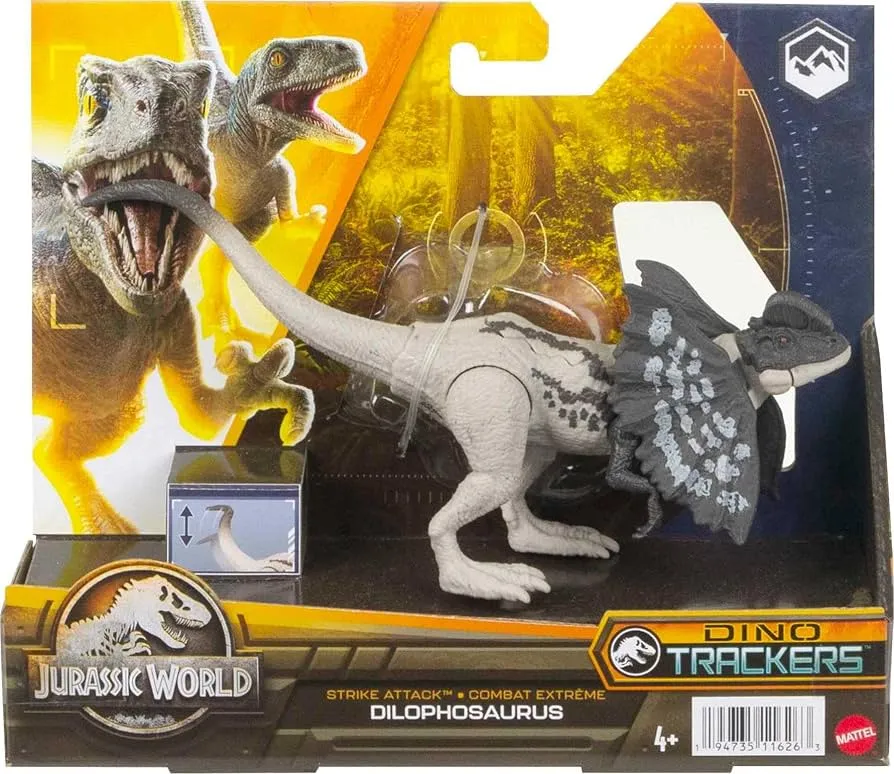
This pale grey Dilophosaurus joined Jurassic World Dino Trackers in Strike Attack wave 2, alongside the green Atrociraptor, Gigantspinosaurus, Edaphosaurus and Prestosuchus. It follows the famous Jurassic Park look, frill and all, in a striking white and black deco. Here is what it looks like, how much our picture of the real Dilophosaurus has changed, and how to unlock it in the Jurassic World Play App.
🎬 Movie frill💥 Strike action🔋 No batteries🧬 DNA scan code
Dilophosaurus: Then and Now
Few dinosaurs have had a bigger makeover. Here is how the picture changed between the first study and the big 2020 redescription.
- Named as a species of Megalosaurus
- The head crests were not recognised
- Thought to have weak jaws
- Skeleton mount partly plaster, shaped like Allosaurus
- Its own genus, named Dilophosaurus in 1970
- Twin crests strengthened by air pockets
- Powerful jaws and strong muscles
- A big predator, up to about 7 m long
The early idea of a weak, slender animal helped inspire the small, venom-spitting version in Jurassic Park. The real Dilophosaurus was the largest land predator of its time in North America.
What Is Strike Attack?
Strike Attack is the action assortment of Mattel’s Dino Trackers line. Each figure has one built-in strike move triggered by a button, no batteries needed. They also have movable joints and a hidden tracking code for the app. The second Strike Attack wave brought this Dilophosaurus alongside the green Atrociraptor, Gigantspinosaurus, Edaphosaurus and Prestosuchus.
Dilophosaurus has appeared in many colours across Jurassic World lines, so this white and black version is easy to spot.
Paint and Colours
Body, legs and tail
Crests, arms, frill and back stripe
Camouflage pattern on the frill
Speckles and tail tip
A ghostly, high-contrast look. Most of the body is off-white with fine dark brown speckles. A black stripe runs down the back, the arms and head crests are black, and the tail tip darkens to brown. The open frill is black with a grey camouflage pattern, which really pops against the pale body.
Sculpt and Detail
Crests and frill
Two small crests sit on top of the head, as on the real animal, though the real crests were tall, thin and much more prominent. The big neck frill comes straight from the Jurassic Park film. No fossil evidence for a frill has ever been found.
Body
A slim, crouching predator with grasping hands and a long tail, similar in size to the other Strike Attack figures. It follows the small movie version rather than the real animal, which was a large, heavily built hunter.
Frill and venom
Action Features and Articulation
✓ Press-to-strike action✓ Posable arms✓ Hidden tracking code✗ No sounds
Press the button on Dilophosaurus’s back and it springs into its strike move. It is purely mechanical, so there are no batteries to replace, and the arms and legs can be posed between attacks. The tracking code is hidden on the figure for the app.
Size and Specs
For ages 4 and up. The frill is part of the sculpt, so there are no loose pieces to lose.
Is It Worth Buying?
This Dilophosaurus is a great pick for fans of the classic Jurassic Park dinosaur and for collectors who want an unusual colour. The white and black deco looks fantastic, the strike action adds play value, and it needs no batteries. It is the movie version, though, so it is small and frilled rather than true to the fossils.
It came out in 2023 and is mostly found second hand now.
What we like
- Iconic movie look
- Striking white and black deco
- Fun strike action
- No batteries needed
Good to know
- Frill is movie fiction
- Much smaller and slimmer than the real animal
- No sounds
About Dilophosaurus
Jesse Williams, a Navajo man, found the first Dilophosaurus bones in 1940 on Navajo Nation land near Tuba City, Arizona. In 1942 he showed them to a team from the University of California, Berkeley. Samuel Welles described the skeleton in 1954 as a new species of Megalosaurus, then gave it its own name, Dilophosaurus (two-crested lizard), in 1970 after recognising the crests.
It lived in the Early Jurassic in the Kayenta Formation of northern Arizona. The largest specimens suggest it reached about 7 m long, making it the biggest land predator known from North America at the time.
In 2020, palaeontologists Adam Marsh and Timothy Rowe published a full redescription, showing it had strong jaws and air-filled crests. The main skeletons belong to the Navajo Nation and are kept at UC Berkeley.
How to Unlock Dilophosaurus Strike Attack in the Jurassic World Play App
Open the Jurassic World Play App (it used to be called the Jurassic World Facts App), tap Scan and point your camera at the DNA code below. The same code is on a small tag on the figure.

Frequently Asked Questions
No. The strike action is mechanical: press the button on its back to trigger it.
No. Both were invented for Jurassic Park. There is no fossil evidence for a frill or venom.
Up to about 7 m long, far bigger than the small dinosaur in the film.
Jesse Williams, a Navajo man, found the first bones in 1940 near Tuba City, Arizona, and showed them to UC Berkeley scientists in 1942.
No. This is the white and black Strike Attack release from 2023, with its own grey-labelled scan code.
Open the Jurassic World Play App, tap Scan and point your camera at the tag on the figure, or at the copy of the code on this page.