

Home › Jurassic World Survival › Cryolophosaurus Wild Roar
Wild Roar Review
Cryolophosaurus Wild Roar Jurassic World Survival Review
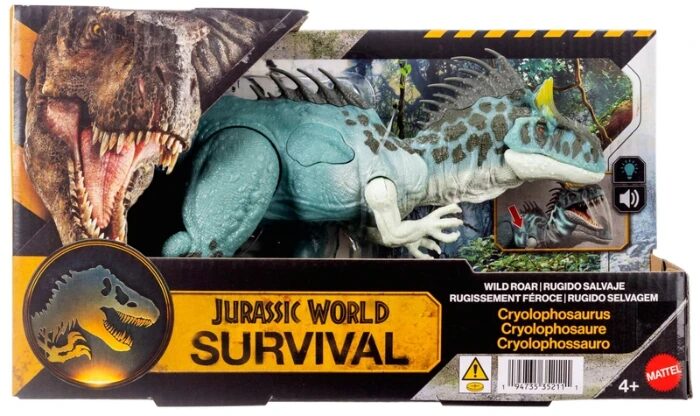
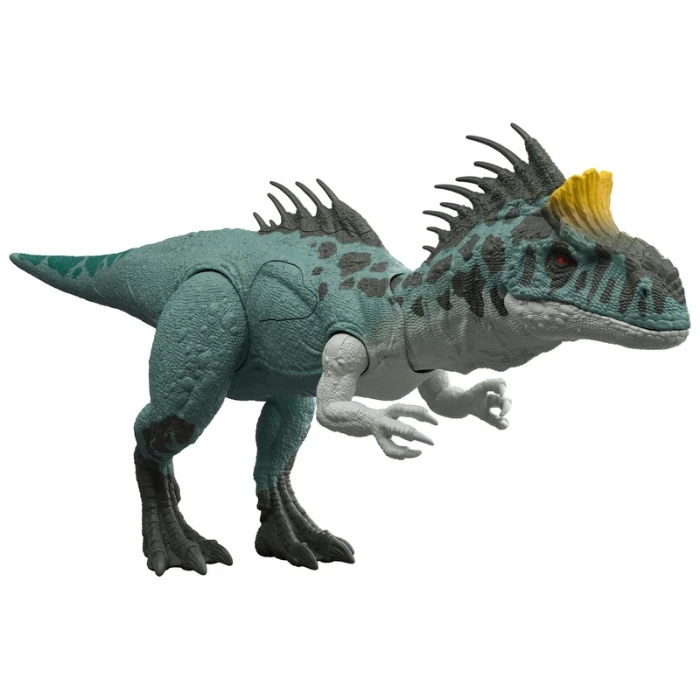
👑 This might be my favourite figure from the entire Survival line so far. The Cryolophosaurus Wild Roar is one of the most striking-looking figures Mattel has ever produced: vivid blue body, glowing yellow crest, quill and spine detailing along the back, lips, and a light-up feature that reveals a hidden speckling pattern visible only in complete darkness. Everything about this figure is exceptional.
👑 Best Mattel Cryolophosaurus💡 Hidden speckling light-up🦷 Sculpted lipsMattel · 2026Scan code included
⭐ Why This Figure Stands Out
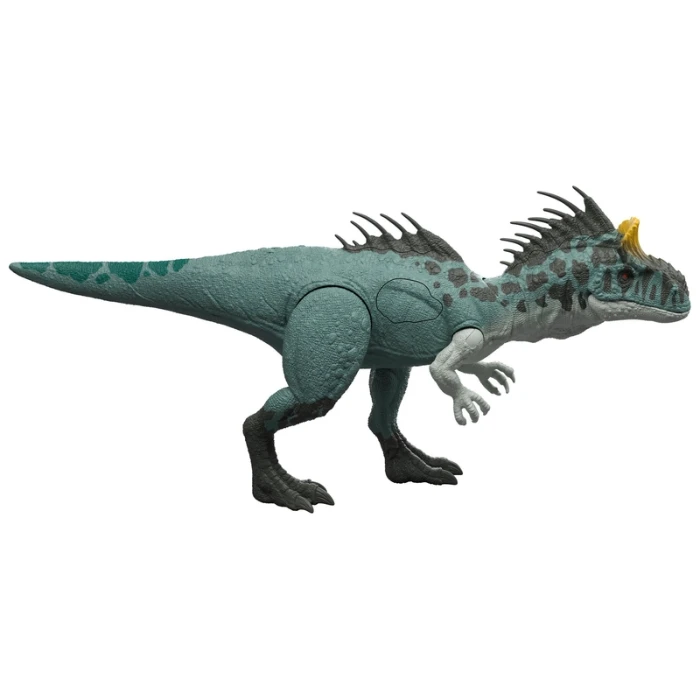
The light blue sits against the yellow of the crest in a way that looks genuinely striking. The spiny quills along the back and neck add Survival-line distinctiveness without being as divisive as the thagomizer tail on the Metriacanthosaurus. The lips give the face a modern, almost predatory elegance, the dark gray markings over the snout and around the eye socket add depth, and the darker greenish-blue at the tail tip adds a finishing colour note. In hand, at almost any angle, this figure makes a lasting impression.
🔁 Previous Cryolophosaurus Releases

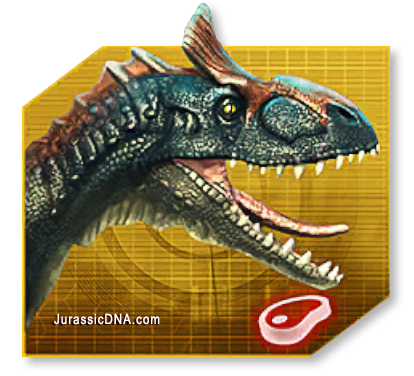
1. Paint Scheme and Sculpt
Primary bodyYellow
Cranial crestDark gray
Snout & eye markingsGreenish-blue
Tail tip
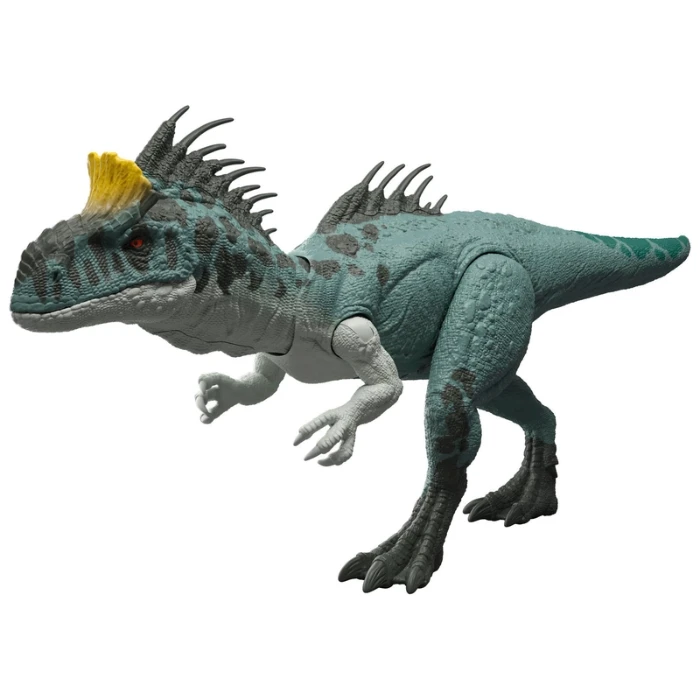
The vivid blue primary body is the most eye-catching element of the colour scheme and one of the more striking base colours in the Survival Wild Roar range. Dark gray stripes run over the snout, circles surround the eye socket and stripes run downward, creating a patterned face that reads well from any angle.
The yellow of the cranial crest is vivid and, given the translucency of parts of the figure, appears to catch the light differently from the rest of the head, making it pop naturally. The darker greenish-blue at the tail tip is a lovely finishing detail and one of the figure’s best touches.
The mouth closes with a slight gap visible, a minor imperfection but not distracting. The teeth are rubber, painted a light yellow / off-white on both jaws.
Sculpt Detail, Head to Tail
Head, crest and lips
The head sculpt features impressive and varied scale detail throughout: fine scales with osteoderms appearing here and there, larger scales along the jawline, scutes moving over the snout, and clearly sculpted nostrils. The cranial crest is the defining feature and is rendered well, with the yellow paint applied cleanly and the crest elevated prominently above the skull in the transverse orientation characteristic of the real Cryolophosaurus.
The lips are something I specifically love on this figure. Against the blue body and yellow crest, they give the face an unexpected detail that is simply gorgeous.
Neck, quills and arms
Moving into the neck, the skin texture varies considerably, with bumpier scales and osteoderms at the top and finer detail toward the throat. The quills or spines along the top of the neck and back are the defining Survival mutation on this figure and they work exceptionally well — they look quite sharp and painful to step on, but are flexible enough to be all look and no danger.
The arms are held close to the body in a natural position and are made from a slightly rubbery material throughout. Arm articulation covers forward, back and out away from the body. Muscle definition in the arm is visible and the elbow is sculpted cleanly.
In the dark
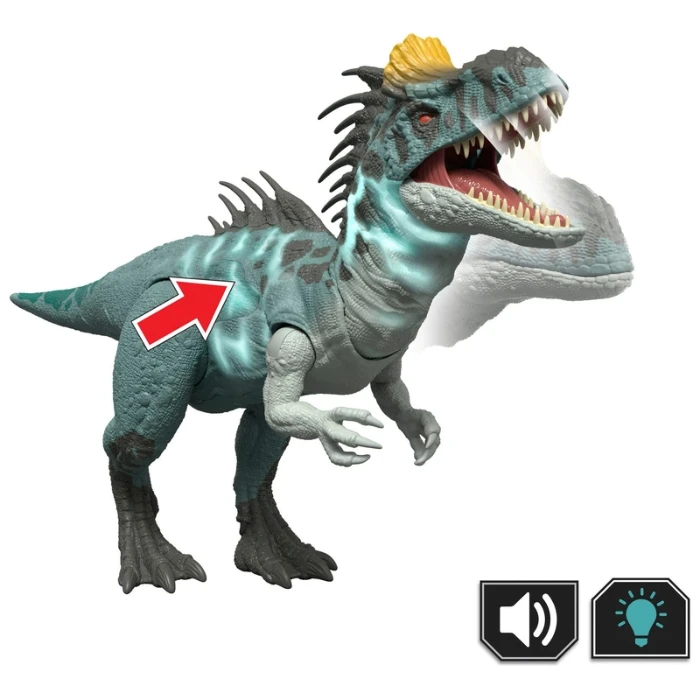
In normal lighting the glow runs through the neck and stomach and is reasonably visible; in dimmed lighting it improves considerably. The speckling is not present on the figure’s surface in normal light at all — it only becomes visible through the light-up mechanism.
2. Action Feature, Light-Up & Articulation
✓ Neck lift (action feature)✓ Jaw snap open✓ Light-up with hidden speckling✓ Sound effects✓ Arms — forward, back, outward✓ Legs — forward and back✗ Tail swivel at the base only✗ Legs are stiff
The action feature is activated by a button and causes the neck to lift upward as the jaw snaps open, producing a strike-from-above motion that suits the Cryolophosaurus well. Sound effects accompany both the action and the light-up.
Specifications at a Glance
Worth noting for comparison: the Metriacanthosaurus from the same wave has a noticeably longer tail, which makes the Cryolophosaurus’s stub particularly stark.
Verdict: Should I Buy It?
Without hesitation. The Cryolophosaurus Wild Roar is the best Mattel Cryolophosaurus ever produced and one of the most visually striking figures in the entire Survival line. The blue and yellow combination is genuinely beautiful, the quill and spine detailing along the back is this Survival mutation at its best, the lips add character to the face, and the hidden light-up speckling is a remarkable detail that rewards anyone who sees it in the dark. The short tail is a bummer, but not bad enough to ruin the overall impression.
✦ What Works
- Best Mattel Cryolophosaurus ever produced
- Vivid blue body against a yellow crest
- Hidden speckling pattern revealed in the dark
- Sculpted lips, rare on a Mattel theropod
- Neck and back quills done tastefully
- Varied, impressive scale detail on the head
- Transverse crest true to the real animal
- Greenish-blue tail tip finishes the scheme
- Arms move forward, back and outward
- Neck lift and jaw snap with sounds
✦ What Doesn't
- Tail is far too short for the body
- Mouth closes with a visible gap
- Tail swivels at the base only
- Leg movement is stiff
- Light-up is modest outside a dark room
3. About the Cryolophosaurus
Cryolophosaurus ellioti (meaning “frozen crested lizard”) is a genus of large theropod dinosaur from the Early Jurassic Hanson Formation of Antarctica, dating to approximately 196 to 188 million years ago. It was the first carnivorous dinosaur discovered in Antarctica, excavated from Mount Kirkpatrick in the Transantarctic Mountains by paleontologist William Hammer and his team during the 1990–91 austral summer, some 4,000 metres above sea level and roughly 640 kilometres from the South Pole. The species was formally named and described in Science in 1994 by Hammer and William Hickerson, the species name honouring geologist David Elliot, who made the initial discovery.
Cryolophosaurus was one of the largest theropods of the Early Jurassic, with the known subadult estimated at 6 to 7 metres in length and 350 to 465 kilograms in mass. Its most distinctive feature is a forward-facing, fan-shaped crest rising from the top of the skull just in front of the eyes, furrowed with ridges rather than smooth. Unlike the paired lengthwise crests of Dilophosaurus, the Cryolophosaurus crest runs transversely across the skull, which is unique among known crested theropods — and earned the animal the nickname “Elvisaurus” among researchers. The crest is thought to have served a display function in species recognition and territorial or breeding contests. During the Early Jurassic, Antarctica was considerably warmer than today, with temperate forests and seasonal daylight variation, and Cryolophosaurus would have been the apex predator of its ecosystem, likely hunting early sauropodomorphs such as Glacialisaurus.
Cryolophosaurus ellioti is the first carnivorous dinosaur ever discovered in Antarctica. Its transverse cranial crest, curving forward and fanning outward above the eyes, prompted field researchers to nickname it Elvisaurus.
How to Unlock
How to unlock the Cryolophosaurus Wild Roar in the Jurassic World Survival collection?
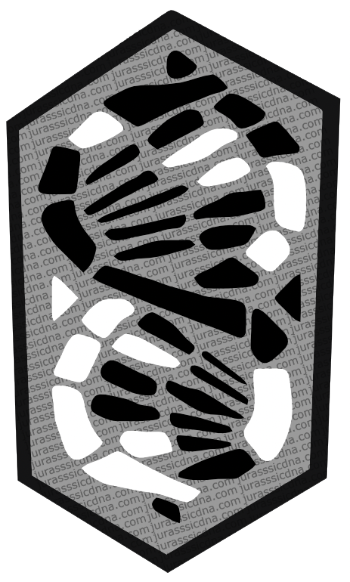
Open up your Jurassic World Play App (previously known as the Jurassic World Facts App), press the Scan button and point it towards the DNA code here:
Cryolophosaurus Wild Roar Gallery
Cryolophosaurus Wild Roar FAQ
Cryolophosaurus ellioti was the first carnivorous dinosaur discovered in Antarctica, living approximately 196 to 188 million years ago during the Early Jurassic. Its distinctive cranial crest runs transversely across the skull rather than lengthwise like most crested theropods, fanning forward and outward above the eyes in a shape researchers compared to the hairstyle of Elvis Presley — earning it the nickname Elvisaurus.
Yes. The light-up activates with the action feature button and runs through the neck and stomach area. In normal lighting it is visible; in dimmed conditions it improves significantly; and in complete darkness it reveals a hidden speckling pattern not visible under normal light, creating a bioluminescent effect with slight colour variation across the body.
The action feature activates a neck lift and jaw snap with sound effects. The neck raises upward as the jaw opens, mimicking a strike-from-above attack. The light-up triggers simultaneously.
The short tail is a design choice rather than a species-accurate feature, and it is the figure’s most disappointing aspect. No clear explanation is apparent from the Survival line design premise. The Metriacanthosaurus from the same wave has a noticeably longer tail, making the contrast particularly stark.
Open the Jurassic World Play App, tap the Scan button, and point it at the DNA barcode on the Cryolophosaurus foot.