
Home › Jurassic World Rebirth › Achillobator Strike Attack
Strike Attack Review
Achillobator Strike Attack
The Achillobator is one of the most anticipated figures in the Rebirth line, because this is the species’ first appearance as a Mattel toy. It looks unlike anything else in Mattel’s current range: a stylised head crest, dramatic tail plumage, injury detailing across the body and a naturally distinctive silhouette. But this is one of those times when size does matter, and the Achillobator is insultingly small.
⭐ First Mattel Achillobator🪶 Head crest + tail plumage🩹 Injury & scar detailing📏 Strike Attack scaleMattel · 2025Scan code included
🪶 Feathered Raptor Head-to-Head
There is no previous Achillobator to compare against, as this is a first release. The most useful comparison is another feathered Strike Attack raptor from the era just before it: the Chaos Theory Pyroraptor. Both share the same format, price point and design idea, a feathered dromaeosaurid in Strike Attack packaging, so side by side they show what Mattel has learned and where its priorities have shifted.
The Pyroraptor is the more cohesive design, with feathers where feathers should be, a consistent silhouette and a colour scheme that reads clearly. The Achillobator is the more ambitious and striking figure, but the body texture compromise and the size decision partly undercut that ambition. If you prioritise design consistency, the Pyroraptor wins. If you want something that looks unlike anything else on your shelf, the Achillobator is the one.
What Is Strike Attack?
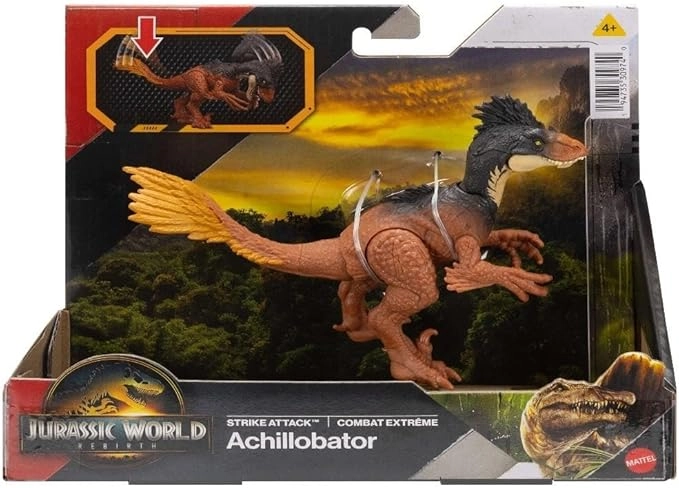
Strike Attack is Mattel’s core action-figure format: figures with standard articulation and a single mechanical attack, usually triggered by pressing the tail. There are no lights, sounds or batteries, and the format sits below larger tiers such as Wild Roar and Gigantic Thrashers in both size and price.
That size bracket is the root of this figure’s biggest problem. It works well for small and medium species, but it squeezes larger animals. Other Strike Attack releases on the site include the Chaos Theory Pyroraptor and the upcoming Primal Ambush wave, such as the Berberosaurus and Utahceratops.
Paint & Colour Scheme
Body, arms & legs
Crest, neck & back
Lower jaw & throat
Tail plumage
Eye
Teeth
Tongue
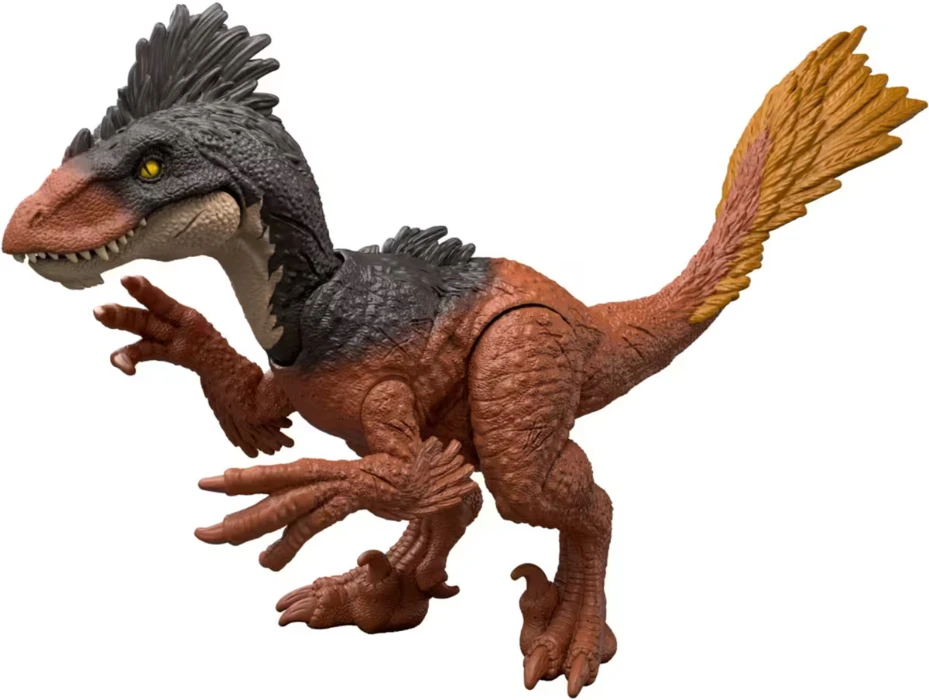
The colour scheme is the part of this figure that works without any qualification. A charcoal black crest and mantle sits over a rust red body, a cream lower jaw and throat pull the face forward, and at the other end a bright orange fan of tail feathers finishes the animal off. On our shelf it reads more like a bird of prey than a lizard, which is exactly the right instinct for a dromaeosaur.
The black of the neck and back does not stop at a hard line. It breaks up into the feathered patch over the shoulders and fades into the red, and the tail plumage warms gradually from the body colour into orange instead of switching abruptly. For a figure at this price, those transitions are handled with more care than we expected.
Where the budget shows is in the small applications. The claws on the hands and feet are left in the base colour, and the teeth are painted, but not neatly. Neither is visible from a normal viewing distance, but both are noticeable once the figure is in your hand.
Sculpt & Detail
A crest that defines the figure
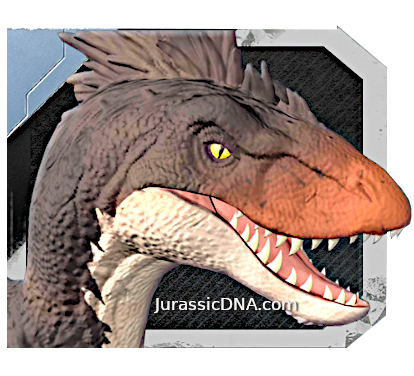
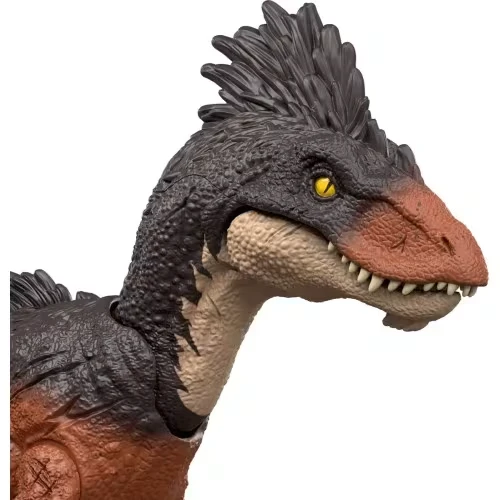
The head is the best part of the sculpt. A tall, swept back crest of feathers rises from behind the eyes and runs down the neck, giving the Achillobator an instantly recognisable profile. It is a stylised choice rather than a scientific one, but it means nobody will mistake this figure for any other raptor in the range.
The face itself is deep and heavy, which suits an animal known for a robust upper jaw. The lower jaw opens through the action feature to show a pink tongue and a row of sculpted teeth, and the cream throat gives the head a clear, readable shape even from across the room.
The body texture compromise
Below the crest and the shoulder feathers, the body switches to a bumpy, pebbled skin that feels closer to a toad than a bird. The texture is crisp and well defined, and it takes the red paint nicely, but it sits awkwardly next to the feathered areas. The figure ends up looking like two different design ideas joined at the shoulders.
What redeems the body is the battle damage. Deep gouges and healed scars are cut into the flanks, legs and arms, and they are sculpted rather than just painted on. They give the Achillobator a worn, survivor look that fits the Rebirth setting, and they are the detail that makes it feel like more than a generic raptor.
Feathers, but only in places
Articulation & Action Feature
✓ Hips, legs swing forward and back✓ Shoulders, arms rotate★ Head lunge on tail pull★ Jaw opens with the strike✓ No batteries needed✗ No knee or ankle joints✗ Head and jaw only move with the action
Articulation is standard Strike Attack: the legs swing at the hips and the arms rotate at the shoulders. That is enough to tilt the Achillobator into a stalking or lunging stance, but there are no knees or ankles, so every pose starts from the same sculpted stride.
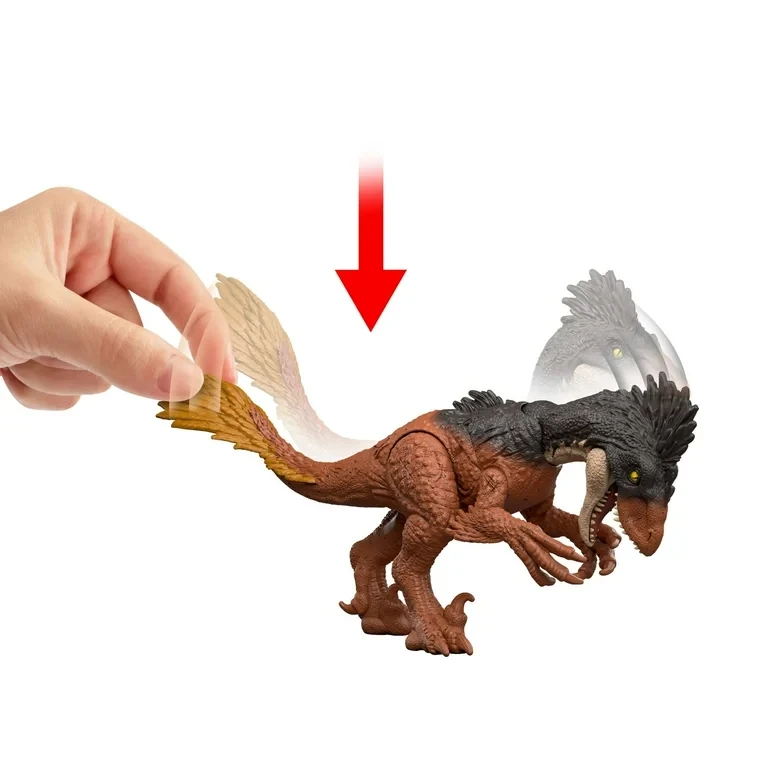
The action feature is where the play value lives. Pull the curled tail downward and the head lunges forward and down while the jaws open, like a raptor driving in to grab prey. Release the tail and it springs back into place. The mechanism is quick and smooth, and it is the kind of feature that gets used over and over during play because it needs nothing more than a thumb.
The catch with building the action into the tail is that the tail plumage, the best looking part of the figure, is also the part that gets grabbed and pulled the most. It is worth keeping in mind if this one is going to a younger collector.
Size: The Achillobator Problem
This is the issue that costs the figure the most points. Achillobator was one of the largest raptors ever found, somewhere around 4.5 to 5 metres long and weighing an estimated 250 to 300 kg. Mattel has released it at the same Strike Attack size as raptors that were less than half that length.
Stand it next to the Chaos Theory Pyroraptor, an animal of roughly 2.5 metres, and the two look like the same animal in different costumes. Put it beside one of the Velociraptors and the Achillobator barely towers over a species that was about the size of a large turkey. For a collector who displays by scale, it simply does not work.
The frustrating part is that the design would have suited a bigger format. A Wild Roar sized Achillobator, with room for proper bulk in the legs and chest, could have been one of the standout raptors in the line. At this size, the robust build that defines the real animal is lost.
Our Verdict
Achillobator finally joining the line was big news for raptor fans, and in many ways the figure delivers. The crest, the orange tail plumage and the sculpted battle damage give it a look nothing else in the Rebirth range can match, and the head strike action is quick, reliable and fun.
The problems are just as easy to see. The feathers stop at the shoulders and give way to a scaly, toad-like skin, the claws and teeth get minimal paint, and above all the figure is scaled down to the same size as raptors that were a fraction of its real length. For one of the biggest dromaeosaurs ever found, that is a hard decision to accept.
If you collect every species, or you simply love unusual raptor designs, it is still worth picking up, since this is the only Achillobator Mattel has made. If you display by scale, or you want the most consistent feathered raptor in this format, the Chaos Theory Pyroraptor is the better buy.
✦ What Works
- First ever Mattel Achillobator
- Dramatic feather crest gives it an instantly recognisable profile
- Orange tail plumage is the best looking detail on the figure
- Sculpted gouges and scars across the body
- Strong black, rust and cream colour scheme with soft transitions
- Fast, reliable head strike action with no batteries
✦ What Doesn't
- Far too small for one of the largest raptors ever found
- Feathers limited to the crest, back, arms and tail
- Toad-like body texture clashes with the feathered areas
- Unpainted claws, including the sickle claws
- Loose paint on the teeth
- No knee or ankle articulation
About the Achillobator
Not a lightweight sprinter like Velociraptor, but a heavy, powerfully built hunter with a deep jaw and thick legs. Achillobator was one of the bruisers of the raptor family.Why the real animal deserved a bigger figure
Where and when. Achillobator giganticus lived in what is now the Gobi Desert of Mongolia during the Late Cretaceous, roughly 96 to 89 million years ago. Its fossils come from the Bayan Shireh Formation at the Burkhant locality, and it was formally described in 1999 by Altangerel Perle, Mark Norell and James Clark.
The name. Achillobator means “Achilles hero”. The first half refers to the large Achilles tendon that would have powered the sickle claw on each foot, and the second comes from the Mongolian word baatar, meaning hero or warrior.
Built like a tank. At around 4.5 to 5 metres long and an estimated 250 to 300 kg, Achillobator was one of the largest dromaeosaurs ever found, in the same league as Utahraptor. Its skeleton is unusually robust for a raptor, with a deep upper jaw and a thigh bone that is longer than the shin, an arrangement that is rare in this family and suggests power rather than pure speed.
An unusual hip. Its pubis points straight down rather than sweeping backward as in most dromaeosaurs, ending in a relatively large pubic boot. That odd combination once led some researchers to suggest the fossil was a mix of two different animals, but later work supported it as a single individual.
What it ate. The heavy jaw and big build point to a predator that tackled large prey. Like every dromaeosaur, it was very likely covered in feathers, which is why the partial feathering on the Mattel figure feels like such a missed opportunity.
Unlock the Achillobator
Code worn off your raptor?
Every Rebirth figure comes with a printed DNA scan code. Scan it with the Jurassic World Play App to add the Achillobator to your digital collection.
If the code on your figure is scratched, rubbed away by play or hidden under a price sticker, scan the copy below straight from your screen. That is exactly what JurassicDNA is for: the complete free scan code database is right here, with no sign-up and no paywall.
Achillobator Gallery

Achillobator FAQ
It stands about 4.25 inches (roughly 11 cm) tall to the top of the head crest and measures about 6.25 inches (around 16 cm) from snout to tail tip. That is standard Strike Attack size, which works out at roughly 1:30 scale for an animal that reached 4.5 to 5 metres.
Yes. Achillobator had never appeared in the Mattel Jurassic World line before this Rebirth release, so it is a brand new sculpt rather than a repaint of an older raptor.
Pull the tail downward and the head lunges forward and down while the jaws open, like a raptor striking at prey. Let go and it springs back into place. No batteries are needed.
Mattel gave it a feathered crest, a feather patch on the back, some feathering on the arms and a full fan of tail plumage, but sculpted the rest of the body with bumpy, scaly skin. Real dromaeosaurs like Achillobator were very likely covered in feathers, so this is a stylistic compromise rather than an accurate restoration.
Yes. Achillobator giganticus was a large dromaeosaur described in 1999 from the Bayan Shireh Formation of Mongolia, dating to around 96 to 89 million years ago. At 4.5 to 5 metres long it was one of the biggest raptors ever found.
Mattel prints the DNA code on the figure for scanning with the Jurassic World Play App. If the code on yours is worn, scratched or hard to read, you can scan the copy shown on this page straight from your screen, free and with no sign-up.
Both are feathered Strike Attack raptors at the same size and price. The Pyroraptor has more consistent feathering and a cleaner design, while the Achillobator has the more striking crest, tail plumage and battle damage but loses out on body texture and scale.
If you collect every species or love unusual raptor designs, yes, since it is the only Achillobator Mattel has made. If scale matters to you, be aware that it is the same size as much smaller raptors, which is the main reason we scored it 3.0 out of 5.