
Home › Jurassic World Survival › Dimorphodon Strike Attack
Strike Attack Review
Dimorphodon Strike Attack Jurassic World Survival Review
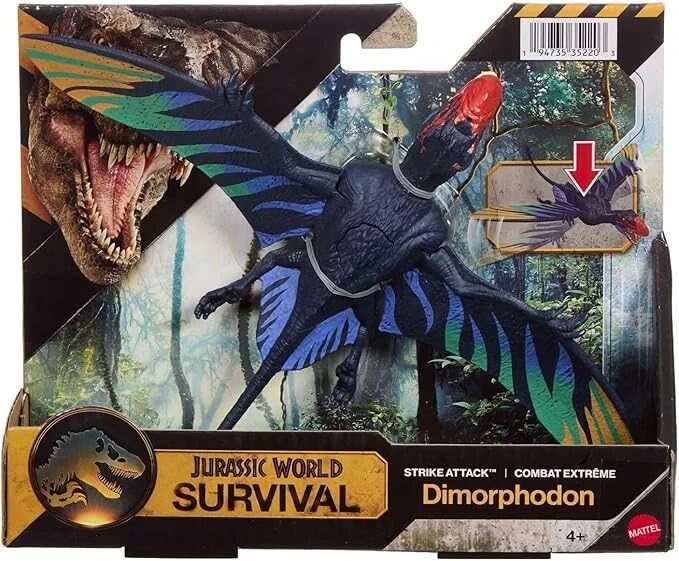
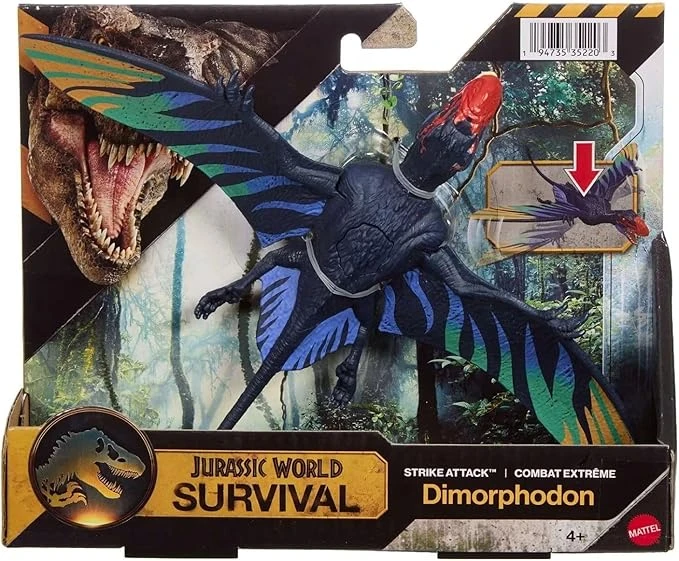
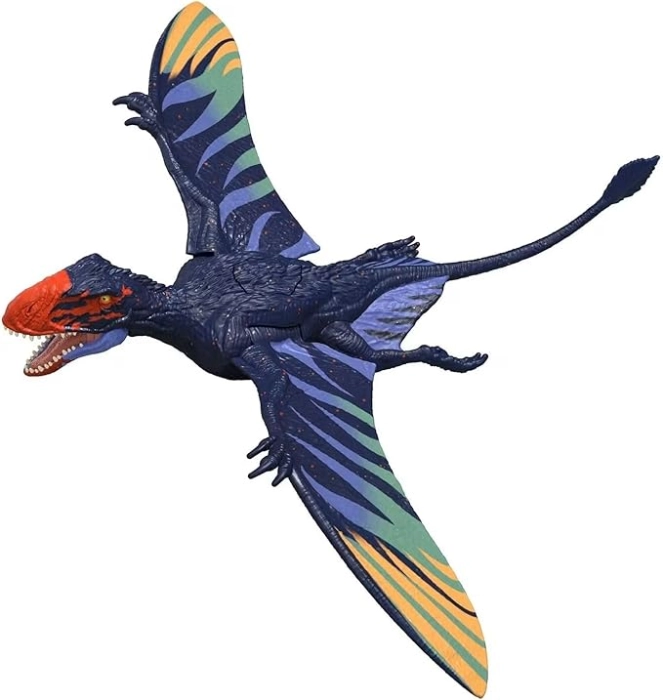
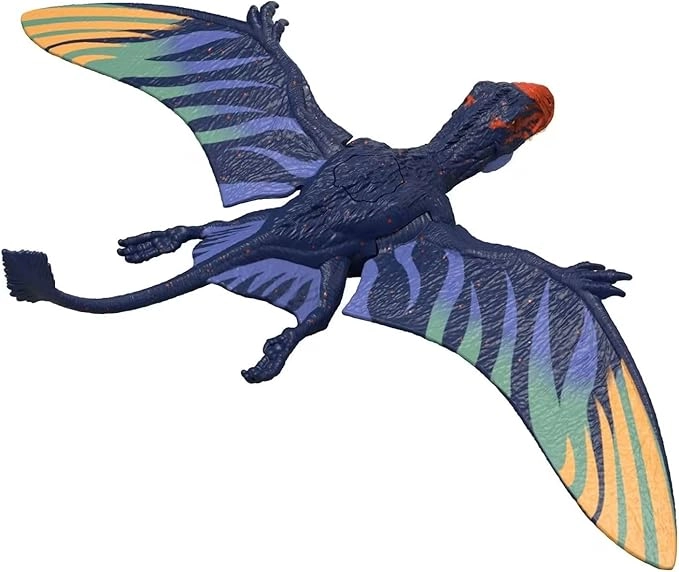
The Survival Dimorphodon carries one of the most colourful paint applications Mattel has ever put on a pterosaur. The blue, green and yellow running through the wing membranes make it read more like an exotic bird than a prehistoric predator — and it is good to see that not every mutated Survival figure has to look hyper-aggressive.
Wing-snap action featureBlue, green & yellow wingsPycnofibres along the spineMattel · 2026Scan code included
About the Survival Line
The Jurassic World Survival line, tied to the Survival PS5 game concept, normally means mutated creatures: fin ridges, thagomizer tails, oversized spikes. The Dimorphodon is the exception. It carries no extreme structural mutations at all — the whole Survival treatment here goes into the paint, and that turns out to be the best decision Mattel could have made for this species.
Previous Dimorphodon Releases
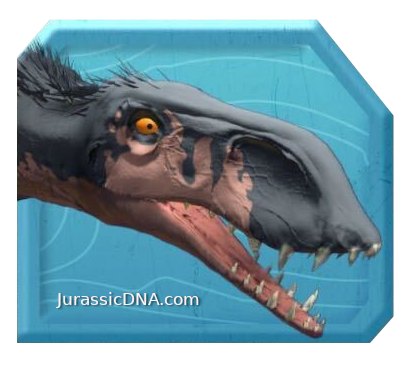
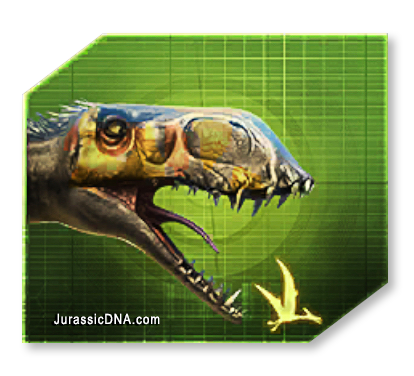
Paint & Colour Scheme
The body’s default colour is a dark blue, and it makes an excellent base for everything else to pop against. The snout is red, and that red carries back along the head toward the eyes. From there the transition out of the body’s base colour and into the multicoloured wing membranes is the part that sells the whole figure.
The overall visual impression is of an exotic bird rather than the standard grey or brown pterosaur we are so used to seeing — and that is a compliment.
Sculpt & Detail
Head and Skull
The head sculpt carries decent skin texture, with visible nostrils and some variation in scale and skin detail across the face. The large, bulky skull that characterises the real Dimorphodon is well represented, so the figure keeps the recognisable big-headed look the species is known for. The teeth are painted an off-white to yellowish tone, and the jaw articulates and closes properly.
Pycnofibres Along the Spine
Running down the body from the top of the head is a line of pycnofibres along the spinal column — a neat detail that acknowledges the modern understanding of pterosaur integument. They start as finer fibres at the head and transition into larger, thicker ones along the back. For a figure at this price point, that is a genuinely thoughtful piece of sculpting.
Wings and Tail
The wing membranes carry good skin texture detail, and the multicolour paint plays beautifully across that surface — the folds and stretch marks in the membrane catch the green and yellow differently depending on the angle.
Action Feature & Articulation
✓ Wing-snap action feature✓ Jaw — articulated✓ Wings — up, down and swivel✗ Legs — no independent movement✗ Tail — no joint✗ No sounds
The wing-snap feature activates when the body is pressed, throwing the wings outward into a striking pose. Press with less force and you get a gentler flapping motion instead. The snap has a good crisp quality to it, and it is the right feature for a pterosaur — spreading the wings in a threat display or a strike is exactly the movement you would expect from the animal.
At a Glance
Should You Buy It?
Absolutely, and especially if you collect pterosaur figures. This is my personal favourite-looking Dimorphodon, despite the fact that it is honestly too colourful for my own taste.
The blue, green and yellow wing combination is a genuine standout in the line, the red snout adds real character to the face, and the pycnofibre detail along the spine is a thoughtful touch that most figures at this price point would have skipped.
✦ What Works
- Best paint job on any Mattel pterosaur
- Blue, green and yellow wing membranes
- Red snout gives the face real character
- Pycnofibres sculpted along the spine
- Accurate big-headed Dimorphodon skull
- Wing-snap action fits the animal
- No forced structural mutations
- Good texture across the wing membranes
✦ What Doesn't
- No sounds on this figure
- Legs have no independent articulation
- Tail has no joint at all
- The colours may be too loud for some
About the Dimorphodon
“Dimorphodon, discovered by Mary Anning in 1828, was the first pterosaur found in England. Its name means two-form tooth, reflecting the two distinct types of teeth in its jaws, which is comparatively rare among reptiles.”
— Richard Owen, who formally named it in 1859
Dimorphodon macronyx is a genus of medium-sized pterosaur from the Early Jurassic, living roughly 201 to 191 million years ago in what is now England. It was found in 1828 by the fossil hunter Mary Anning at Lyme Regis on the Dorset coast, making it the first pterosaur discovered in England. Originally classified as a species of Pterodactylus, it was given its own genus by Richard Owen in 1859. The name means “two-form tooth”, a reference to the two distinct kinds of teeth in its jaws: four or five large fang-like teeth at the front, followed by many smaller ones behind — an arrangement that is comparatively rare among reptiles.
Dimorphodon had a wingspan of about 1.45 metres (4.75 feet) and a body length of roughly 1 metre (3.3 feet). Its most distinctive feature was its proportionally enormous skull, around 22 centimetres long, lightened by large openings separated by thin walls of bone like the arches of a bridge. Despite the big head the body was relatively compact. Like Rhamphorhynchus, it had a long tail with a rudder-like tip. It probably lived along coastlines and was most likely a piscivore, using those front teeth to catch fish, though it may also have hunted small land vertebrates and insects. Modern research suggests Dimorphodon was covered in pycnofibres, a hair-like integument, over much of its body — which is exactly what the Mattel Survival figure acknowledges with the fibres sculpted along its spinal column.
How to Unlock Dimorphodon
How do you unlock Dimorphodon Strike Attack in the Jurassic World Survival collection?
Open your Jurassic World Play App (previously the Jurassic World Facts App), press the Scan button and point it at the DNA code below.
Jurassic World Survival — Dimorphodon Strike Attack DNA Scan Code
Gallery
Frequently Asked Questions
The action feature is a wing-snap mechanism. Pressing the body throws the wings outward into a striking pose. Press more gently and the wings move in a slower flapping motion without the full snap.
The Survival Strike Attack Dimorphodon has a dark blue primary body and a red snout with the red carrying back toward the eye. The wing membranes are painted in striking patterns of green and yellow, and pycnofibres run along the spinal column. It is one of the most colourful pterosaur figures Mattel has ever produced.
Pycnofibres are the hair-like integument that modern research suggests covered much or all of pterosaur bodies. The Mattel Survival Dimorphodon acknowledges this with pycnofibres sculpted along the spinal column, which is a palaeontologically thoughtful detail for a toy in this price range.
Dimorphodon was discovered by the fossil hunter Mary Anning at Lyme Regis in Dorset, England, in 1828, making it the first pterosaur found in England. It was formally named in 1859 by the palaeontologist Richard Owen.
Open the Jurassic World Play App, tap the Scan button, and point it at the DNA barcode on the Dimorphodon’s wing, or at the code shown on this page.