
Review
Chilantaisaurus Jurassic World Rebirth Gigantic Thrashers Review
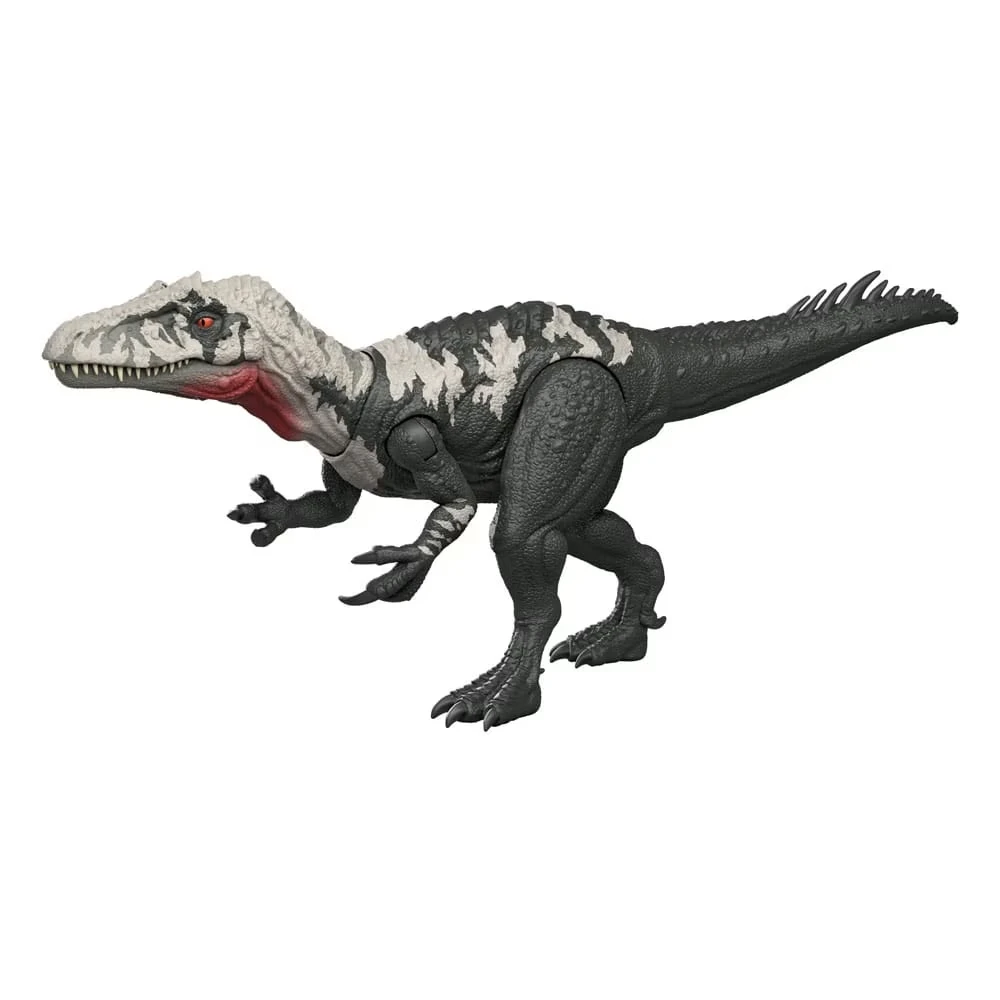
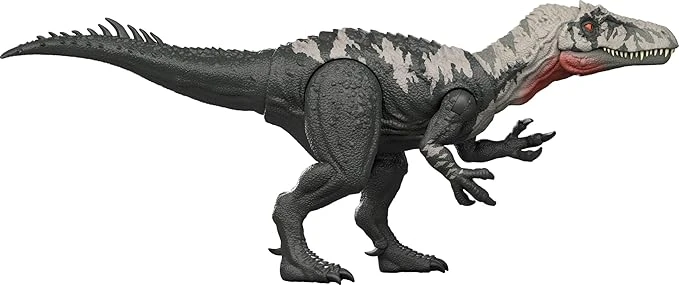
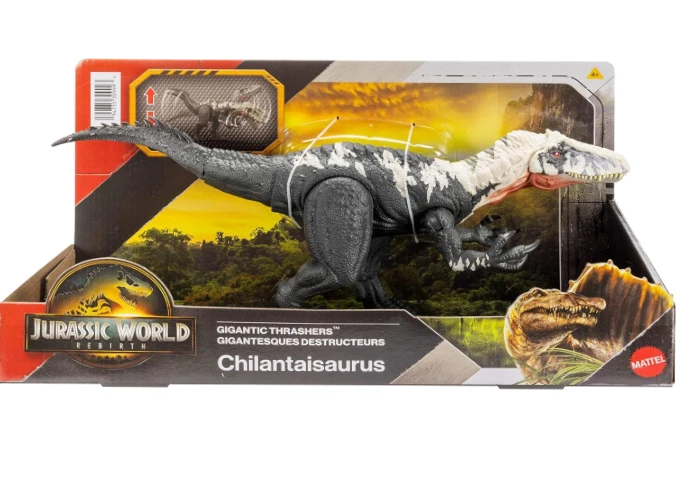
The Gigantic Thrashers line has produced some of Mattel's most visually impressive figures, and the Chilantaisaurus may be the finest yet. Very destinctive color scheme, combined with a dual-direction action feature and exceptional skin texture variation across the entire body, make this one of the most compelling large theropod releases in the current Rebirth lineup. Going in with modest expectations makes the reality all the more satisfying.
A Family Reunion in Plastic: The Neovenatoridae Connection
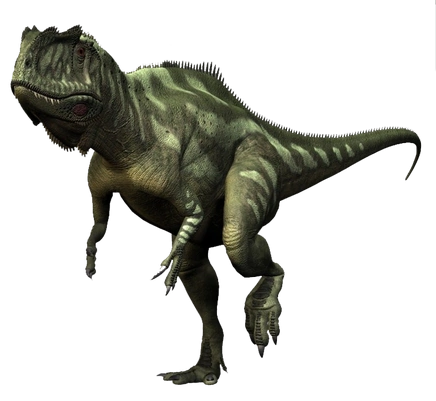
The comparison between the Chilantaisaurus and the Epic Evolution Neovenator is not arbitrary. Multiple phylogenetic studies have classified both Chilantaisaurus and Neovenator within the Neovenatoridae family, making them distant relatives within the same prehistoric lineage. Mattel has given collectors two members of the same dinosaur family across two different toy lines. The Chilantaisaurus was significantly larger (11 to 13 m vs Neovenator’s 7.5 to 9 m), both were powerful mid-Cretaceous predators, and both are represented in the Gigantic Trackers/Thrashers format. It is the closest thing to a family reunion you will find in a toy collection.
How Does It Compare to the Epic Evolution Neovenator?
The Epic Evolution Neovenator was a well-received Gigantic Trackers release, notable for its head-to-tail paint coverage and a distinctive quill feature. The Chilantaisaurus arrives in the same format and at roughly the same scale, giving collectors a natural point of comparison between these two prehistoric relatives.
Head-to-Head: Epic Evolution Neovenator (Gigantic Trackers) vs Rebirth Chilantaisaurus (Gigantic Thrashers)
Epic Evolution Neovenator
- Head-to-tail paint coverage ✓
- Green and gray two-tone scheme
- Red eye — relatively rare from Mattel ✓
- Retractable quills (unique feature) ✓
- Arm chomp action feature
- Limited leg articulation range
- Face detail slightly underwhelming
Rebirth Chilantaisaurus
- Head-to-tail paint coverage ✓
- Six-tone scheme (exceptional) ✓
- Red eye with gray pupil outline ✓
- No special gimmick, strong standard ✓
- Multi-directional tail attack ✓
- Swivel ankles and smooth leg articulation ✓
- Extraordinary face and head detail ✓
Both figures are strong entries in Mattel’s large theropod format. The Neovenator remains notable for the quill gimmick and the pleasantly thorough green-and-gray paint. But in almost every other category, paint complexity, face detail, action feature versatility, and overall visual impact, the Chilantaisaurus is the more accomplished figure.
About the Toy
1. Sculpt and painting
The head sculpt is exceptional. Scale detail varies meaningfully across the face. Varying in size scales along the lower jaw, larger osteoderm-like scales toward the top of the head, smooth skin around the nostrils and eye, and a bumpy texture transitioning between zones. The nostrils are precisely sculpted, the eye socket is well defined, and the teeth are the newer sharp-style that makes every recent Mattel figure more convincing up close. Both upper and lower jaw articulate as part of the action feature, and the interior of the mouth is fully painted in pink with a gloss coat throughout. A scoot-like ridge runs from the top of the head down through the center of the neck, echoed by similar ridges along almost the entire spinal column.
The ridge line along the spinal column is one of the figure’s distinctive features: it starts small at the base of the neck, grows to a substantial size through the mid-back, then tapers back down as it enters the tail. Osteoderms continue through the tail, and a natural curve gives it a good display presence.
This is arguably the most textured Mattel figure at this scale. Rather than a consistent pattern repeated across the body, the Chilantaisaurus has a lot of distinct skin styles across different zones.
The arms move forward, back, and out away from the body. The hands are well sculpted with scoots down the fingers and claws in a softer material that allows for sharper-looking tips.
The legs have very strong muscle definition. Swivel ankles add posing flexibility and are a welcome feature at this scale.
2. Action Feature & Articulation
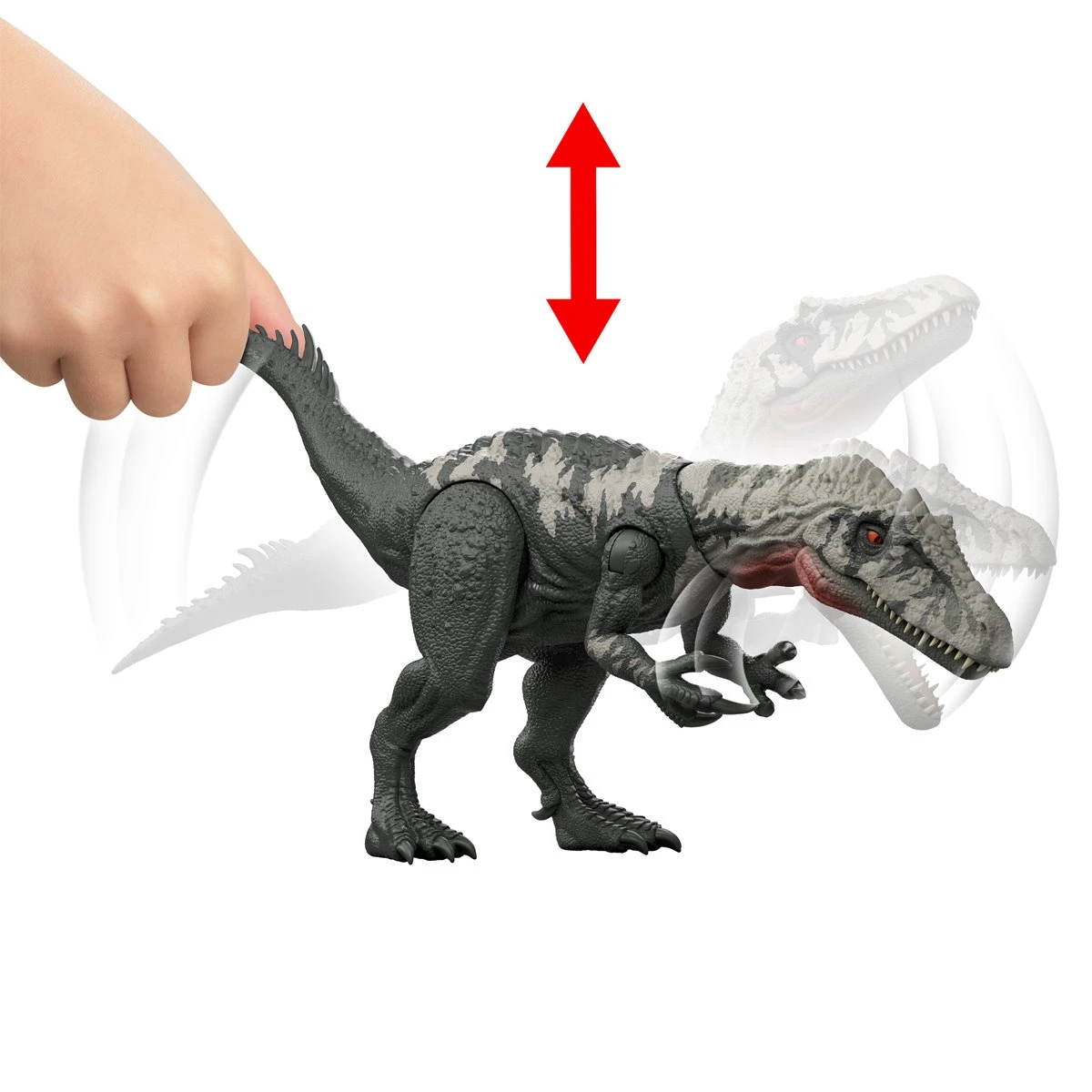
The most versatile action feature in the Gigantic Thrashers line so far is present here. The tail joint operates in multiple directions simultaneously. Push the tail up and the head snaps down. Push the tail down and the head snaps up. Twist the tail and the head attacks sideways. Tilt it at an angle and the attack follows the angle. This gives the Chilantaisaurus a genuinely dynamic play pattern rather than the single-direction snap of most similar figures. There is also a dedicated swivel point in the tail before the action feature joint, adding further independent posing.
- Upper jaw (articulated)
- Lower jaw (articulated)
- Neck (action feature linked)
- Tail swivel (independent)
- Tail joint (multi-directional action)
- Arms (forward, back and outward)
- Legs (forward and back)
- Swivel ankles
Verdict Should I buy it?
Without question. The Chilantaisaurus is one of the best Gigantic Thrashers figures Mattel has produced, and a strong contender for the most impressive large theropod in the entire Rebirth lineup. The striking paint scheme is genuinely exceptional, the skin texture variation is extraordinary, the multi-directional action feature is the most versatile in the format, and the red throat and metallic purple face give it a visual identity that nothing else in the collection shares.
How to unlock
How to unlock Chilantaisaurus in Jurassic World Rebirth Collection?
Open up your Jurassic World Play App (previously known as the Jurassic World Facts App), press the Scan button and point it towards the DNA code here:


3. About the Chilantaisaurus
Chilantaisaurus tashuikouensis was a large theropod that lived during the Late Cretaceous period, approximately 85 to 72 million years ago, in what is now Inner Mongolia, China. Its fossils were first discovered in 1960 during a joint Sino-Soviet expedition and formally described by Chinese paleontologist Hu Show-Yung in 1964. The name derives from Ch’i-lan-t’ai, the Jilantai Salt Lake near where the specimen was found.
With an estimated length of 11 to 13 metres (36 to 43 ft) and a mass of 2.5 to 6 tonnes, Chilantaisaurus was one of the largest predators of its region and time. One of its most distinctive features was its unusually large forelimb claws, proportionally bigger than most large theropods, which typically evolve smaller arms as body size increases. This feature has contributed to ongoing debate about its classification, with scientists variously placing it in Spinosauridae, Carcharodontosauria, or Neovenatoridae depending on the analysis. The Neovenatoridae classification, which it shares with the much smaller Neovenator of England, remains among the most commonly cited in recent studies.
The most widely accepted pronunciation is chi-LAN-tye-SORE-us, though kee-LAN-tye-SORE-us is also heard. The name derives from Ch’i-lan-t’ai, a salt lake in Inner Mongolia, China where the fossils were discovered.
Yes. Multiple phylogenetic studies classify both Chilantaisaurus and Neovenator within the Neovenatoridae family, making them distant relatives. Chilantaisaurus was considerably larger (11 to 13 m vs Neovenator’s 7.5 to 9 m) and lived in China during the Late Cretaceous, while Neovenator lived on what is now the Isle of Wight during the Early Cretaceous.
The tail joint operates in multiple directions. Pushing the tail up snaps the head down, pushing it down snaps the head up, twisting or tilting the tail sends the head attacking sideways or at an angle. This makes it the most versatile action feature in the Gigantic Thrashers line.
Both are large theropod figures in the Gigantic Trackers/Thrashers format and distant relatives within the Neovenatoridae family. The Chilantaisaurus has a more complex paint scheme (six tones vs three to four), a more versatile action feature, better skin texture variation, and more striking face detail. The Neovenator has a unique quill-extension feature and was notable for head-to-tail paint coverage. Both are strong figures; the Chilantaisaurus is the more impressive overall release.
Open the Jurassic World Play App, tap the Scan button, and point it at the DNA barcode on the Chilantaisaurus Gigantic Thrashers figure’s packaging.