

Home › Jurassic World Epic Evolution › Guaibasaurus Strike Attack
Strike Attack Figure Guide
Guaibasaurus Strike Attack
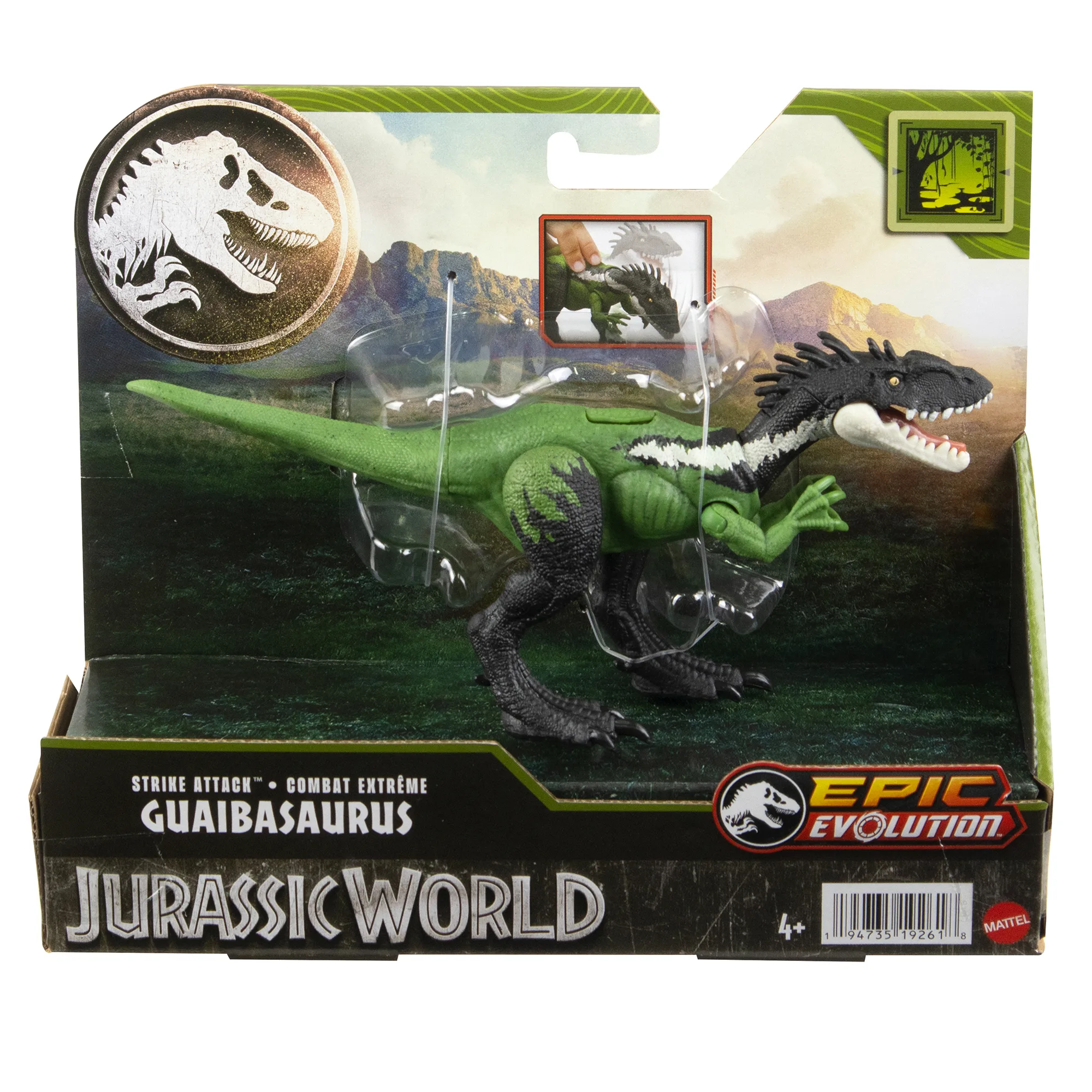
Guaibasaurus is an early dinosaur from Brazil that scientists still cannot place with confidence, sitting somewhere near the split between the meat-eating and the long-necked dinosaurs. Mattel added it to the first Strike Attack wave of Jurassic World Epic Evolution as a green figure with black legs, a black spiky head and a white stripe along the neck. Here is what the figure looks like, why it puzzles scientists, and how to unlock it in the Jurassic World Play App.
Early dinosaurStrike actionNo batteries🧬 DNA scan code
Family Puzzle: Where Does It Fit?
Guaibasaurus has been moved around the dinosaur family tree more than once.
Studies have placed it as an early theropod, an early sauropodomorph, or close to the base of both, and the debate continues.
What Is Strike Attack?
Strike Attack is the action assortment of Mattel’s Epic Evolution line. Each figure has one built-in strike move: press the button on its back and it lunges into an attack, no batteries needed. They also have movable joints and a DNA code that unlocks the animal in the Jurassic World Play App.
Guaibasaurus came in the first Strike Attack wave of Epic Evolution, alongside Kaprosuchus, Tuojiangosaurus and Velociraptor.
Paint and Colours
Body and tail
Legs, arms and head
Stripe along the neck
Inside of the mouth
A sharp, high-contrast scheme. The body and tail are a deep green, the legs, arms and head are black, and a bright white stripe runs along the side of the neck. The open mouth is red with white teeth.
Sculpt and Detail
Head and crest
The head is narrow with an opening jaw full of teeth, topped with a row of spiky scales.
Body and legs
Guaibasaurus stands on long back legs with grasping hands held forward and a long tail behind.
Figure vs fossil
Action Features and Articulation
✓ Press-to-strike action✓ Movable joints✓ No batteries needed✗ No sounds
Like every Strike Attack figure, Guaibasaurus has one action: press the button on its back and it lunges into a bite. It has posable limbs and needs no batteries.
Size and Specs
Medium figure for ages 4 and up. Look for the Epic Evolution logo and the green body with black legs.
Is It Worth Buying?
Guaibasaurus is a fun, striking figure of a rare early dinosaur, with bold paint and a strike action. The head spikes are invented, but it is a great pick for Triassic fans.
It came out in the first Epic Evolution Strike Attack wave.
What we like
- Rare early dinosaur
- Bold green and black paint
- Strike action
- No batteries
Good to know
- Head spikes are invented
- Skull largely unknown
- No sounds
About Guaibasaurus
Guaibasaurus was named in 1999 by Jose Bonaparte and colleagues from fossils found in the Caturrita Formation of Rio Grande do Sul, Brazil. The name refers to the Rio Guaiba basin.
It lived in the Late Triassic, about 215 million years ago, and was about 2 m long.
Guaibasaurus was a small, two-legged early dinosaur. Its exact place in the dinosaur family tree is still debated.
How to Unlock Guaibasaurus in the Jurassic World Play App
Open the Jurassic World Play App (it used to be called the Jurassic World Facts App), tap Scan and point your camera at the DNA code below.

Frequently Asked Questions
Press the button on its back and it lunges into a bite.
No. Strike Attack figures have no electronics.
About 2 m long.
In the Late Triassic, about 215 million years ago.
In southern Brazil.
Open the Jurassic World Play App, tap Scan and point your camera at the copy of the code on this page.