
Home › Jurassic World Dino Trackers › Edaphosaurus Strike Attack
Strike Attack Figure Guide
Edaphosaurus Strike Attack
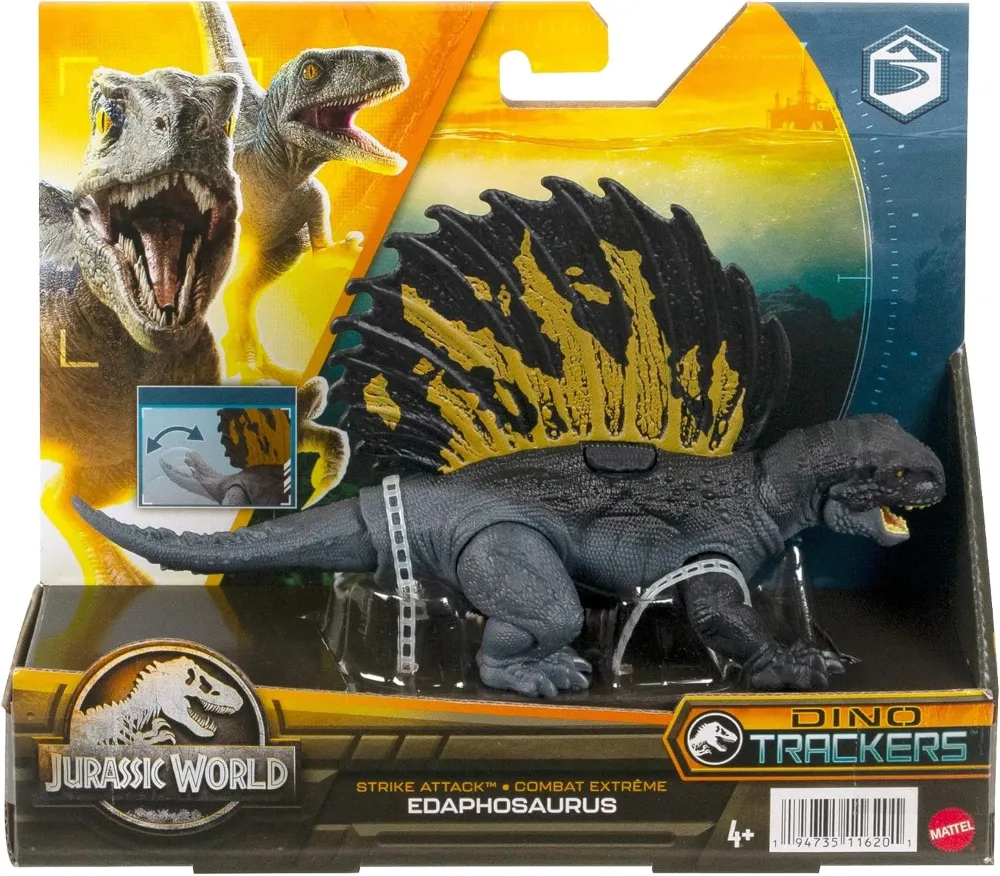
Edaphosaurus joined Jurassic World Dino Trackers in the Strike Attack range alongside Gigantspinosaurus and Prestosuchus. It is not a dinosaur at all: it is a sail-backed plant-eater that lived tens of millions of years before the first dinosaurs, and it is actually more closely related to you than to T. rex. Mattel’s figure gives it a blue-grey body, a charcoal head and a dramatic orange-flamed sail. Here is what it looks like, where it sits in the family tree, and how to unlock it in the Jurassic World Play App.
⛵ Sail back💥 Strike action🔋 No batteries🧬 DNA scan code
Closer to You Than to T. rex
Around 320 million years ago, the family tree of land animals split into two big branches. Edaphosaurus sits on the same side as us.
Despite the name ending in saurus, Edaphosaurus was not a lizard or a dinosaur. Its group, the synapsids, eventually gave rise to mammals, including us.
What Is Strike Attack?
Strike Attack is the action assortment of Mattel’s Dino Trackers line. Each figure has one built-in strike move: press the button on its back and it lunges into an attack, no batteries needed. They also have movable joints and a hidden tracking code for the app. The second Strike Attack wave brought Edaphosaurus, Gigantspinosaurus and Prestosuchus.
Strike Attack has continued in later Jurassic World lines, and the range is a great way to add some action to a Dino Trackers collection.
Paint and Colours
Lower body, back legs and tail
Head, shoulders, front legs and sail
Flame pattern on the sail
A bold, moody look. The head, shoulders and front legs are a dark charcoal that fades into blue grey over the hips, back legs and tail. The tall sail is charcoal too, with a bright mustard-orange flame pattern rising from the base, which makes it the eye-catching centrepiece of the figure.
Sculpt and Detail
The sail
The sail runs from the shoulders to the hips, with a wavy top edge and ridges marking the long spines inside. On the real animal, each spine carried little bony crossbars, giving the sail a knobbly look. Scientists still debate whether it helped with temperature control, display, or both.
Head and body
The body is low and wide, sprawling on short, strong legs, which fits the real animal well. The head is shown with an open, toothy mouth for battle play, which is where the figure takes the most liberties (see below).
A gentle plant-eater
Action Features and Articulation
✓ Press-to-strike action✓ Movable joints✓ Hidden tracking code✗ No sounds
Press the button on Edaphosaurus’s back and it springs into its strike move. It is purely mechanical, so there are no batteries to replace, and the joints let you pose it between attacks. The tracking code is hidden on the figure for the app.
Size and Specs
For ages 4 and up. Edaphosaurus is rarely made as a toy, so this is one of the easiest ways to add a sail-backed synapsid to a collection.
Is It Worth Buying?
Edaphosaurus is a great pick for kids who love sail-backed animals and for collectors who want something older and stranger than a dinosaur. The flame-patterned sail looks fantastic, the strike action adds play value, and it needs no batteries. Just know that the fierce, toothy head is Mattel’s styling rather than science.
It is mostly found second hand now.
What we like
- Rare synapsid in toy form
- Striking flame-patterned sail
- Low, sprawling body like the real animal
- No batteries needed
Good to know
- Head far too big and toothy
- Only one action
- No sounds
About Edaphosaurus
Edaphosaurus was named in 1882 by American palaeontologist Edward Drinker Cope, from a crushed skull and lower jaw found in the red rocks of Texas. Cope did not know at first that it had a sail; later finds revealed its tall, knobbly-spined back.
It lived from the end of the Carboniferous into the Early Permian, roughly 300 to 280 million years ago, around 70 million years before the first dinosaurs. Fossils are known from Texas, Oklahoma, New Mexico, West Virginia and parts of Europe. The largest species reached about 3.5 m long and over 300 kg.
It was one of the earliest large plant-eating land animals. It lived alongside the meat-eating Dimetrodon, a fellow sail-backed synapsid that evolved its sail separately.
How to Unlock Edaphosaurus in the Jurassic World Play App
Open the Jurassic World Play App (it used to be called the Jurassic World Facts App), tap Scan and point your camera at the DNA code below. The same code is on a small tag on the figure.

Frequently Asked Questions
No. It was a synapsid, part of the group that later gave rise to mammals, and it lived long before the first dinosaurs.
No. The strike action is mechanical: press the button on its back to trigger it.
Pavement lizard, after the plates of grinding teeth in its mouth. Edward Drinker Cope named it in 1882.
Plants. It was one of the earliest large plant-eating land animals.
The largest species reached about 3.5 m long and over 300 kg, though smaller species existed too.
Open the Jurassic World Play App, tap Scan and point your camera at the tag on the figure, or at the copy of the code on this page.