Home › Jurassic World Dino Trackers › Elasmosaurus Gigantic Trackers
Gigantic Trackers Figure Guide
Elasmosaurus Gigantic Trackers
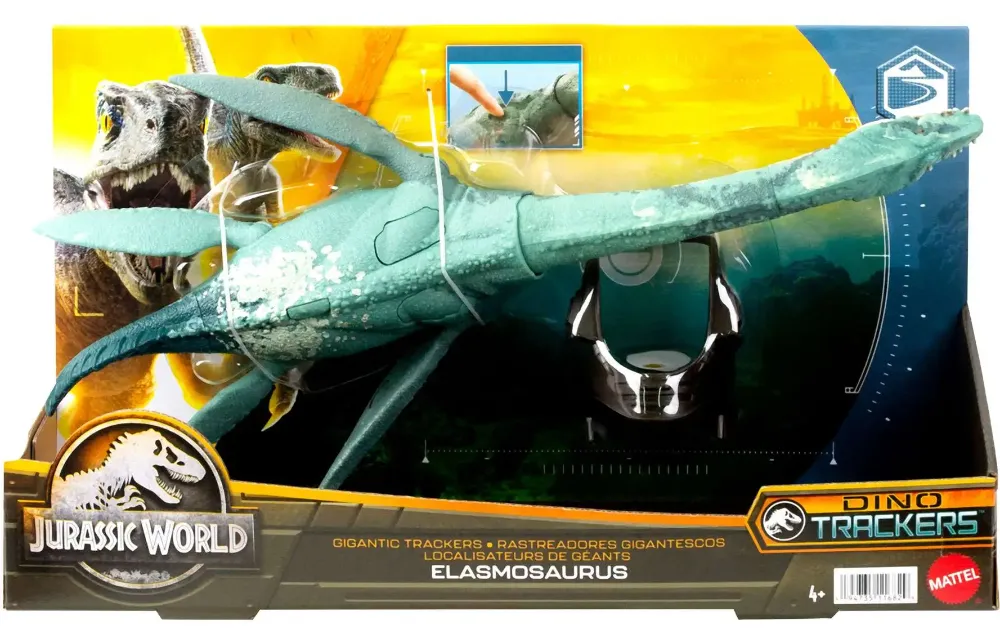
Elasmosaurus brought a long neck and four big flippers to the second wave of Gigantic Trackers in Jurassic World Dino Trackers, alongside Bistahieversor. It is not a dinosaur but a plesiosaur, one of the sea reptiles that shared the Cretaceous oceans with mosasaurs. The figure is a teal swimmer with a pale belly, a striking neck attack and a side-to-side swing, and it comes with a saddle-style tracker. Here is what it looks like, what it does, and how to unlock it in the Jurassic World Play App.
🌊 Marine reptile🦕 Long-necked plesiosaur💥 Two attack moves🧬 DNA scan code
The Head on the Wrong End
Elasmosaurus is famous for one of the most embarrassing mistakes in the history of palaeontology, and it helped start the Bone Wars.
The figure, happily, has its head on the right end. With 72 neck bones, more than almost any other animal known, it is easy to see how Cope got confused when the skeleton arrived in pieces.
What Is Gigantic Trackers?
Gigantic Trackers was the largest regular assortment in Mattel’s Dino Trackers line. Each figure is roughly 35 cm long, has a species-specific attack plus a side-to-side tracking motion, and comes with removable tracking gear, a nod to the tracking devices seen in Jurassic World Dominion. Wave 1 paired Sinotyrannus with a Stegosaurus, and wave 2 brought Elasmosaurus and Bistahieversor.
The Gigantic Trackers name carried on in Epic Evolution and Chaos Theory, and Primal Ambush keeps the big figure slot alive with its Gigantic Thrashers.
Paint and Colours
Neck, back, flippers and tail
Blotches along the neck and back
Throat and belly
Tip of the tail fin
Inside of the mouth
A calm, believable sea colour scheme. The whole upper side is a soft teal with darker blotches running down the neck and back, like dappled light through water, while the throat and belly are a pale cream. That light underside is classic countershading for a swimming animal. The only bold notes are a navy tip on the tail fin and a red mouth that shows when the jaws open.
Sculpt and Detail
Head and neck
The head is small and slender, as it should be on an elasmosaur, with a long row of needle-like teeth for snagging fish and squid. The neck is long and smooth, with a ridge of texture along the top, and it is the moving part of the figure: it dips and sweeps for both attacks.
Body, flippers and tracker
The body is a compact, rounded barrel with four long, pointed flippers, all of which move. The short tail ends in a small fin. The tracking gear is a black saddle that clips over the back between the flippers, carrying a little tracker device, as if a research team had tagged the animal at sea.
How long was that neck?
Action Features and Articulation
✓ Opening jaw✓ Four moving flippers★ Press the back: neck strike★ Side-to-side neck swing✓ Removable tracker saddle✗ Cannot stand on its own flippers
Press down on the back and the long neck dips forward and down in a strike, snapping at prey below. The second motion swings the neck from side to side, the tracking motion that every Gigantic Trackers figure shares, as if the animal is scanning the water. Both moves are mechanical, so there are no batteries. Like most plesiosaur toys, it looks best resting on its belly rather than propped on its flippers.
Size and Specs
Product code HLP26, sold in the HLP23 Gigantic Trackers case, for ages 4 and up. Most of its length is neck, so it takes up a lot of shelf space for its weight. It makes a natural pair with the Kronosaurus from Wild Roar and the small Dakosaurus from Danger Pack for a Dino Trackers sea display.
Is It Worth Buying?
Elasmosaurus is a good pick for kids who love sea creatures and want something other than another Mosasaurus. The neck strike is easy to trigger, the teal and cream paint looks natural, and the flippers all move. Collectors get a large, fairly accurate long-necked plesiosaur, something Mattel rarely makes.
It is mostly found second hand now. Check that the tracker saddle is included when you buy one used.
What we like
- A big long-necked plesiosaur
- Neck strike plus side-to-side swing
- Natural teal and cream colours
- Four moving flippers
- No batteries needed
Good to know
- Neck shorter than the real animal's
- Does not stand on its flippers
- Tracker saddle often missing used
- No sound or lights
About Elasmosaurus
Elasmosaurus platyurus was named by Edward Drinker Cope in 1868 from a skeleton found the year before by army surgeon Theophilus Turner near Fort Wallace, western Kansas. It comes from the Pierre Shale, laid down on the floor of the Western Interior Seaway that split North America in two, about 80.5 million years ago.
It was a plesiosaur, a sea reptile with a small head, a short tail, four paddle-like flippers and an enormous neck. The animal is usually estimated at around 10.3 m long, with the neck alone about 7 m and made of 72 vertebrae, one of the highest counts known for any animal.
It probably hunted fish, squid and other small prey, using its long neck to reach into schools without moving its whole body. It is not a dinosaur: plesiosaurs are a separate group of reptiles that lived in the sea.
How to Unlock Elasmosaurus in the Jurassic World Play App
Open the Jurassic World Play App (it used to be called the Jurassic World Facts App), tap Scan and point your camera at the DNA code below. On the figure, the same code is on a small tag near the base of the tail.

Gallery

Frequently Asked Questions
It is about 14 inches (35 cm) long from snout to tail, and most of that length is neck.
Press the back and the neck strikes forward and down. It also has a side-to-side neck swing. Neither move needs batteries.
No. It was a plesiosaur, a sea reptile that lived at the same time as some dinosaurs but belonged to a separate group.
About 10.3 m long, with a neck of around 7 m made of 72 vertebrae.
In 1868 Edward Drinker Cope mistook the long neck for the tail when he first reconstructed the skeleton. Joseph Leidy pointed out the error in 1870, and the mistake became part of the Bone Wars rivalry with Othniel Marsh.
Open the Jurassic World Play App, tap Scan and point your camera at the tag on the figure, or at the copy of the code on this page.