
Home › Jurassic World Chaos Theory › Huayangosaurus Strike Attack
Strike Attack Figure Guide
Huayangosaurus Strike Attack
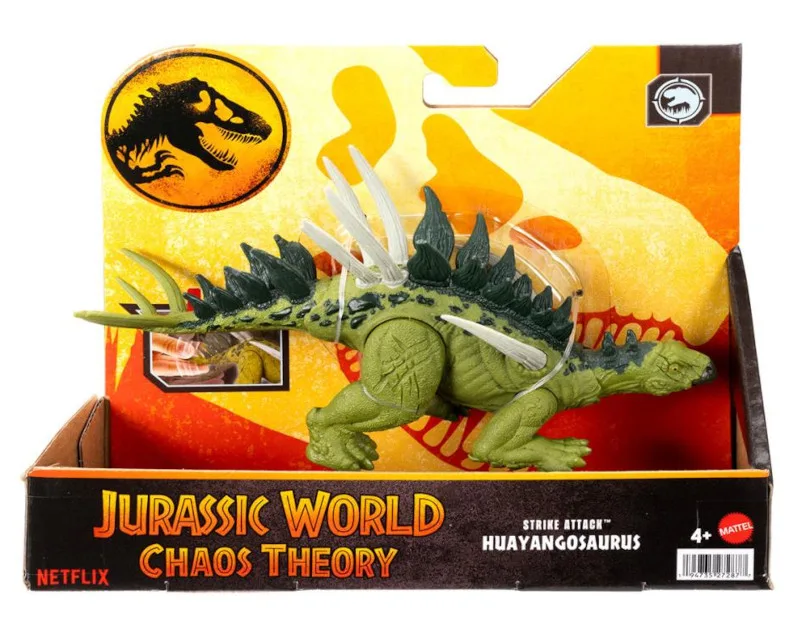
Huayangosaurus is one of the oldest and smallest stegosaurs, a Middle Jurassic plant eater from China that still had teeth at the front of its mouth. Mattel added it to the first Chaos Theory Strike Attack wave as a green figure with dark plates, long pale shoulder spikes and a tail strike. Here is what the figure looks like, what made early stegosaurs different, and how to unlock it in the Jurassic World Play App.
Early stegosaurStrike actionNo batteries🧬 DNA scan code
Family Album: An Early Stegosaur
Huayangosaurus shows what stegosaurs looked like before Stegosaurus.
Its plates were narrower and more spike-like, so it looked spikier than the famous plated Stegosaurus.
What Is Strike Attack?
Strike Attack is the action assortment of Mattel’s Jurassic World Chaos Theory toy line. Each figure has one built-in strike move: press the button and it lunges into an attack, no batteries needed. They also have movable joints and a DNA code that unlocks the animal in the Jurassic World Play App.
It came in the first Chaos Theory Strike Attack wave with Herrerasaurus, Huayangosaurus, Pyroraptor and Thapunngaka.
Paint and Colours
Body, legs and tail
Plates along the back
Shoulder and tail spikes
Belly
A leafy scheme. Huayangosaurus is green with darker green plates along the back and long cream spikes on the shoulders and tail.
Sculpt and Detail
Head and plates
The head is small and low. Narrow, pointed plates run along the neck and back.
Spikes and tail
Long spikes stick out from the shoulders, and the tail ends in spikes for the strike swing.
Figure vs fossil
Action Features and Articulation
✓ Press-to-strike action✓ Movable joints✓ No batteries needed✗ No sounds
Like every Strike Attack figure, Huayangosaurus has one action: press the button and it swings its spiked tail. It has posable legs and needs no batteries.
Size and Specs
Mattel product code JCL61, for ages 4 and up, in a Chaos Theory branded box.
Is It Worth Buying?
Huayangosaurus is a rare early stegosaur with accurate shoulder spikes and a fun tail strike. A great pick for stegosaur fans.
It came out in the first Chaos Theory Strike Attack wave.
What we like
- Rare early stegosaur
- Accurate shoulder spikes
- Tail-swing strike
- No batteries
Good to know
- Smaller than Stegosaurus toys
- Mostly green paint
- No sounds
About Huayangosaurus
Huayangosaurus was named in 1982 by Dong Zhiming and colleagues from fossils found in the Dashanpu Quarry of Sichuan, China. The name comes from Huayang, an old name for Sichuan.
It lived in the Middle Jurassic, about 165 million years ago, and was about 4.5 m long.
Huayangosaurus was one of the earliest stegosaurs, a plant eater with plates, shoulder spikes and a spiked tail.
How to Unlock Huayangosaurus in the Jurassic World Play App
Open the Jurassic World Play App (it used to be called the Jurassic World Facts App), tap Scan and point your camera at the DNA code below.

Frequently Asked Questions
Press the button and it swings its spiked tail.
No.
It was older and smaller, had front teeth and long shoulder spikes, and narrower plates.
About 4.5 m long.
In Sichuan, China.
Open the Jurassic World Play App, tap Scan and point your camera at the copy of the code on this page.