
Home › Jurassic World Chaos Theory › Farlowichnus Danger Pack
Danger Pack Figure Guide
Farlowichnus Danger Pack
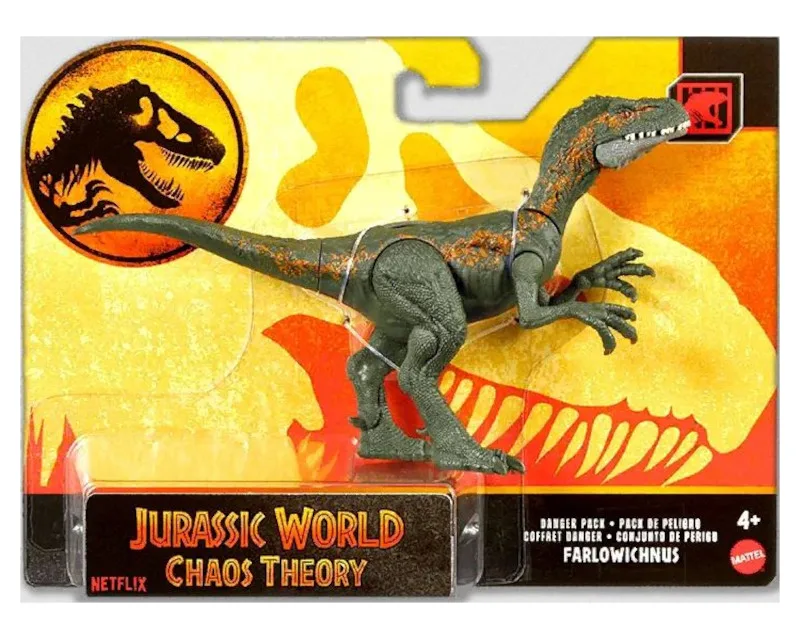
Farlowichnus is one of the strangest names in the whole Jurassic World toy range, because it is not a dinosaur skeleton at all but a set of footprints. The tracks were left by a small, fast meat-eater crossing an ancient desert in Brazil. Mattel added it to the second Chaos Theory Danger Pack wave as a slim, dark green theropod. Here is what the figure looks like, what the footprints tell us, and how to unlock it in the Jurassic World Play App.
Footprint speciesFast runnerNo batteries🧬 DNA scan code
Track Report: A Name for Footprints
Farlowichnus is an ichnogenus, a name given to footprints rather than to bones.
Nobody knows exactly which dinosaur made the tracks, so the figure is a generic small theropod with a footprint name.
What Is Danger Pack?
Danger Pack is the smaller, battery-free assortment of Mattel’s Jurassic World Chaos Theory toy line, based on the Netflix animated series. The figures have movable joints and a DNA code that unlocks the animal in the Jurassic World Play App, but no sounds or motorised attacks.
It came in the second Chaos Theory Danger Pack wave with Farlowichnus, Guemesia and Hypsilophodon.
Paint and Colours
Body, arms and tail
Stripes on the back
Legs
Belly
A camouflage scheme. Farlowichnus is a dark forest green with darker stripes along the back and tail, olive legs and a paler belly.
Sculpt and Detail
Head and arms
The head is narrow with an opening jaw. Long arms reach forward with grasping claws.
Legs and tail
Long, slim legs and a long tail give it a fast, running build.
Figure vs fossil
Action Features and Articulation
✓ Movable joints✓ Small and sturdy✓ No batteries needed✗ No sound or attack motion
Like every Danger Pack figure, Farlowichnus keeps things simple: posable limbs and no electronics.
Size and Specs
Mattel product code JDW31, for ages 4 and up, in a Chaos Theory branded box.
Is It Worth Buying?
Farlowichnus is a curiosity, a toy of a footprint species. It is a nicely slim theropod, but everything about its body is guesswork.
It came out in the second Chaos Theory Danger Pack wave.
What we like
- Unique footprint species
- Slim running build
- Camouflage paint
- No batteries
Good to know
- Body is invented
- Feet do not match the tracks
- No sound or attack motion
About Farlowichnus
Farlowichnus rapidus is an ichnospecies, a name for fossil footprints. The tracks were found in the Botucatu Formation of Brazil, an ancient field of sand dunes.
The footprints come from the Early Cretaceous and were made by a small, fast two-legged theropod.
The name honours the American palaeontologist James Farlow, an expert on dinosaur footprints.
How to Unlock Farlowichnus in the Jurassic World Play App
Open the Jurassic World Play App (it used to be called the Jurassic World Facts App), tap Scan and point your camera at the DNA code below.

Frequently Asked Questions
It is a real fossil name, but for footprints, not bones. The dinosaur that made them is unknown.
No.
A scientific name given to trace fossils such as footprints.
In the Botucatu Formation of Brazil, an ancient desert.
The palaeontologist James Farlow.
Open the Jurassic World Play App, tap Scan and point your camera at the copy of the code on this page.