Meet the "Hell Heron" The Spinosaurus had a colorful secret hidden on its head, and a new 2026 fossil find is rewriting everything we thought we knew about one of prehistory's largest predators.
April: 2026
When you think of the biggest, baddest predators to ever walk the Earth, Tyrannosaurus rex usually takes the crown. But out in the scorching sands of the Sahara Desert, scientists have just uncovered a stunning new look for a dinosaur that was even longer than T. rex: the Spinosaurus. And it is turning out to be far stranger, far more colorful, and far more fascinating than anyone expected.
Paleontologists are calling this specific find the “Hell Heron,” and it is changing everything we thought we knew about how these river monsters looked, behaved, and competed for survival in one of the most dangerous ecosystems in Earth’s history.
A crest like a scimitar
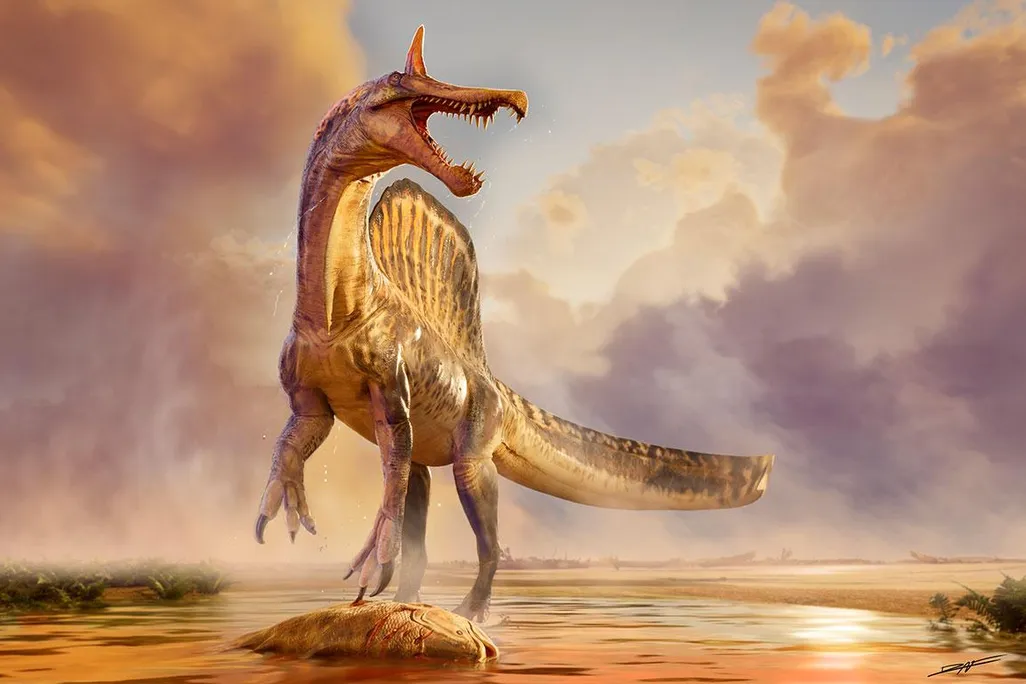
We have always known Spinosaurus had a massive sail on its back, rising dramatically above its spine like a living billboard. But this new discovery shows something even more striking perched on top of its skull: a tall, razor-sharp crest shaped like a curved scimitar sword.
Scientists believe this crest was not just structural. The bone geometry suggests it was covered in richly vascularized skin, the same kind of tissue that, in modern animals, blazes with vivid pigment. Imagine a dinosaur the size of a school bus stalking the river’s edge with a neon-colored sword jutting from its forehead. That was the Hell Heron.
“Imagine a dinosaur the size of a school bus with a neon-colored sword on its head, wading silently into the river.”
Why the “Hell Heron”?
If you have ever watched a heron standing perfectly still beside a pond before snapping up a fish in a single lightning strike, you have already seen a miniature Spinosaurus in action. Scientists think this giant predator hunted in exactly the same patient, deliberate way, only scaled up to a creature that could swallow a person whole.
Showing off in a crowded world
Ninety-five million years ago, the Sahara was not the barren desert we know today. It was a vast, humid floodplain threaded with enormous rivers, thick with ferns and cycads, and crawling with predators of every size. It was, in the bluntest possible terms, an extremely dangerous place to find a good fishing spot.
Scientists believe the Hell Heron’s colorful scimitar crest served as a kind of living advertisement in this crowded, competitive environment. Like the bright dewlap of a modern iguana or the iridescent tail feathers of a peacock, it could broadcast information across a distance without a single roar, a single swipe, or a single wasted calorie spent on fighting.
To a rival Spinosaurus, a brilliantly colored crest meant: “This stretch of river belongs to me. Move along.” To a potential mate, it signaled health, maturity, and genetic quality. The bigger and brighter the crest, the better the owner’s chances of holding prime territory and attracting a partner. It was evolution’s answer to a neon “No Vacancy” sign.
Three Fast Facts
Built for water: Unlike almost every other large theropod, Spinosaurus had dense, compact bones that reduced its buoyancy, flat paddle-like feet for propulsion, and nostrils positioned high on its snout so it could breathe while mostly submerged. It was, in effect, a giant semi-aquatic ambush predator.
The sail mystery: Scientists still debate whether the tall spines along its back formed a true upright sail or a thicker, buffalo-like hump. Either way, it may have helped regulate body temperature in the sweltering Cretaceous heat.
A lonely giant: Because the Hell Heron was so large and so specialized for aquatic hunting, it had almost no direct competition for its food source. The river was its kingdom, and it ruled it essentially unchallenged, at least until something even bigger came along.
The Hell Heron is a vivid reminder that the deeper scientists dig, the stranger and more spectacular life on this planet turns out to have been. A building-sized fish-hunter with a glowing sword on its head, standing motionless in an ancient Saharan river, waiting for its moment: sometimes reality is more extraordinary than anything we could invent.