
Home › Jurassic World Dino Trackers › Eocarcharia Wild Roar
Wild Roar Figure Guide
Eocarcharia Wild Roar
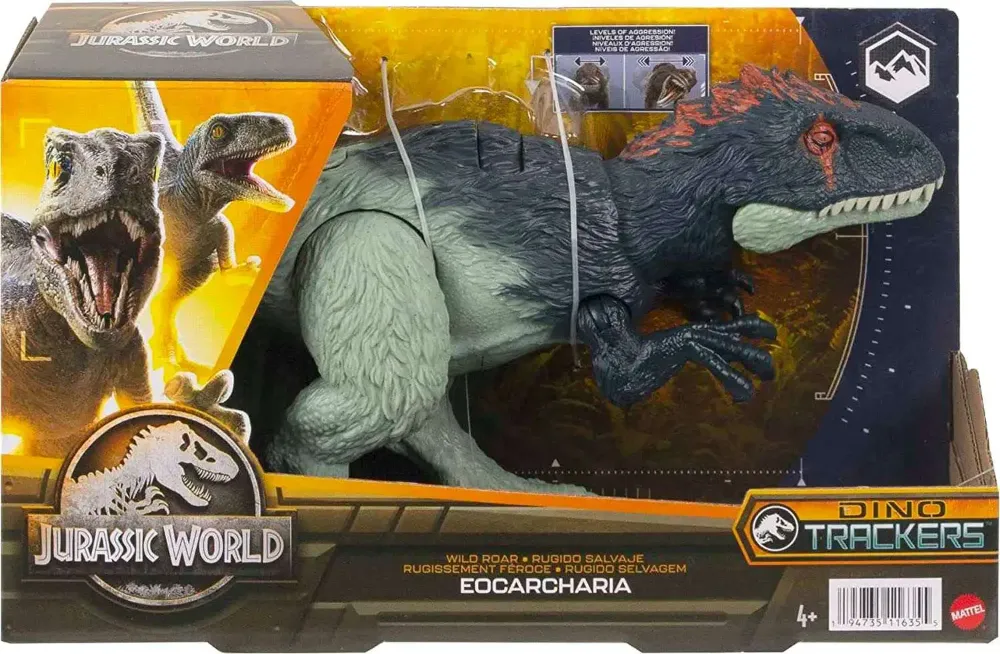
Eocarcharia led the first wave of Wild Roar figures in Jurassic World Dino Trackers in 2022, alongside Kronosaurus, Dryptosaurus and Diabloceratops. It is a mid-sized meat-eater with a bold two-tone paint job, a red brow over the eye and a roaring, lunging bite triggered from the hips. It is also one of the very few toys ever made of this African predator. Here is what the figure looks like, what it does, and how to unlock it in the Jurassic World Play App.
🦖 Rare species in toy form🔊 Roar sound💥 Lunging bite🧬 DNA scan code
Who Lived Next Door to Eocarcharia?
Eocarcharia comes from the Elrhaz Formation of Niger, about 112 million years old and one of the richest dinosaur sites in Africa. Several of its neighbours have Jurassic World figures too, so you can rebuild a slice of its world on the shelf.
With Suchomimus fishing the rivers and Kryptops on land too, Eocarcharia shared its world with at least two other large predators, which makes it one of the busiest predator line-ups known from the Early Cretaceous.
What Is Wild Roar?
Wild Roar is the mid-sized assortment of Mattel’s Dino Trackers line. Each figure has a roaring sound, a species-specific attack motion and movable joints, and runs on button cell batteries that come already installed. Wave 1 brought Eocarcharia, Kronosaurus, Dryptosaurus and Diabloceratops, and wave 2 added Orkoraptor, Irritator, Nigersaurus and Regaliceratops.
Wild Roar has carried on in every Jurassic World line since, with later figures adding lights and wheel-activated attacks.
Paint and Colours
Head, neck, shoulders and arms
Hips, legs and tail
Brow ridge, spines on the head and eye
Lower jaw and throat
Teeth
This is one of the boldest colour splits in the Dino Trackers range. The front half is a deep navy, almost black, from the snout to the shoulders and arms, then the colour gives way to a pale sage grey across the hips, legs and tail. Red picks out the brow ridge, the small spines on top of the head and the eye, which draws your attention straight to the face. The light grey lower jaw and white teeth stand out against the dark head when it opens up to bite.
Sculpt and Detail
Head and brow
The head is deep and boxy, as you would expect from a carcharodontosaurid, with a thick ridge over the eye and a short row of spines running back over the skull. The mouth opens to show a long row of white blade-like teeth. That heavy brow is a nice touch, because it nods to the real animal’s most famous feature.
Body, arms and legs
The body has fine scale texture and a low crest of spines along the back. The arms end in three clawed fingers and the legs are thick and well muscled, giving the figure a solid, stocky stance. There is a visible joint where the front and back halves meet, which is what drives the lunging attack.
The fierce eye
Action Features and Articulation
✓ Opening jaw✓ Posable arms✓ Legs forward and back★ Press the hips: lunging bite★ Roar sound✗ Batteries wear out
Press down on the hip area and the whole front half of the body lunges forward and down while the jaw snaps, and a roar plays at the same time. It is a quick, punchy strike that works well in play fights. The sound runs on three LR44 button cell batteries that come installed, so it works straight out of the box, but used figures may need fresh batteries.
Size and Specs
Product code HLP17, sold in the HLP14 Wild Roar case. It came out in 2022 for ages 4 and up and runs on three LR44 button cells, which are included. At around 31 cm long it sits between the small Danger Pack figures and the big Gigantic Trackers.
Is It Worth Buying?
Eocarcharia is a strong pick for kids who want a predator that roars and bites. The hip-press attack is easy to trigger, the dark-and-light paint looks dramatic, and the red brow gives it real character. For collectors it is a rare chance to own this African carcharodontosaurid, and it pairs nicely with the Nigersaurus from the same line.
It came out in 2022, so today it is mostly found second hand. Test the roar before buying a used one, or plan on fitting three new LR44 batteries.
What we like
- A rare African predator in toy form
- Roar plus a lunging bite
- Bold navy and sage colour split
- Heavy brow nods to the real skull
- Pairs with Nigersaurus from the same line
Good to know
- Sound needs working batteries
- Visible joint across the middle
- Body shape is a guess, real fossils are skull only
- No ankle or tail movement
About Eocarcharia
Eocarcharia dinops was named in 2008 by Paul Sereno and Stephen Brusatte from fossils collected in 2000 at Gadoufaoua, on the edge of the Ténéré Desert in Niger. The bones come from the Elrhaz Formation and date to the middle of the Cretaceous, roughly 112 million years ago. The name means fierce-eyed dawn shark, after its blade-like teeth and the thick bony brow over its eyes.
Only several skull bones and isolated teeth are known, so its size is an estimate, usually around 6 to 8 m long. It was placed as an early member of the carcharodontosaurids, close to the North American Acrocanthosaurus and more primitive than giants like Giganotosaurus.
Its status is not settled. In 2025, Andrea Cau and Alessandro Paterna argued that the original fossils may mix bones from two animals, a spinosaurid skull roof and carcharodontosaurid snout bones. If that holds, the name could be on shaky ground.
How to Unlock Eocarcharia in the Jurassic World Play App
Open the Jurassic World Play App (it used to be called the Jurassic World Facts App), tap Scan and point your camera at the DNA code below. On the figure, the same code is on a small tag at the top of the hips.

Gallery

Frequently Asked Questions
It is about 12 inches (31 cm) long and about 6 inches (15 cm) tall.
Press down on the hips and the front of the body lunges forward with a snapping bite while a roar plays.
Yes, the roar runs on three LR44 button cell batteries, which come installed in a new figure.
Eocarcharia dinops means fierce-eyed dawn shark, after its blade-like teeth and the thick bony brow above its eyes.
Only skull bones and teeth are known, so estimates vary, usually around 6 to 8 m long.
Open the Jurassic World Play App, tap Scan and point your camera at the tag on the figure’s hips, or at the copy of the code on this page.